
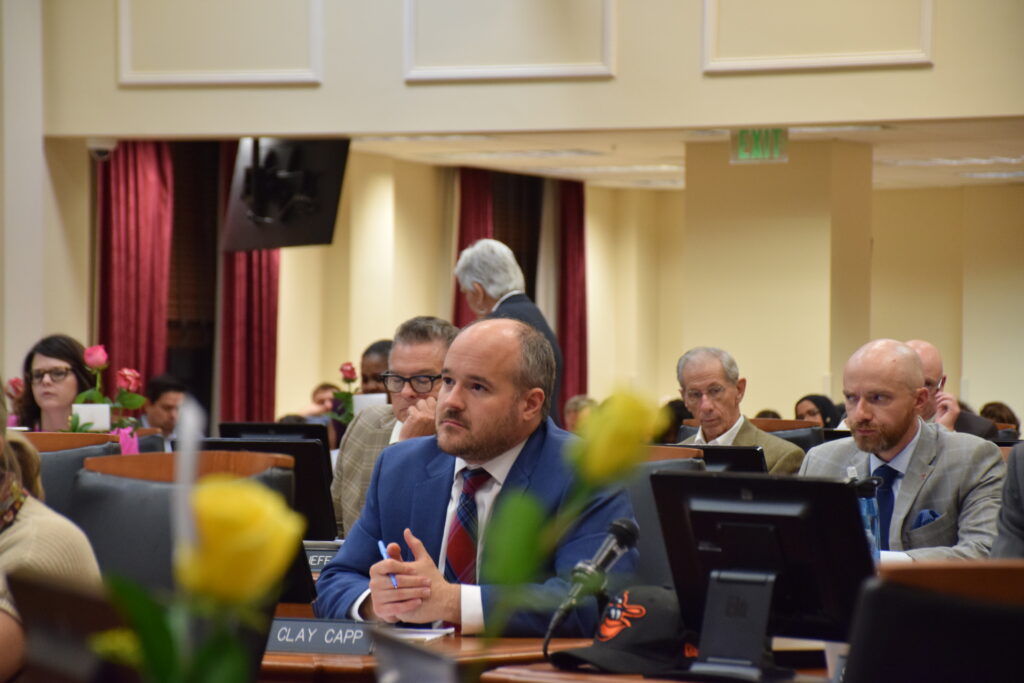
The ACLU of Tennessee and the state are taking time to “explore the possibility of settlement” in the ACLU’s lawsuit against the Tennessee law that can charge public officials with a felony for voting in favor of sanctuary city policies.
At the start of this year, state lawmakers passed an omnibus immigration bill that created a new immigration enforcement division, created a separate driver’s license design for undocumented Tennesseans, and made it a felony for any local official to vote in favor of so-called “sanctuary city” laws. These are policies that limit cooperation between local government and federal immigration enforcement, and have been highly politicized in recent years.
Tennessee had already banned sanctuary cities back in 2019. Still, the Department of Homeland Security inaccurately included Nashville on a list of sanctuary jurisdictions earlier this year. And Republican lawmakers — like House Majority Leader William Lamberth — say the 2019 ban didn’t have any “teeth” to it.
So, they passed a new one: Now, if any elected officials vote in favor of such policies, the Tennessee Attorney General can initiate the process to remove the official from office, and charge them with a felony.
“Easiest crime in the world to avoid,” Lamberth said during a hearing at the start of the year. “Just don’t vote in favor of sanctuary cities.”
But the criminalization of the vote is exactly what the ACLU Tennessee takes issue with. Legal Director Stella Yarbrough argues it’s a First Amendment violation.
“When you criminalize the vote based on its content, that is viewpoint discrimination,” Yarbrough said. “And that is something that the First Amendment just doesn’t tolerate.”
‘Dissenting voices’
The lawsuit was filed in June on behalf of seven Nashville Metro Councilmembers. It also argues that the law fails to clearly define what constitutes a sanctuary city policy, and that the constitution protects legislators and their actions while they are governing.
Yarbrough said there aren’t many laws like it.
“It really does skew authoritarian,” Yarbrough said. “The way local legislators sometimes have to operate or people who are in minority parties have to operate is to vote for things they know they aren’t going to be able to pass. But that’s — kind of — dissent. That’s key democracy — to have, to protect minority voices and dissenting voices. And so often it’s done through voting.”
The lawsuit seeks a declaratory judgement from the court, rather than injunctive relief. That means the ACLU is looking for the court to define the legal landscape and rule on the constitutionality of the law, instead of order specific actions.
It often can be difficult to get the court to weigh in before the law has been enforced — which is the case here. No local official has been charged or removed from office for voting in favor of sanctuary city policies. But Yarbrough says there are two exceptions to that general rule, both of which are relevant in this case.
She says the courts can “carve out leeway” for laws that vaguely criminalize activity, or that involve speech protected under the First Amendment.
“We don’t want speech to be chilled before you can go to the court and say, ‘Hey, this horrible thing happened to me,’ ” Yarbrough says. “Courts traditionally have recognized that you should be able to go to Court before that harm happens, as long as you can articulate that it’s about to happen or could reasonably happen.”
Earlier this month, a three-judge panel was appointed to hear the case. Those judges have now approved a motion for “extension of time,” which will give the ACLU and the state until Oct. 10 to explore the possibility of a settlement.

 On Air - 90.3 WPLN-FM