
A Japanese medical device company is moving its engineering operations to Nashville.
Nissha Medical Technologies announced Wednesday that it would be partnering with Vanderbilt to advance endoscopic devices. These are tools that doctors use to visualize the interior of organs — like the digestive tract or respiratory system. They are used during procedures like colonoscopies and can help diagnose conditions ranging from cancer to ulcers to internal bleeding.
The company, which is headquartered in Buffalo, New York (though its parent company is based in Kyoto, Japan), plans to share an incubator space with Vanderbilt. It will continue an existing partnership there with the local EndoTheia medical device company, which is headed by a Vanderbilt faculty member.
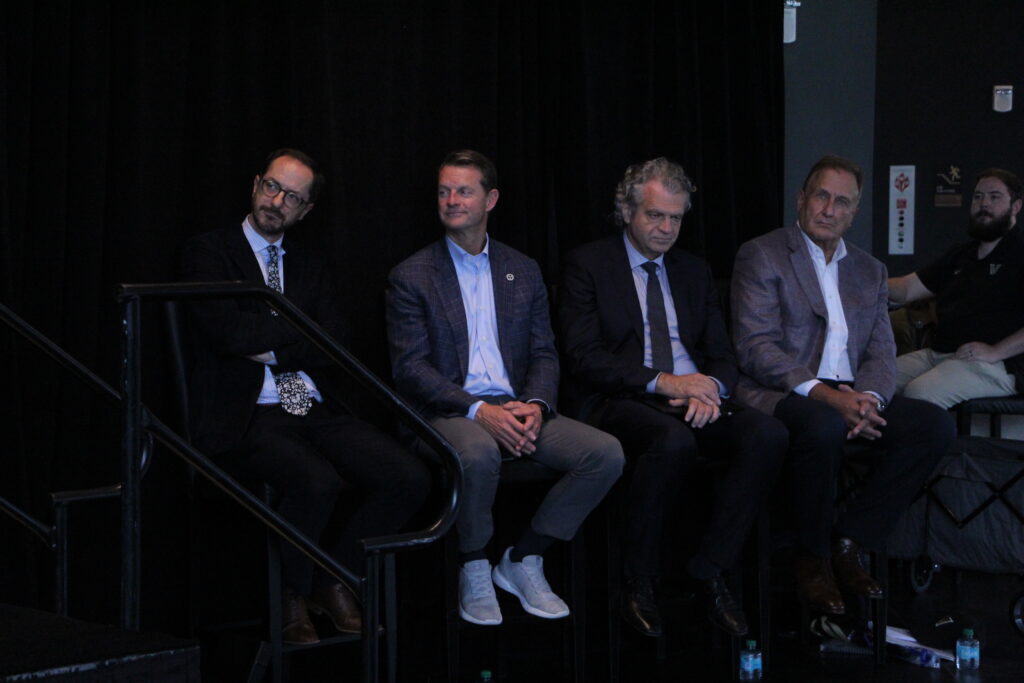
“I have never seen such a broad group of entities come together and support a project with this magnitude and do it in such a fast way,” Nissha CEO Sam Heleba said. At the announcement, he spoke alongside Department of Economic and Community Development Commissioner Stuart McWhorter, Vanderbilt Chancellor Daniel Diermeier and Nashville Mayor Freddie O’Connell.
Nissha says the move will bring 38 new jobs and a $4.5 million investment.
It’s also a move the state really wanted.
“We were hearing from the company that they were thinking about other states,” McWhorter said. “And I was like, ‘There’s absolutely zero chance that’s going to happen.’”
McWhorter said the state got “creative” with its incentives.
Tennessee’s FastTrack grants are state dollars that go to companies to help them offset costs of moving operations to the state. They’re often based on the number of new jobs created. That’s why, McWhorter said, the state tapped into another fund to make sure the grant was desirable to Nissha.
“Because they were building out some lab space here, it makes it a little bit more difficult because that’s just capital expenditure,” McWhorter told WPLN News. “We had to structure it in a way that wasn’t necessarily tied to jobs but as part of an accountability agreement. If we just went through that [jobs] lens, it would have been probably a grant that they wouldn’t have liked, and they might have gone to another state.”

 On Air - 90.3 WPLN-FM