
This story was produced by the Tennessee Lookout and WPLN News, with support from the Pulitzer Center and the Education Writers Association.
In the late 2010s, state Rep. Harold Love, D-Nashville, provided the Tennessee Legislature with proof that the state failed to properly fund Tennessee State University for years. He convinced lawmakers to tally how much the state owed its only historically Black public university.
But nearly 50 years earlier, his father was working on a tally of his own.
Love is a TSU alum with a family heavily connected to the university. His father, Harold Love, Sr., served as a state representative whose district included TSU, and his mother taught mathematics there.
“I would spend time at my mother’s office at Tennessee State,” he said. “I would spend time at my father’s office at the Capitol. And my father, I think, wanted to set the groundwork for me to know what he was doing.”
Even at home, during dinner, “there were conversations oftentimes about Tennessee State’s funding and the work he was doing and trying to get money for the school,” Love said.
Those conversations stayed with him when he followed in his father’s footsteps and became a state representative in 2012. His father died in 1996, but Love found ways to keep his memory alive.
While moving into his father’s old office at the state capitol, he was going back and forth to his parents’ house to bring some of Love Sr.’s memorabilia with him. He came across a 1970 report in his father’s papers called “The Special Needs of Negro Universities.”
He didn’t think much of it until years later.
No state matching funds for TSU
As a new lawmaker, Love began meeting with his constituents to learn about their most pressing concerns. He said he was surprised when a TSU agriculture dean asked him to get the state to match their land grant agricultural funds.
TSU and the University of Tennessee Knoxville are the state’s two land grant universities. In the late 1800s, Congress donated land or money to states so they could build colleges. These schools get federal funding for programs like agriculture and science, and the states are required to match those funds.
Love vaguely remembered his parents discussing this funding for TSU when he was a child. The university provided him with a report stating that between the years 2000 and 2007, the school didn’t receive any state funding to match its land grant programs. There was no information available before 2000.
Love visited the legislative library to review archival budget records dating back to fiscal year 1957. He was expecting to find more proof that the state underfunded TSU. Still, he was shocked to find that, for many years, the state hadn’t budgeted any land grant matching funds for the school.
“That was my natural belief that it was something, but then I’m like, hold on, this a zero,” he said. “Not even a zero. It’s not even a line there.”
The state did, however, provide those funds for the University of Tennessee. Love found that sometimes Tennessee gave the school more than the one-to-one match that the federal government required.
“Why would the state of Tennessee not fund a university that’s educating kids? I can’t think of a rational reason why,” Love said. “And so my mind has to go to, ‘Well, you must have not thought that the kids at this school were as valuable as the other school.’”
Still, he had trouble getting his colleagues on board. Love was a freshman legislator who didn’t yet wield much political power.
“The disconnect was, I’m saying that TSU has been underfunded,” he said. “But to throw that broadly out there — ‘Well, what do you mean underfunded? You didn’t get what you asked for last year?’ ‘No, no. For the last 30 years.’”
‘Read the report’
Frustrated, he started looking again through his father’s old papers. It was then that he said he heard a voice: Read the report.
Love is a man of faith and the pastor of Lee Chapel A.M.E. Church in North Nashville. He said the voice was not audible, but rather internal.
So he picked up his father’s old report about the needs of Black universities.
“And when I read it, I said, ‘Wow, this is exactly what I needed,’” he said.
The legislative report stated that in 1970, TSU had only received $51,599 of the $4.5 million in federal land grant funds given to Tennessee. This provided Love with proof that concerns about land grant underfunding at TSU were brought to the legislature nearly 50 years earlier.
“I could then make the case that Tennessee State University had not been getting its funding,” he said. “There was research done in the 1970s that spoke to this, and here we still are at this present age.”
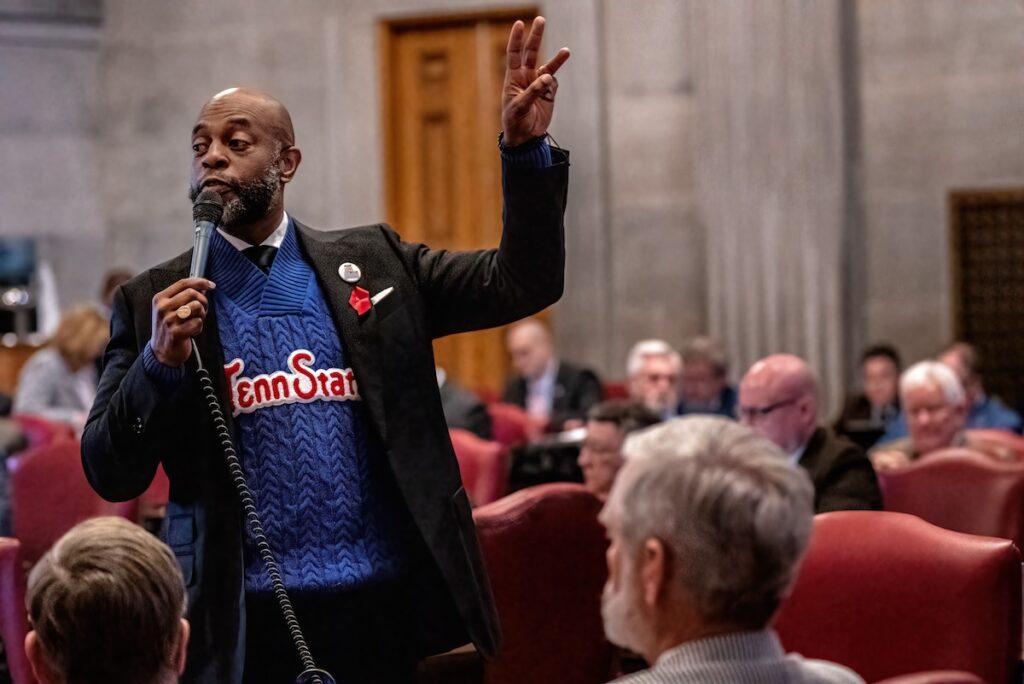
During debates about the 2016 FOCUS Act, which changed the governance structure for Tennessee State University, Love held up his father’s report on the floor of the Tennessee House and began reading from it. He explained to lawmakers that the state’s chronic failure to match those federal funds had forced TSU to pull money from its operational funds to cover the difference.
The effect was immediate.
“As I start reading the report, the chair of education comes over and says, ‘We got it. We understand, and we’re gonna fix it,’” he said.
The state then started fully matching the federal funds for TSU going forward. Love credits his father’s research for this victory.
Still, Love knew this wasn’t enough to make up for the backpay.
Political momentum for funding
Then came the summer of 2020.
The police killing of George Floyd in Minneapolis sparked racial justice movements across the country. Many people in positions of power, including in Tennessee, were making attempts to address these injustices.
Love recalls Tennessee House Speaker Cameron Sexton, R-Crossville, calling Black lawmakers into his office and asking if there were “instances you can point to where we’re not treating African Americans right in Tennessee,” Love said. “So my hand goes up. I said, ‘Tennessee State’s matching funds.’”
According to Love, Sexton agreed to set up a legislative committee to look into the underfunding. “‘I really want to know, how much is it?’” Love recalls Sexton saying. “‘Because I don’t want you to keep thinking that we’re just eating around the edge.’”
Sexton did not respond to requests for comment on this meeting.
Finally, Love was able to do thorough research on the state’s budget records back to the 1950s. He and his colleagues came up with a number: Tennessee had shortchanged TSU by as much as $544 million, without accounting for inflation.
Love knew he had to act quickly. At that moment, he said, he had the right legislative mix — with the governor, lieutenant governor, speaker of the House, and other committee chairs all on board to address the state’s underfunding TSU. The political momentum was there.
In 2022, at Gov. Bill Lee’s request, the legislature approved $250 million for TSU for infrastructure improvements — a major victory, although Love was still eyeing additional funding.
But then, in February 2023, the state comptroller released a scathing audit of TSU operations and its finances. It found that the school disregarded financial management guidelines, including students not receiving the scholarships they were promised and freshmen having to live in hotels because the school didn’t have enough housing.
At the state capitol, Love immediately started trying to do damage control.
“When the report came out, my first thought was … I don’t need another competing story coming up and saying, ‘Yes, there’s underfunding, but also there’s this,’” Love said. “I tell folks all the time, I say, listen, two things can be true. You could have underfunding and you can have some fiscal policy that were not followed.”
But TSU’s alleged fiscal mismanagement became the focus at the state Capitol for multiple years. There were legislative hearings. The president of TSU resigned. Then the governor pushed to replace the entire board of trustees at TSU.
And then, another bombshell dropped: The Biden administration put out a report with their own calculation of how much southern states have underfunded their historically Black land grant universities over the last 30 years, based on a completely different calculation.
The state of Tennessee, it said, owed TSU more than $2 billion, more than any other southern state.
Love was stuck in the middle — on one side, trying to convince lawmakers that TSU still deserved its remaining backpay, and on the other side, trying to talk down TSU alumni who wanted him to demand even more money from the state.
“The challenge is, how long can we keep making the case for underfunding?” he said. “We should always be able to make the case, but you’re also dealing with human beings and people.”
Today, TSU has a new president who seems to have a good relationship with the state. The Trump administration has not followed up on the Biden administration’s report.
And Love said he is still trying to recover another couple hundred million dollars for the school — although it’s unclear if the political momentum is still there to make it happen.
This is Part 3 of The Debt. Read Part 1 and Part 2 here.

 On Air - 90.3 WPLN-FM