
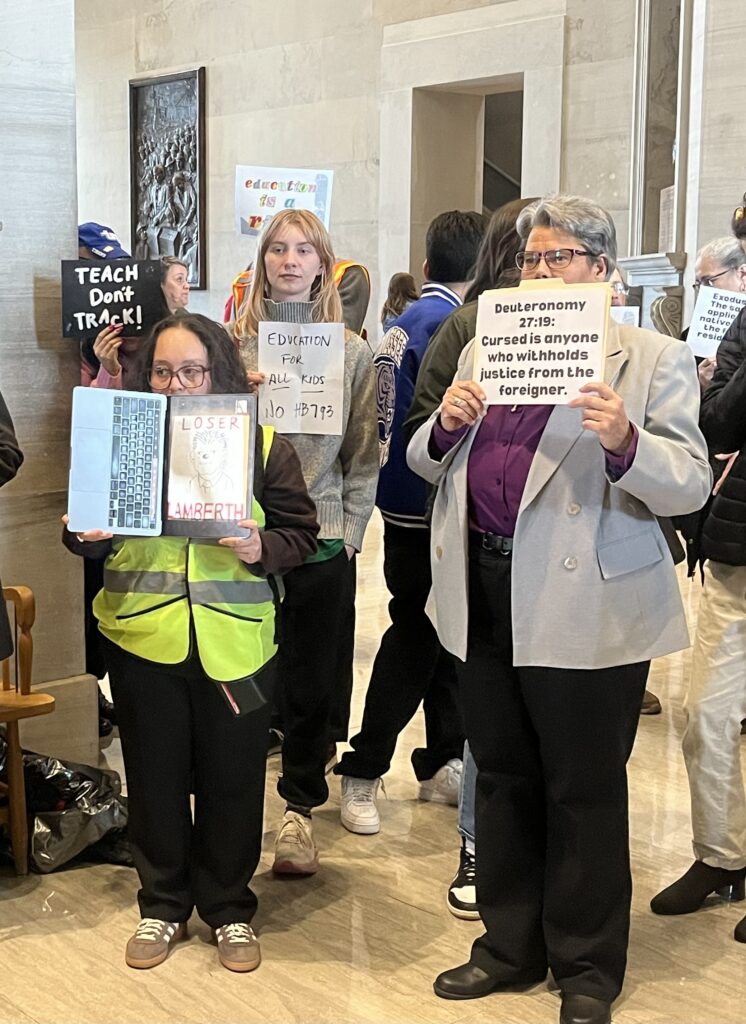
A measure requiring schools to report students’ immigration status has passed the Tennessee House, 70-25. Although the Senate version of the bill has already passed, lawmakers must reconvene before the bill can become law.
Legislators sparred over the controversial measure with some arguing that it would cost taxpayers millions of dollars and create increased immigration enforcement activity in certain communities. Others insisted that the bill is a setup for Republican lawmakers to continue fighting the long-standing legal precedent that guarantees all children the right to an education.
Reporting requirement may cause absenteeism, critics warn
The bill’s sponsor, Rep. William Lamberth, R-Portland, argued on the House floor that schools already collect students’ personal information, like birth certificates and proof of residency, so HB793 is simply a data tool to help the state government make more informed decisions.
Protestors lined the halls of the state Capitol with signs saying, “Teach not Track” and “Education for All.” The tension carried into the chambers with Democratic lawmakers saying the bill called for teachers to act as Immigration Customs and Enforcement officers. Others, like Rep. Gloria Johnson, D-Knoxville, warned that the bill would cause absenteeism among immigrant students.
“We are targeting innocent children,” she said. “And we are making them afraid to go to school because they’re afraid of what information that would go to the government and what that would do to their families.”
The bill is an amendment, and, in its original form, would have allowed public schools to refuse undocumented students or charge their families tuition. However, Lamberth amended the bill over concern it would cost the state $1.1 billion in federal education funding. The bill defied federal civil rights laws and ran afoul the Plyler v. Doe Supreme Court ruling that guarantees all children the right to an education, regardless of their immigration status.
‘They are out to overturn Plyler’
Lamberth has not expressly stated what the state government would do with the information about students’ legal status. He did say that he was amazed that so many were against using data to make more informed decisions about allocating resources.
Rep. Gabby Salinas, D-Memphis, however, argued that Lamberth will use this data to continue his previous efforts of challenging the Plyler ruling that guarantees education for all. During the 2025 legislative session, when the original bill was first introduced, Republicans openly stated that they did not agree with the legal precedent and hoped to retry it with a different outcome.
Salinas called out lawmakers who said they were uncomfortable with the original bill but supported the amendment.
“The end result of this bill, whether it’s amended version or not, will still be the same,” she said. “They are out to overturn Plyler. They changed the language because even Republicans were standing up and saying, this is not okay, not on our watch.”
Lamberth’s amendment does address the Plyler ruling. It states that the number of undocumented people living in the United States has quadrupled in the last thirty years and there’s been “a material change in the illegal immigration environment” that existed when that legal precedent was set in 1982. Lamberth also argues in the amendment that the Tennessee state government is best suited to determine education policy for its residents.
The Senate version of the bill, sponsored by Sen Bo Watson, R-Hixon, passed during last year’s session. It still includes language allowing schools to refuse undocumented students.
The House and Senate will now have to enter a conference committee to reconcile the two versions of the legislation.

 On Air - 90.3 WPLN-FM