
More than a dozen Tennessee small towns have watched their hospitals go dark. Linden is among them.
The community sits on the Buffalo River in Middle Tennessee — about 90 miles from Nashville. It’s in Perry County, which is one of the poorest counties in the country, according to state data.
Mayor Wess Ward has been in Linden his whole life. Hospital closures started long before he took office. But they really started surging after he did, back in 2016.
“There was something definitely wrong somewhere — some red tape, some bureaucracy, something that was causing the closure of so many,” he said. “I mean, it wasn’t just a coincidence that all these small communities lost their hospital at one time.”
In Waverly, about 40 miles north of Linden, the hospital nearly closed. The one in McKenzie — 70 miles northwest — wasn’t as lucky. It did close. So did the one in Parsons, 20 miles west.
“And then we were sitting around in the middle of all that,” Ward said. “So, yeah, we knew that it was a ticking time bomb, you know.”
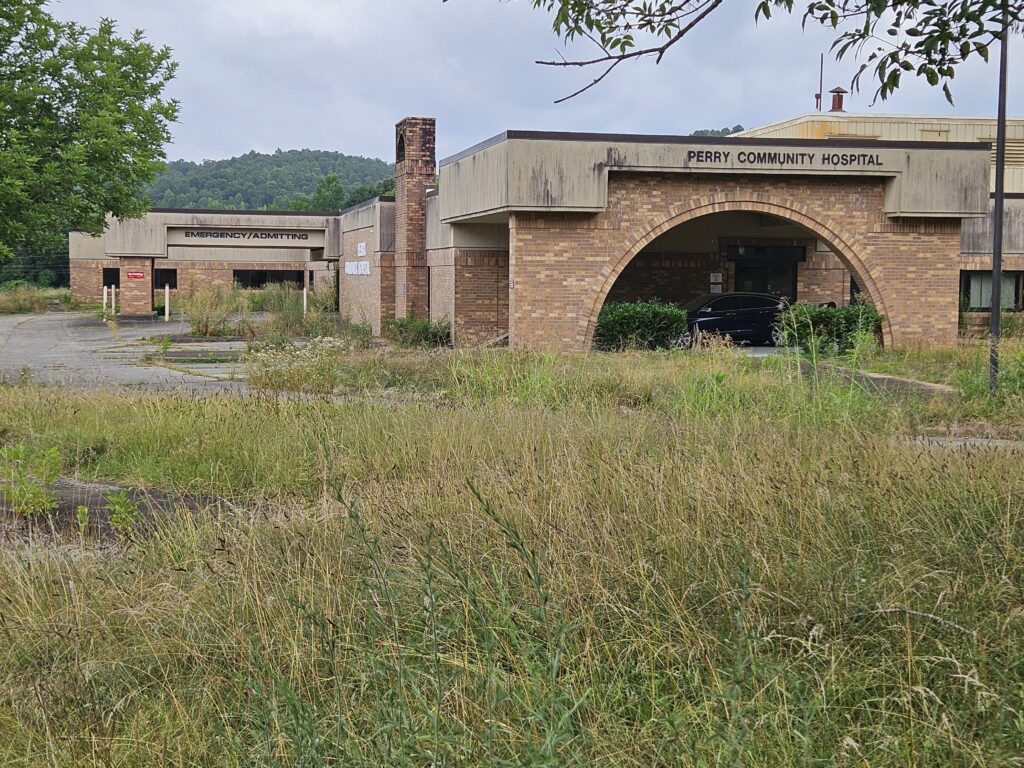
The hospital closed in 2020.
 Blake Farmer WPLN News
The signage was removed from the hospital after it closed. In this 2022 photo by WPLN’s Blake Farmer, the facility sits abandoned.
Health researchers generally sort the country’s rural hospital closure crisis into waves, with the most recent starting in 2010. That’s when Tennessee’s crisis started. Like many other states, fallout from the COVID-19 pandemic made a difficult situation even worse. More hospitals closed. Since then, Tennessee has taken the top spot for closures per capita.
More than a dozen rural hospitals have closed since 2010 — depending on the definition of closure. Some organizations — like health care strategy firm Chartis — call it a closure when a hospital shutters the inpatient wing. The Cecil G. Sheps Center in North Carolina is less strict, and it says Tennessee has lost 15 hospitals.
More in this series: Healthcare Hollow
Texas is the only state that has lost more hospitals, but it has quadruple the population. So per capita, Tennessee’s rate is head and shoulders over the rest of the country.
And even now, the Sheps Center reports indicate nine more are teetering on the edge of closure.
For Ward, losing Perry County’s hospital was personal. A few years ago, he was feeling a little rough after clearing some land on a bush hogger. He got home around 8 p.m. and lost consciousness for several hours.
“I wake up, just feel like somebody’s standing on my chest,” he said. “Keys, stuff laying on the floor. Get up and drive out to the hospital and walk in. Everybody’s like, ‘What are you doing here?’ I’m having a heart attack.”
When asked what would have happened if his heart attack happened when the hospital was closed, he said, “I probably wouldn’t be sitting here.”
More: This Is Nashville discusses Healthcare Hollow
Technically, Perry County residents can get to a hospital in Jackson, about 60 miles away. Or they could go a bit farther — an hour and a half — to Maury Regional or one of the major hospitals in Nashville.
That’s a long way to drive if you’re sick or even need basic healthcare. Many don’t have a car. Or, more commonly, they have an unreliable car, according to Ward.
“They know they can take one of these back roads into town,” he said.
“A lot of people have never drove on interstate and won’t drive on interstates,” he said. “There are people here that are so country… most of them are up in their years now, but some of them don’t have a Social Security Number because they were born at home with a midwife. And, you know, they’ve never been to Nashville. They’ve never been out of Perry County.”
That’s for locals. Lacking a hospital can be dangerous for other people, too.
Much of rural Tennessee has a natural beauty that draws tourists. Perry County is no exception. The Buffalo River runs right through Linden, attracting canoers. Its winding, scenic roads draw thousands seeking other outdoor adventures — like riding motorcyles.
“That first year of the hospital closed, I remember it seemed like we had a motorcycle wreck every weekend that whole first year,” Ward said. “At least that’s behind us now.”
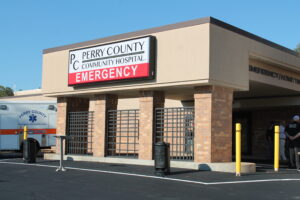
The new Perry County Community Hospital opened its doors on Sept. 29, 2025.
That’s because Linden residents have their hospital again—it’s reopened, due to the efforts of Braden Health
“It’s more than just one specific thing that causes that many hospitals to fail,” said Kyle Kopec, the COO of Braden Health. “Our perspective is it’s some of the outdated legislation. It’s some bad actors mixed in that eroded trust. It’s very bad management, because a lot of the Tennessee hospitals that closed were run by a very small number of companies that changed hands with each other a few times. And it’s most importantly, just the community does not want to go there anymore.”
Braden has now reopened four hospitals in rural Tennessee. Perry County is the latest.
The hospital held a ribbon-cutting ceremony in September. Scores of people showed up at the new facility for tours and group pictures. The new CEO, Hali Sanders, was among the speakers stirring up excitement.
“We’re here today, not just to mark a new beginning, and not just opening a new hospital, but to restore trust and dignity and care to a community that needs care so much,” Sanders said.
Soon after the hospital opened, people started coming in for treatment, in many cases giving a glimpse at what was happening when the hospital was closed for so many years. Sanders described one of those patients: a woman had a benign infection, but without access to care, she became septic.
“She had kept hearing on the radio that the hospital was going to open, so she waited 5 days for the hospital to open,” she said. “By the time she got here, she was so sick she was really close to dying… These people just need to know we’ve opened the door… and we are ready to take care of all their needs.”
Tennessee’s current rural health landscape is plagued by hospital closures, reduced medical services and worker shortages. But Perry County Community Hospital sends a message: rural healthcare is not a lost cause.
“In rural America, everyone knows small towns, word spreads,” Kopec said. “Then patients start coming. And then we work really hard to treat them well. And then they tell more people that they were treated right. And that’s the secret for us (at Braden Health) for building community support. It’s a very slow thing.”
This story is part of our Healthcare Hollow series, made possible, in part, by the NIHCM Foundation.

 On Air - 90.3 WPLN-FM