
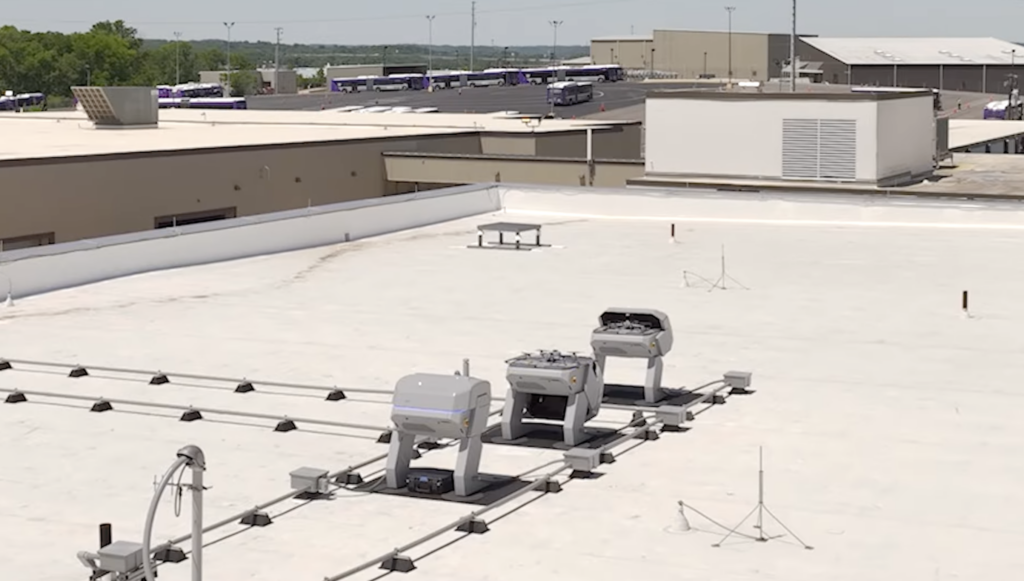
The drone program introduced last week by the Metro Nashville Police Department is facing backlash stemming from a lack of oversight.
The “Drone as First Responder” program is a pilot that police have been testing within a two-mile radius around the Madison precinct. The drones are responding to emergency police and fire calls, missing-person cases and significant traffic crashes. Already, MNPD has reported that the program has led to one arrest in a domestic violence case. After the suspect left the scene, the drone operator identified the suspect (through the drone) and alerted ground officers to his location.
The drones operate by using cameras to record the scene. MNPD told WPLN News that they “work similarly to safety cameras” — recording begins as they approach the scene, providing a visual for responding officers.
But the program, which will run for up to 45 days, has received community pushback over the fact that it never went before the Metro Council.
Nashville’s code includes a statute that requires surveillance technology to get explicit approval from the Metro Council. In recent years, the council has leaned against such technology, and enacted guardrails around police use of camera networks.
Mayor Freddie O’Connell told media last week that he doesn’t think that rule applies in this case.
“One, it is a pilot, it’s very limited,” O’Connell said. “And two, Metro Legal’s analysis so far has suggested that it has not triggered the surveillance-based provisions that would require a public hearing.”
Metro Legal told WPLN News that an exemption in the statute is what excluded the program from being required to undergo council approval. The exemption says the surveillance statute does not apply to “surveillance technology by or on behalf of law enforcement that is used on a temporary basis for the purpose of a criminal investigation supported by reasonable suspicion, or pursuant to a lawfully issued search warrant, or under exigent circumstances as defined in case law.”
But community safety advocates and some Metro Councilmembers say that the program should have gone through the council.
Kelly Chieng, a local organizer says that she feels the program was “illegally implemented,” given that the drones are also used in significant traffic crashes, a use that is not included in the exemption.
“To say this also falls under this exemption of the surveillance statute, but they’re using it for car crashes — to us that does not track and really does not hold water,” Chieng says. “At a minimum, this needs to come to council for a vote and there needs to be a public hearing.”
Councilmember Emily Benedict, who represents District 7, posted a video to social media last week questioning how the drones work, and why she was not included in MNPD’s engagement with the council.
Mayor O’Connell has said that the councilmembers whose districts are involved — this includes Districts 3, 9, 10, 11 and 15 — were briefed on the program. In a map shared by MNPD, the portion of Benedict’s District 7 that would have fallen within the program’s two-mile radius looks to have been intentionally cut out of the otherwise-circular boundary.
“Nobody reached out to me. Nobody from MNPD or the administration reached out to me to say, ‘We’re doing this trial and it’s going to keep all these other people safer,’” Benedict said. “Now, I don’t believe this is actually going to make people safer. And so if they would have come to me, what I believe they were afraid of, they were chicken … to be held accountable to the fact that this is a surveillance technology and that is not allowed to be put in place without a public hearing at council.”
Both Chieng and Benedict — along with public commenters at recent Metro Council and Metro Human Relations Commission meetings — have expressed concern about the drones being tested in a lower-income, majority non-white neighborhood.
“We also need to be incredibly careful of where we’re implementing this type of stuff,” Chieng said. “I think we know enough about what has happened historically in this country to know that we’re never going to see drones trialed in Belle Meade or Green Hills or wealthier, whiter areas.”
This council cohort has shown willingness to curb MNPD’s use of surveillance technology previously. In 2022, MNPD began using surveillance integration network Fusus without council approval. Eventually, public pressure spurred the department to pause use of Fusus until the council could weigh in. In a narrow vote, the council ultimately rejected use.

 On Air - 90.3 WPLN-FM