
In recent years, Nashville has only gotten more dangerous for pedestrians. So far this year, 21 people have died while walking.
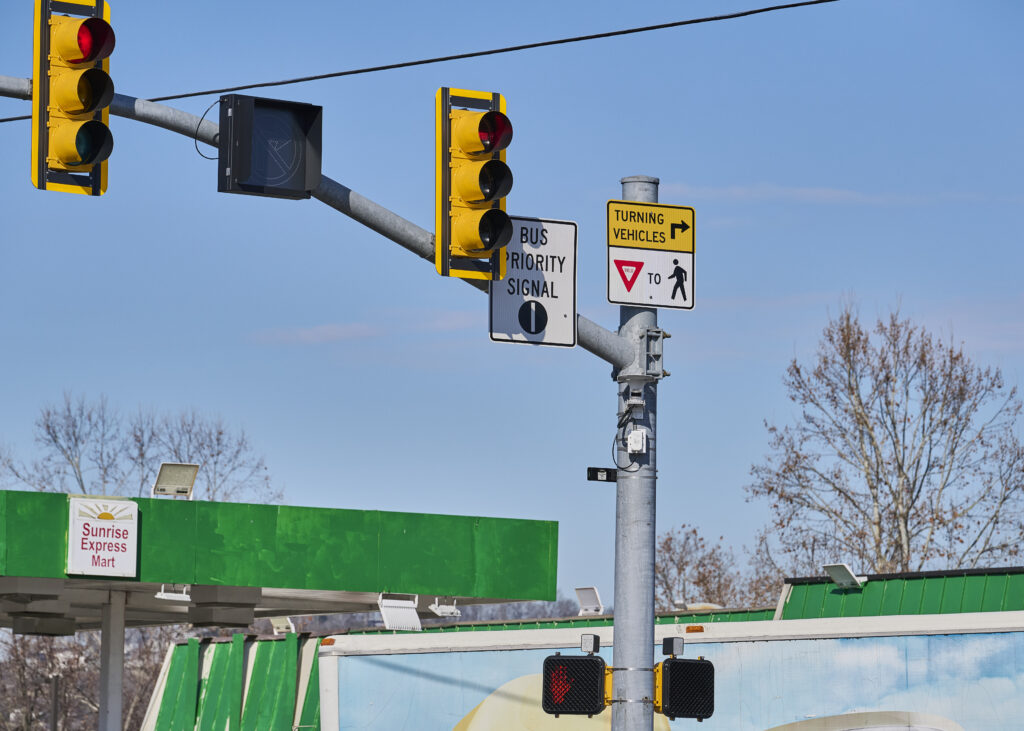
In an attempt to make streets safer for pedestrians, city leaders are considering restricting where drivers are allowed to turn right on a red light. The idea is that right-on-red turns would be banned in much of downtown, school zones and at some high-traffic intersections.
Councilmember Sandra Sepulveda, who is sponsoring the Metro Council bill, says the proposal has been in the works since 2024 — a delay, she says, that has had consequences.
“It’s been pushed off for so long, and, during that time, people have passed away,” Sepulveda said. “People are at risk.”
Sepulveda initially filed a bill that would have banned right-on-red turns throughout all of Nashville’s Urban Services District (this is made up of Nashville’s pre-consolidation city limits, plus areas like Madison and Antioch). Sepulveda is now planning on introducing a substitute version of the bill that limits the measure to instead only prohibit the turns in targeted areas.
If the bill is approved, the city would install a sign at every traffic signal where a right turn is banned. And, Sepulveda says, police would start out by issuing warnings, before issuing citations to repeat offenders.
It’s a move that’s been made in other cities, including New York City, San Francisco, Atlanta and Ann Arbor, Mich.
Still, Sepulveda says she anticipates some pushback.
“People had concerns when seat belts were implemented,” Sepulveda said. “People had concerns when the speed limit was implemented. Change is something that’s difficult.”
And, Nashville’s drivers do have mixed feelings about the proposal.
“I think it would be good and bad at the same time,” Jessica Olive said while gassing up at an Inglewood gas station. “I mean it would help with not hitting people — because the crash that just happened recently downtown — but again, the traffic and the hold up. It’s already hard. People are, like, road raging.”
Another longtime resident, Dave Francis, said there are other initiatives he’d rather see.
“People’s brains move slowly, and if you try to do a big change like that, I don’t see it working,” Francis said. “But it’d be great if every neighborhood had sidewalks. If anybody’s really, actually, concerned about safety, that would be a good place to go.”
Robin Owen, who serves on the Vision Zero Advisory Committee, says she understands the hesitation.
“I drive almost every day myself, and driving through the city is really stressful,” Owen says. “It is also really frustrating when I’m not that far from my house and it still takes me 20 to 30 minutes to get home.”
But she thinks the stakes are what make the adjustment worth it.
“Would you be willing to be slowed down a little bit, get home two minutes later, if it means that somebody else gets home alive that night?” Owen asks. “I think most people — when they know what’s actually at stake in the conversation — they’re much more open to that, right?”
The substitute version of the bill will heard by the Traffic and Parking Commission next month, and will be discussed at the Metro Council’s meeting on Sept. 15.

 On Air - 90.3 WPLN-FM