
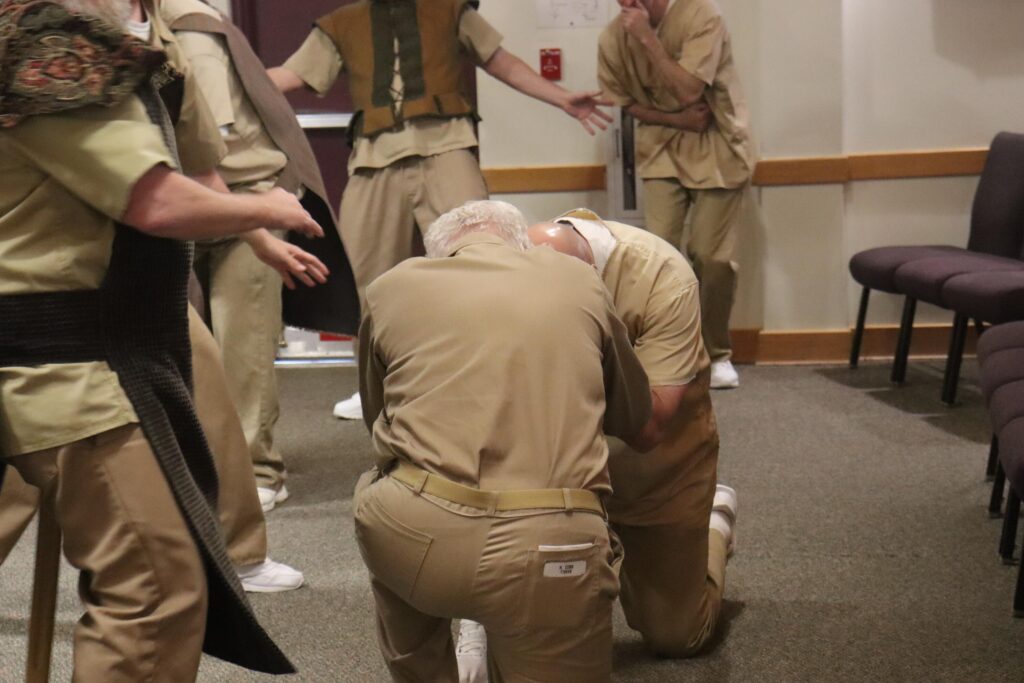
In William Shakespeare’s “The Tempest,” father and daughter Prospero and Miranda are abandoned on a deserted island. After 12 years, Prospero plans to seek his revenge on the men who place him there.
In the opening scene, a vicious storm hammers a ship carrying the King of Naples and his crew.
A group of actors screams in agony, delivering their lines to a nearly packed house. Their Elizabethan period costumes flow over khaki jumpsuits with their prison numbers and last names visible underneath.
They’re some of the 22 incarcerated men who turned the Luther Luckett Correction Complex chapel into a stage for the 31st season of Shakespeare Behind Bars. The program is one of few of its kind in the country, and its cast and crew say its impacts reach beyond the prison’s walls.
Behind the curtain
Theater veteran and former Louisville resident Curt Tofteland worked for Kentucky Shakespeare as producing artistic director for 20 years. He launched an education department there in 1990 to teach Shakespeare to kindergarten through 12th grade students and tour plays in that style to Kentucky schools.
He said he wanted to use his passion for Shakespeare to teach underserved communities.
“I believe that art can heal,” Tofteland said. “And I believe Shakespeare, in particular, he was really interested in human behavior and emotional literacy and writing about the interior world of a human being.”

In 1991, he put on his original play, “Boy Meets Girl Meets Shakespeare,” at Louisville’s Juvenile Detention Center.
“And that began my work in corrections,” he said.
Four years later, Tofteland pitched the idea of a theater program at Luther Luckett in La Grange, Kentucky, to its warden at the time, Larry Chandler. Chandler recently said he had his reservations about the plan at first.
“He’s not the typical guy that you think about coming into corrections and doing these kinds of programs,” Chandler said.
He said he also was skeptical of the art itself.
“I’m not a big Shakespeare fan,” he said. “But [Tofteland] has it right when he says, ‘Shakespeare has talked about almost every condition of life.'”
Chandler said he witnessed how the program changed the men.
“It’s an amazing thing to see a bunch of guys on this yard out here rehearsing lines from Shakespeare,” he said. “It gets everybody’s attention.”
What was once a small theater group practicing lines at Luther Luckett is now a larger organization. Over three decades, Shakespeare Behind Bars has expanded to eight other Kentucky prisons and to a juvenile facility in Illinois.
The costume puzzle
Ahead of the season’s debut, Kentucky Shakespeare’ costume designer Donna Lawrence-Downs milled around her Louisville studio. It’s cluttered with clothing racks, sewing machines, spare thread and long white tables draped with assorted fabrics.
She’s made around 700 designs in her career, but she said Shakespeare Behind Bars comes with unique challenges. This year, she made 41 costumes for the Luther Luckett program in addition to costumes for Kentucky Shakespeare’s upcoming season.
“I build big seam allowances in the backing so things can be reused from year to year because of the scale of the guys,” Lawrence-Downs said. “I have one guy that’s got a 37-inch chest and four guys that have a 60-inch chest.”
But she said the biggest puzzle was figuring out how to dress the men playing female characters. In “The Tempest,” there are five female roles, and she said she had to create designs the men were comfortable with.
“Nobody wears wigs or anything like that,” Lawrence-Downs said. “They wear scarves on their heads and they wear long tabards, and that indicates a female role. It’s a garment that front and back are just rectangles and some belting on the sides.”
Luther Luckett’s policy includes several conditions about outside materials. For example, the cast’s costumes cannot conceal their jumpsuits. Additionally, all costumes must pass through the facility’s metal detectors. The Department of Corrections also requires Lawrence-Downs to detail what outfits she plans to bring to the cast. She said that can get complicated.
“When you say to me, ‘What is this?’ I say, ‘It’s a sheep.’ The answer really is, ‘It’s towels and fur,'” she said.
Lawrence-Downs’ costumes for “The Tempest” included wolves, island spirits and noblemen.
Part of the circle
Kentucky Shakespeare is the primary sponsor of the program, and its actors lend their expertise to the men at Luther Luckett.
Crystian Wiltshire is a longtime Kentucky Shakespeare actor and a program facilitator for Shakespeare Behind Bars. He visits the prison three times a week to help the cast and crew.
“Even deeper than that is to help them get to the truth in their characters and in the relationships that they’re building throughout the year,” Wiltshire said.

The men in Shakespeare Behind Bars also choose their own castmates, and as Wiltshire explained, there are some prerequisites.
“They have to have at least a year of clean conduct,” he said. “They can’t have any write-ups of any kind. Also, they have to have a sponsor, and a sponsor can only be someone that is already a part of our circle.”
Sponsorship is one of six steps to joining the group. The process can be slow, but Wiltshire said this protects the Shakespeare Behind Bars community.
“I heard one of the guys, he’s always said that this program is not for anyone trying to get less time on their sentence,” Wiltshire said. “If someone on the yard comes up to him and says, ‘Why do you do it?’ He just says, ‘Personal growth.’ And that’s what it’s about.”
The cast members spend hours researching their characters. Wiltshire said he enjoys watching the men find connections with their roles, specifically J.S., who played Prospero.
The Department of Corrections allowed LPM News to record the performance on the condition of using the men’s initials instead of their names. It had not previously allowed anyone to record a performance at Luther Luckett for six years.
“What this gentleman said to me was, ‘What I identify most about Prospero is that he’s a father, and I’m a dad. And I know that my daughter is going to come and see this show, and I get to take on this role of a father who has done wrong to others, but ultimately, not only forgives, but is forgiven for the things that he has done over 12 years in the show,'” Wiltshire said about J.S.
For Wiltshire, Shakespeare Behind Bars represents what he loves most about theater.
“It is a group of people coming together for a common goal and growing along the way, becoming better people,” he said. “And it just so happens that Shakespeare is the bridge for all of those things to happen.”
‘Art as an intervention’
On a recent Monday evening, the Shakespeare Behind Bars actors performed for their loved ones from the outside for the first time this season. Seventy-six local thespians, family members, friends and prison staff sat close in rows of chairs that nearly reached the back wall of the prison chapel.
A week prior, other incarcerated men at Luther Luckett saw the performance.
The production opened with monologues from the youngest members of the cast, who are in the Shakespeare Behind Bars’ Journeymen program for incarcerated men up to 30 years old.
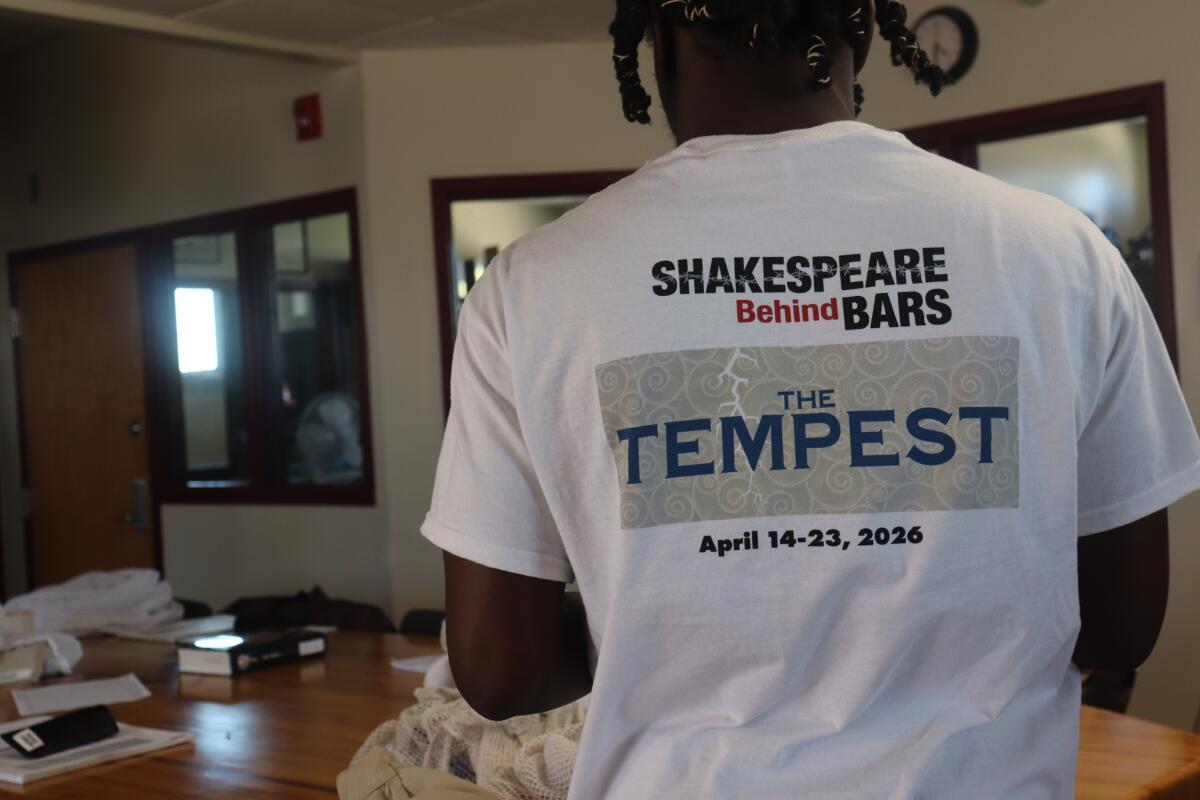
During “The Tempest,” Lawrence-Downs’ designs came to life against a handmade backdrop of a thick forest and a waterfall.

The first time the group ever performed this play was in 2003, and it was captured in a documentary about the program.
According to the Kentucky Center for Economic Policy, more than 32,000 people were incarcerated in Kentucky’s local jails and state prisons in 2022. Recent data from Kentucky’s Justice and Public Safety Cabinet say about 30% of people released in 2023 were incarcerated again within 24 months. Among all Shakespeare Behind Bars alumni, the recidivism rate is 6%.
Danielle Littman, a professor at The University of Utah, published a research review in 2020 on prison arts programs and its impacts on those incarcerated.
“One of the things that we were looking at was a general sense of hope and meaning and purpose while incarcerated,” she said. “This sense of, ‘If this is my life, and now I have this arts identity, and this arts program to be a part of now, I have more of a sense of purpose and meaning in my life than I did previously.'”
Some of the actors will spend the rest of their lives in prison. H.C. has been in the cast since 1995. In “The Tempest,” he was Alonso, the King of Naples.

J.S. has been incarcerated for more than a decade. But on stage, he had magical abilities and was the Duke of Milan. He said he learned 546 lines for this performance.
LPM News was not allowed to record one-on-one conversations with the cast, but some of the actors being part of the play is inspiring, like therapy for them. Out of the 22 men, only six had ever read Shakespeare before joining the group.
Littman — who reviewed 25 studies on prison arts programs — said little research is available to explain how these programs can affect people long-term.
“The reality is, there hasn’t been a ton of research that’s looking at the arts as an intervention that people believe is scientifically meaningful,” she said.
It’s been six years since Jeff Smith, who performed in Shakespeare Behind Bars, was released from Luther Luckett after serving 26 years. He said he believes prison arts programs are meaningful beyond the prison walls.

“I was addicted to drugs, and so I had to get money for drugs. And you know what that leads to: Robberies, thefts, burglaries. I couldn’t stop,” Smith said. “So I finally caught myself in Shakespeare. I’m telling you, it totally changed my transformation, and it just kept me out of prison.”
Smith currently lives in Georgia and works as a tree trimmer. He made the journey back to Kentucky to support his friends, and he said the show reminded him of how he learned.
“My attitude’s always been, ‘Hell with you.’ Now it’s not,” Smith said. “It’s, ‘What do you need from me?'”
During intermission, the excitement in the room was palpable. The full cast lined up in front of the stage with their hands clasped behind their backs, and the audience mirrored them from three feet away, preventing physical contact.
Among the audience is Jerry Guenthner, a Shakespeare Behind Bars alum who said he was incarcerated for 37 years, 11 months and 16 days.

When he reached the audience line, the cast immediately noticed their old friend, whom they call “Big G.” The men crowded around him and waved, nearly in unison.
“Long time, no see,” one of the actors shouted at Big G.
Guenthner said, when he was in prison, he witnessed what Warden Chandler saw in the yard.
“You just seen the light come on in their eyes,” Guenthner said. “You realize that they were different people, and I wanted that too.”
Shakespeare Behind Bars changed his life and taught him invaluable lessons, he said.
“By the time I left, my eyes were as open as they could be, I think, to believe in the beauty, the inherent beauty and dignity of every person,” Guenthner said.
Back on the stage, J.S. delivered Prospero’s epilogue alone.
J.S. gradually removed his costume as he recited his lines. Then, he pulled out his prison badge and clipped it back to his jumpsuit. Next, he grabbed his glasses and placed them on the bridge of his nose – transforming from the character back into himself..
“Now I want spirits to enforce, art to enchant. And my ending is despair,” J.S. said, as Prospero. “Unless I be relieved by prayer, which pierces so that it assaults, mercy itself and frees all faults. As you from crimes would pardoned be. Let your indulgence set me free.”
During a Q&A after the show, J.S. explained why he choreographed the closing that way.
“Prospero throughout the entire play, he is a bastard to everybody, and he demands forgiveness from everybody,” J.S. said. “But he never apologizes for bad things that he’s done. I just wanted to cast off the character and ask for forgiveness from everybody.”
The entire audience stood to their feet with applause, roaring through the chapel. Guenthner wiped a tear from his eye.
Some of the cast will return for “Much Ado About Nothing” next season, and some may not. Regardless, they’ll all stay part of the small community these actors have created in the most unlikely of places.
 On Air - 90.3 WPLN-FM