
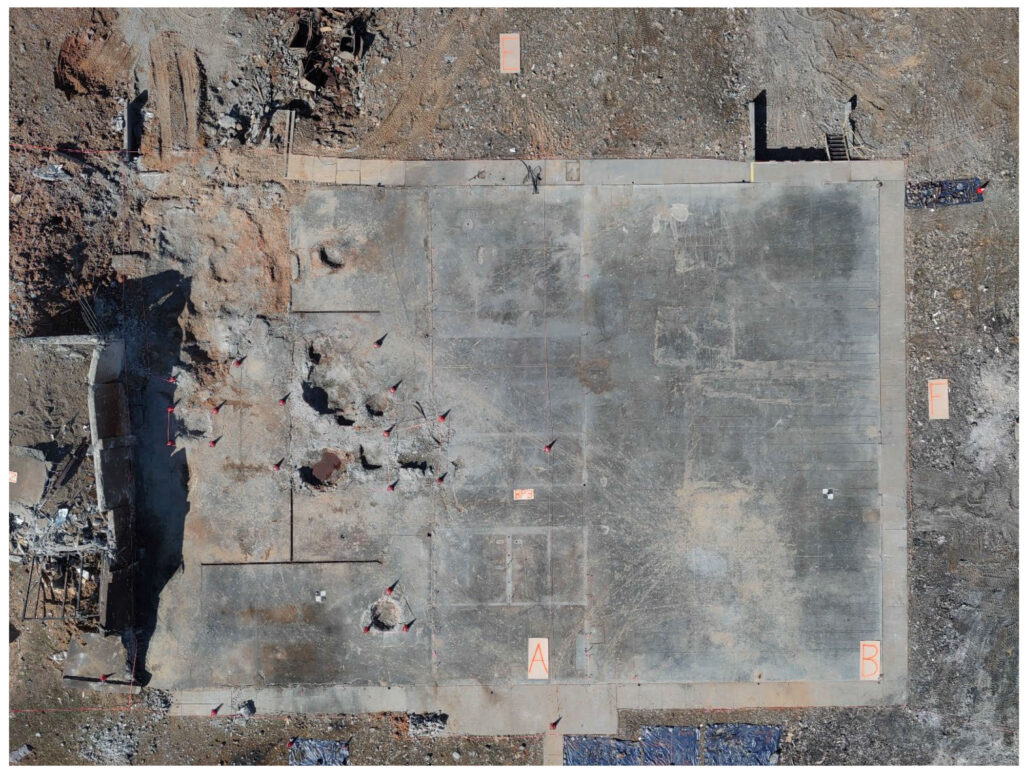
An explosion at a munitions plant in Hickman County that killed 16 people in October could have ignited for a multitude of reasons due to dangerous working conditions, according to a six-month investigation by state officials.
The Tennessee Occupational Safety and Health Administration issued 100 citations and a record $3.1 million penalty against Accurate Energetic Systems.
All but five citations from TOSHA were considered “serious” due to dangerous or even life-threatening working conditions, according to a review of the documents provided to WPLN News.
Among the allegations, TOSHA claims the company exposed workers to known explosion, fire and blast hazards.
“The employer did not furnish employment and a place of employment which were free from recognized hazards that were causing or likely to cause death or serious physical harm to employees,” TOSHA wrote in a citation.
 George Walker IV/AP Photo
 A woman holds a candle vigil honoring the victims of a blast at an explosives plant, Accurate Energetic Systems, Sunday, Oct. 12, 2025, in Waverly. (AP Photo/George Walker IV)
The penalties totaled about $3.1 million. The highest individual charge was $70,000, an amount TOSHA issued in about 40 different citations.
Gov. Bill Lee said the large penalty is meant to prevent other companies from similarly violating their policies and guidelines.
“That should be a deterrent to businesses going forward,” Lee told reporters on Thursday.
Before this incident, the largest penalty TOSHA issued was $380,000 after an explosion killed one person at a military flare manufacturing facility in 2001.
AES will have 20 days to request an informal conference or file a formal contest to the citations issued by TOSHA on April 7. The company is reviewing the findings and plans to meet with TOSHA, according to AES CEO Wendell Stinson.
“As we closely assess these compliance findings alongside ongoing investigations, including our own, into what caused the explosion, our top priority will remain our employees, their families, and our neighbors,” Stinson said in an email.
What happened Oct. 10
AES manufactures and stores explosives for the military, aerospace and commercial demolition markets. The company headquarters are located in the town of McEwen in Humphries County, while the manufacturing facilities are located in the neighboring Hickman County.
On Oct. 10, workers were processing what the industry calls cast “boosters,” devices often containing TNT (2,4,6-trinitrotoluene) or other highly explosive materials used to initiate larger detonations. Boosters set off when exposed to sufficient heat, friction, shock or impact, according to a March report by the U.S. Chemical Safety and Hazard Investigation Board.
Workers were melting down explosive material, pouring it into tubes, letting it cool, and packaging it. They were in “Building 602” with 25,000 pounds of explosive material.
In an instant, a detonation set off a pressure wave, burning or detonating more than 90% of those explosives. Debris lifted 700 feet in the air, and people felt the shock wave 20 miles away, according to the report.
The explosion killed 16 people and caused multiple injuries.
A review of historical explosions by WPLN News places the incident as the deadliest explosion in the U.S. during the 21st century. It is the most lethal explosion since a petrochemical plant owned by ARCO in Texas exploded in 1990 and killed 17 people.
‘Plain indifference’ to worker safety
TOSHA issued 100 violations: 59 “willful serious,” 32 serious, 4 “repeat serious” and 5 “other-than-serious.” The willful charges totaled $3 million.
Multiple willful violations demonstrated that AES had an “intentional disregard and plain indifference” to worker safety.
While TOSHA did not identify the cause of the explosion, it listed various ways that an explosion could have been sparked due to poor safety controls.
AES failed to provide information regarding the “ignition potential” for chemical compositions from physical triggers like friction, impact, heat and electrostatics.
The company did not provide safety information for the safe upper and lower limits for temperature, pressure, flow and composition — nor the safety information that spelled out the “consequences of deviations” from safe operating limits for critical parameters.
TOSHA also claims that the company had “excessive personnel, unnecessary occupancy, and explosive quantities far beyond the minimum needed for safe and efficient operations.”
During the investigative process, TOSHA looked for violations of occupational safety and health standards. The agency is not tasked with determining what caused a workplace accident or who is at fault, TOSHA said in a statement.
TOSHA last inspected the AES campus in 2019 and issued citations. The company contested those citations, and the case was resolved in 2023, according to Chris Cannon, the spokesperson for the Tennessee Department of Labor and Workforce Development.
TOSHA documents ‘accumulation of explosive dust’
Among the “serious” violations, the agency claims that AES had these conditions on or about Oct. 10 and on prior dates in Building 602:
- “allowed the accumulation of explosive dust on surfaces including equipment and duct work”
- did not ensure precautions to prevent the ignition of flammable vapors in various circumstances
- failed to develop simple safety information “for the process of manufacturing general cast boosters”
- didn’t have proper information for the “explosive melt-pour manufacturing” process, ventilation system or safe work practices to provide control over the entrance
- no safety training for employees “conducting melt pour processes involving explosive materials such as pentolite, pentaerythritol tetranitrate, “Composition B,” cyclotol, tritonal, cyclonite and TNT
- did not ensure that employees were provided effective information and training on hazardous chemicals in their work area including but not limited to those presented by: TNT, cyclonite, and pentaerythritol tetranitrate
- AES had a plan that required employees to evacuate when lightning was detected within 5 miles. “In actuality, during severe thunderstorms, employees in Building 602 removed conductive footwear and remained inside the building because they could not leave explosives unattended.”
- “AES became aware of significant health hazard information for cyclonite following documented employee seizures and TOSHA’s 2019 inspection but failed to revise labels within six months as required… AES had direct knowledge that cyclonite causes central nervous system effects, including seizures, yet continued to use cyclonite-containing…with improper labels.”
- failed to provide employees effective training on the proper procedures for putting on, taking off, adjusting, and wearing required personal protective equipment, including respirators
Update: The story was updated on April 12, 2026 with a statement from AES CEO Wendell Stinson.

 On Air - 90.3 WPLN-FM