


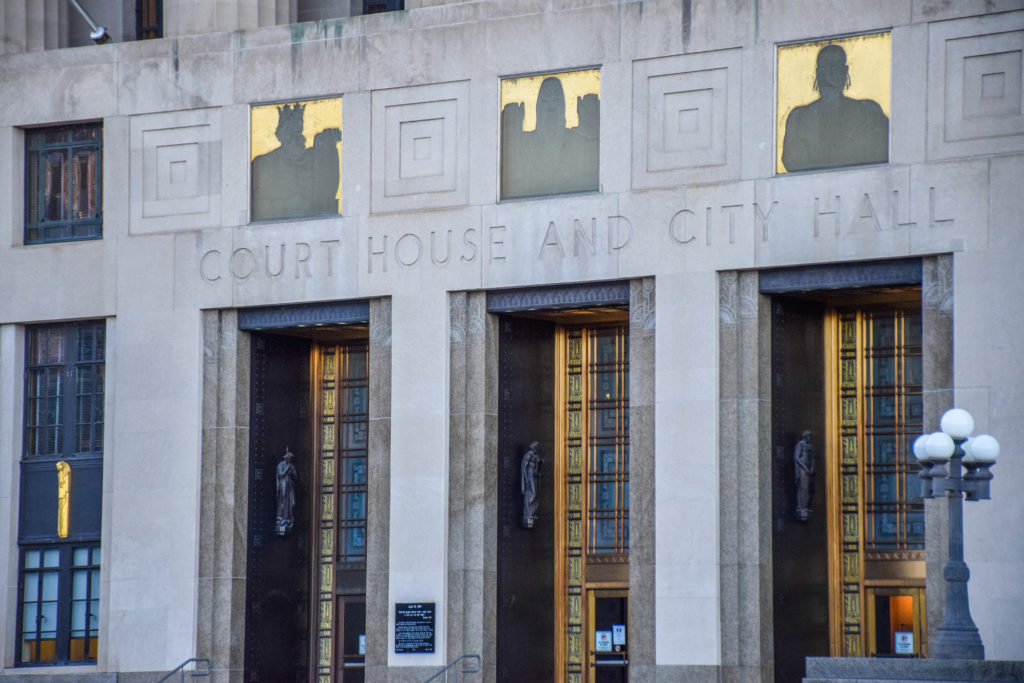
Visitors to Nashville’s city hall and historic courthouse must pass beneath its impressive facade. With its massive Doric pillars and limestone exterior, the courthouse looks like it comes straight from the Greeks. (Watch out Parthenon, there’s a competitor!)
One feature that catches the eye is the trio of gold panels above the front doors. These shiny yet mysterious portraits motivated a question to Curious Nashville:
What are the pictures on the front of the Metro Courthouse that appear to be outlined in gold? Are they ever going to be restored?
It so happens that this question came to Curious Nashville all the way back in 2016, during the first year of this project. As the series is now marking 10 years of answering questions, it is finally time to tackle this answer.
For starters, each picture shows a famous lawmaker. From left to right, the figures are King John, Moses, and Justinian. Each of these figures are historical representations of law and justice.
- King John of England signed the Magna Carta, a British document that established the ideas of a constitutional government under the rule of law.
- Moses received the Ten Commandments from God in the Bible.
- Justinian, a Roman emperor, established the Justinian code, a foundation upon which modern legal tradition has grown from.
Of note, there is a fourth golden panel. It’s on the back side of the courthouse facing James Robertson Parkway, depicting Lady Justice.
Anne-Leslie Owens, the public art collections manager for Metro Arts, describes in a 2020 interview that Lady Justice’s features include “a blindfold representing blind justice, a balance for weighing the evidence, and a sword, which could represent authority — and perhaps the fact that justice can be swift and final.
“Here, she’s even seen with an owl, perhaps representing wisdom.”
How were the panels made?
Each of these shiny gold panels are actually made of glass. Despite the opaque exterior, the panels appear as etched glass indoors. Crafted around 1937 by artist David Harriton, these panels were made with a fairly unique technique of that time: sandblasting. According to a 1944 Popular Science article on Harriton, sandblasting for art was a technology that was not widely available then.
Sandblasting is a process where high-pressure air is used to spray abrasive particles to etch the glass. Oftentimes, a stencil is put on the glass, and areas not covered by the stencil get blasted. Meanwhile, the glass that remains under the stencil stays untouched. The glass that gets blasted has a noticeable difference in depth, along with a frosted or textured look. This process can be repeated multiple times to achieve a three-dimensional and shaded look on the glass.
Moreover, Metro Arts research indicates that the gold on Harriton’s panels was achieved using gold leaf, which was attached to the panels using an adhesive.
A report from the agency in 2017 indicates that much of the history of the creation of these panels is unknown. They were created for the Metro Courthouse and installed in 1937 before being dedicated that same year. The report found that there isn’t much information on the commission or reasoning for Harriton’s choice of subjects.
Nashville’s Deteriorating Sculptures And Monuments Need Costly Repairs
Restoration plans?
The same 2017 report says the conditions of these panels were “poor/fair.” Extreme temperatures, as well as vibrations from downtown construction continue to pose a risk (PDF page 22-23).
The Metro Historical Commission has worried about the glasswork since 1988, and some breaks have occurred.
Moreover, the report states that the panels have “inadequate cushioning,” and they are covered in grime and “translucent paint.” The report stated that the treatment priority of the panels was “high”.
As for the maintenance and restoration of the artwork, there has been no effort in recent years nor any plan to do so at the moment, Owens said.
One factor could be the estimated $250,000 restoration cost outlined in 2017 — and that’s alongside a long list of sculptures and other artwork in need of attention.
Allyson Mao is a senior at Harpeth Hall. She completed this report while job shadowing at WPLN News.
 On Air - 90.3 WPLN-FM