


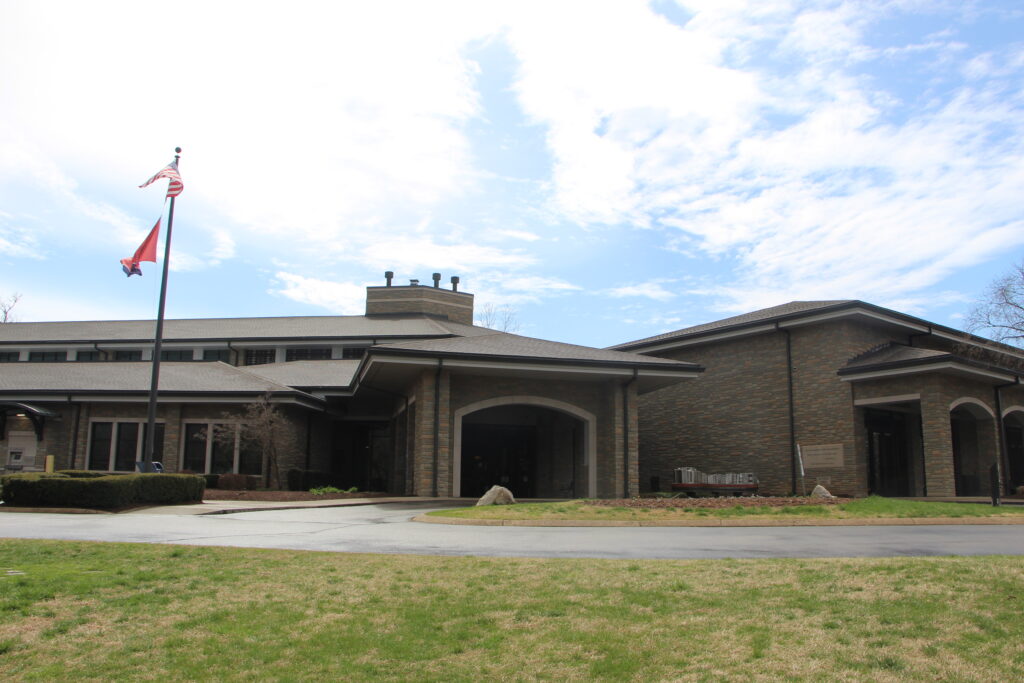
Much of Middle Tennessee’s important Native American history has been lost or disturbed by development.
This has prompted listeners like Kelly Cannon to wonder what’s been lost. She asked Curious Nashville about something she’d heard from a colleague:
“… that when the Brentwood Library was built, remains were found of ancient Mississippian people, along with evidence of ancient mounds. Is this true? Where were the bodies moved to? Who took responsibility for the remains?”
A discovery in 1997
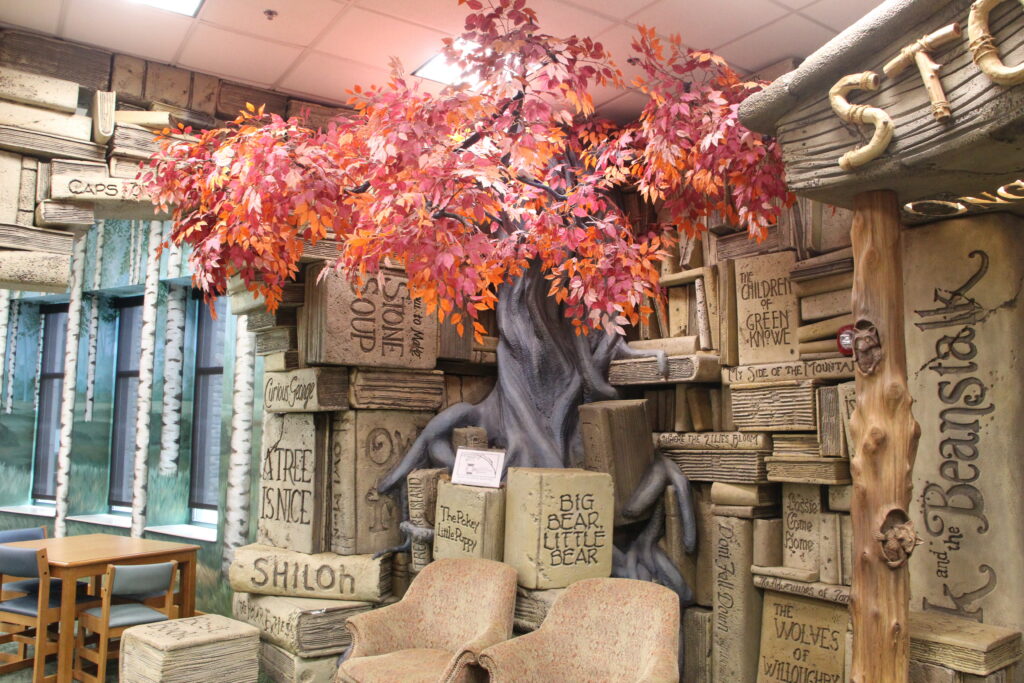
The Brentwood Library is impressive: Sunlight streams into the stacks through large windows, the children’s area is sculpted as an enchanted forest.
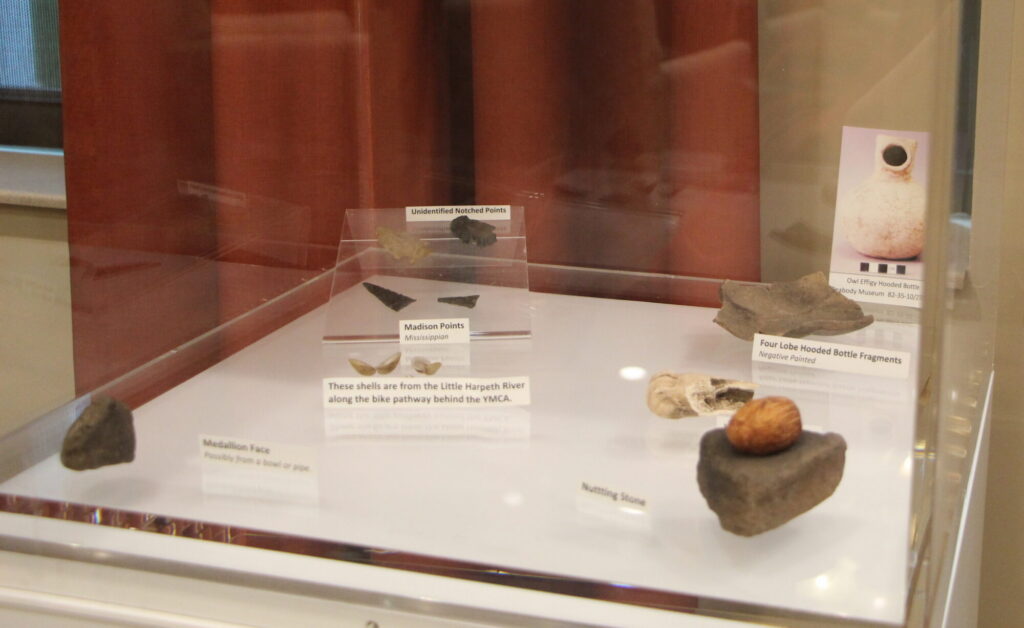
It might be easy to overlook something tucked into a display case in one of the meeting rooms. But the array of items — a tool to grind maize, a pottery shard, a whitetail deer bone, shells from the Harpeth River, a medallion face fragment, and arrowheads and knife points — serve as clues to what was once buried below: an entire Mississippian town.
 Cynthia Abrams WPLN News
The Brentwood Library features a whimsical children’s area, complete with an enchanted forest.
“Mississippian” refers to the era between roughly 1000 AD until contact between Indigenous people and European settlers. This was the era during which Indigenous people resided at the site of the Brentwood Library, as evidenced by things like homes, a protective defensive wall, fire pits and graves. These were discovered and documented in 1997, when the Brentwood Library was constructed.
“The common characteristics of a Native American town for this time period are a series of several dozen houses,” said Phil Hodge, the state archeologist and director of the Tennessee Division of Archaeology. “There were over 60 houses found here at Brentwood Library. In this particular case, it was surrounded by a wooden palisade protective defensive wall.
“And so, when you put all those things together, you have a concentrated group of people living at a single place for a period of time, and we classify that as a town.”
 Cynthia Abrams WPLN News
Some of the artifacts uncovered during construction are on display at the Brentwood Library.
So why was the library built? Were there important artifacts and burials?
Many people didn’t want construction to continue.
As detailed in a nearly 600-page report from 2005, when the city began construction in July 1997, they encountered stone box graves. Under Tennessee state law, all human remains are protected — it’s a felony to disturb or destroy them.
That left two options: redesign or get permission to remove the remains.
Because city officials felt they were too far along in the process, they sought the removal order. That was approved the following month, and then in September 1997 the Brentwood City Commission voted to move 58 of 78 graves on the 17-acre site.
This ran against the wishes of the Indigenous community, prompting daily protests and even the arrest of a protester.
Hodge, who worked on the Brentwood Library excavation as one of his first archaeologist jobs, remembers the opposition.
“Across the street, Native American community members were actively protesting the site every day,” he said.
Toye Heape, who’s now the vice president of the Native History Association, was one of the protesters. He said the group was asking for design adjustments to prevent the removal of remains.
“We weren’t asking them to stop constructing the library,” Heape said. “I mean, it would’ve cost a little bit more to do that with the parking lot, accommodate the burials, but considering the importance of the of the site, we thought it was worth it. But in the end, they decided that they just couldn’t do that.”
Tom Kunesh, the president of the Tennessee Ancient Sites Conservancy, works to protect Indigenous sites. He wasn’t present at that time, but says his first reaction to the existence of the Brentwood Library is “sadness.”
“It’s like a gut punch,” Kunesh told Curious Nashville. “Then there’s anger and then a lot of hopelessness. And what can what can we do? We can organize … to protest these developments and they did a really good job. But Brentwood was built.”
Ultimately, under the supervision of the Chickasaw Nation, the disturbed remains were reburied at an undisclosed location. Heape said this can be a difficult process.
“The favored place to rebury them is at or near where they were originally buried, but that’s not always possible,” he said. “They had to figure out which ceremonies they wanted to perform because most tribes didn’t have a reburial ceremony, so they have to adapt for that. It’s complicated for them.”
The first ‘plundering’
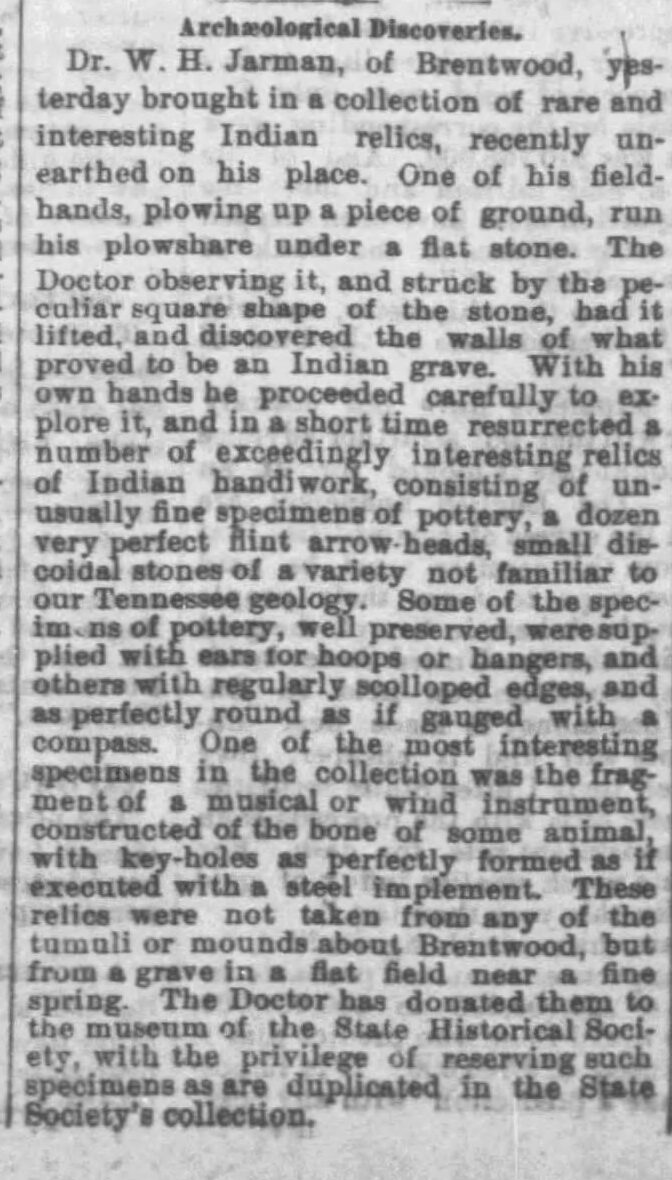
Jarman’s discoveries were detailed in local Nashville newspaper the Daily American in 1881.
The 1990s library construction wasn’t the first time Indigenous remains had been disturbed where the library now stands.
The land had been disrupted back in the 1880s, when Confederate Captain-turned-doctor William Jarman purchased the land and soon encountered stone box graves.
Jarman didn’t just leave them there. He contacted a local newspaper, the Daily American. The paper’s editor encouraged Jarman to reach out to powerful Harvard anthropologist Frederic Ward Putnam. In 1882, Putnam traveled to Tennessee to excavate.
“They were going through and finding these towns, these mounds, and by today’s standards plundering them, focused solely on the graves,” Hodge said.
These remains and artifacts have been held by Harvard for more than a century.
Repatriation efforts
This local controversy ties into a nationwide failure to return looted artifacts and graves back to the tribes.
Repatriation has been required by federal law since 1990, but reporting by ProPublica finds that many institutions resisted for decades.
At the time of ProPublica’s 2023 investigation, Harvard’s Peabody Museum — where findings from the Jarman Farm excavation ended up — held the remains of more than 1,000 Native Americans.
That reporting also revealed that the University of Tennessee Knoxville was one of multiple institutions thwarting the repatriation process by categorizing everything in their collections that might be subject to the law as “culturally unidentifiable.”
The database with The Repatriation Project shows more than 11,300 Native American remains were taken from Tennessee, and that more than 3,000 have not been made available for return to tribes.
Listen to an extended conversation on repatriation and preservation from This Is Nashville:
“A lot of institutions, especially those with big labs and lots of resources, often wanted concrete, beyond-a-doubt evidence to return ancestral remains,” Mary Hudetz, one of the investigative reporters behind The Repatriation Project, told Curious Nashville. “At the same time, tribes are saying, ‘Look, in many cases, we lived on this land for however many centuries or thousands of years.’ Those people come from the same land. We have different parts of our culture that clearly replicate.”
Disruptions continue
In 2024, some NAGPRA loopholes were closed, speeding up repatriations. And, at Harvard, the Peabody Museum is working to return the artifacts from Brentwood to the tribes.
When state archaeologist Phil Hodge thinks about development projects today, he says the approach has evolved.
“That’s been the big lesson learned from those — all of those projects in the 80s and 90s and early 2000s that ended up impacting sites and having these graves or other kinds — developers have come to understand that it is cheaper to avoid impacting these resources if it’s possible,” Hodge said.
There’s also the work of Tom Kunesh and the Tennessee Ancient Sites Conservancy, advocating for private landowners to protect sites through cultural conservation easements.
“Sites are lost because private landowners own it,” Kunesh said. “And there are many places where towns have been discovered.”
Kunesh also advocates for improved educational signage at places of Indigenous importance, as well as encouraging communities that historically resided here to return.
“I think the greatest problem that we have is that we don’t have Indigenous representatives of the Yuchi and Muscogee people here in Nashville,” Kunesh said. “So there is a national movement for ‘land back,’ as we talk about ‘language back’ and ‘culture back,’ ‘religion back.’ ”
Yet development continues to disrupt Native sites:
- remains were removed to make way for Moss-Wright Park in Goodlettsville in 1977;
- artifacts were removed from the site of the Sounds baseball stadium in 2014, and;
- Native activists have sounded the alarm that construction of the Oracle campus along the Cumberland River could disrupt possible burials sites.
The Brentwood Library project is not alone, and what happened is not easily forgotten: Indigenous remains may have been buried for centuries, but that “final” resting place wasn’t to be.

 On Air - 90.3 WPLN-FM