

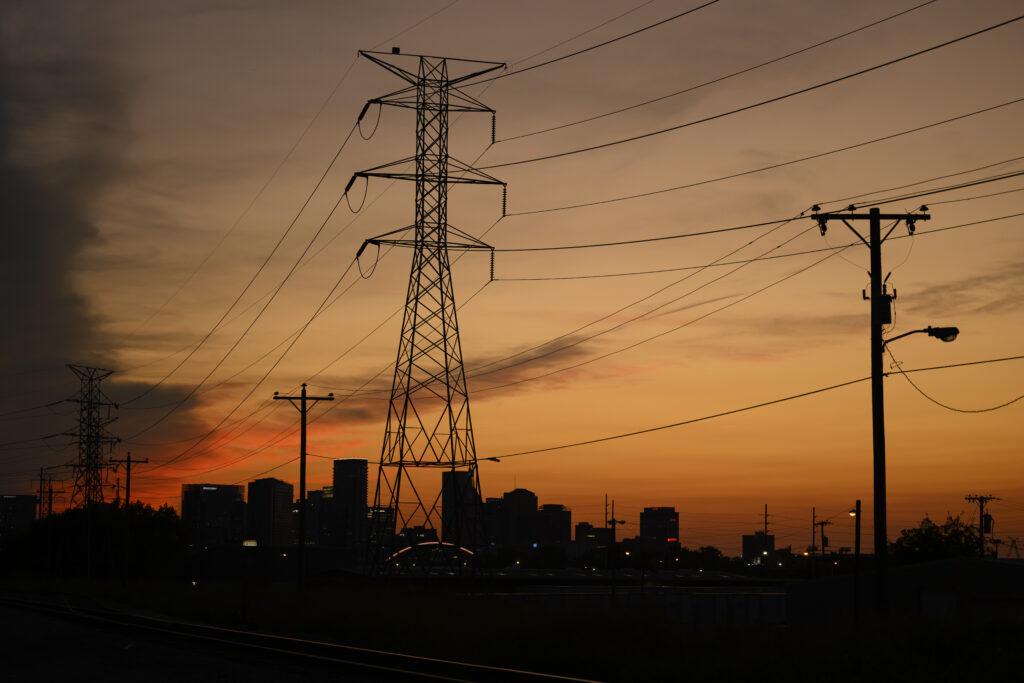
In the aftermath of Winter Storm Fern, when hundreds of thousands of Nashvillians lost power — some for more than a week — several people asked Curious Nashville some form of this question:
“What would it take to bury power lines in Nashville?”
And, this week, Nashville Electric Service has taken a step toward evaluating the possibility of moving some lines underground. The NES board voted to allocate $3 million to a three-year contract with Burns & McDonnell to conduct a systemwide study of “undergrounding” and grid hardening.
“[It] will determine where undergrounding is most effective and if a broader expansion is financially sustainable,” NES said in a statement to WPLN News.
Separately, the utility is also launching four neighborhood pilot programs for underground power later this year. The NES board will decide in May on the location and funding of those pilots.
But utility experts, like Wade Sexton, a Knoxville-based board member of the National Utility Contractor’s Association of Tennessee, say that switching to underground power lines is not that simple.
Undergrounding pros and cons
Overhead lines are the significantly cheaper option — which is why they are what we see predominantly around Nashville and across the country.
“Electricity has always been a quality of life issue — you know, it needs to be affordable and we’ve got to get it to everyone,” Sexton told Curious Nashville. “Overhead is always going to the be the least cost to install, least cost to maintain, least cost to repair.”
When utilities want to pursue buried lines there are two main components: migrating the main lines, which run along the street, as well as burying the lines that connect to individual houses.
Depending on the decision of a utility company, homeowners can be on the hook for the cost of connecting the home to the main. And, even if they don’t have to pay for the wire, they often have to front the cost of the conduit installation at their homes — and that’s one of the largest costs, Sexton Said, especially given Nashville’s topography.
“These utility companies, they’re not profit centers,” Sexton said. “They don’t generate any profit. They just pass everything through. So if I spend money on you, I’ve got to go get it from someone else.”
Big ‘B’
In his 30 years, Sexton says he’s never seen any utility pursue a total system switch to underground lines. In urban areas, he estimates the cost at up to $2 million per mile to go underground for the main lines. With thousands of miles of electrical lines in a place like Nashville, the overall cost would be well into the billions.
“It gets into the multi-digit billions … a big ‘B,’ ” Sexton said.
Burying lines is also not as effective without 100% buy-in from complete neighborhoods. Because if some areas or houses opt to remain on overhead lines, storm outages that take out overhead lines could still cause outages.
“So you’ve done everything to get your neighborhood put underground, but the next guy didn’t — and your power is still out,” Sexton said.
New construction is the instance where buried lines can have the most payoff. NES has buried lines in newer developments and some parts of downtown.
But, even then, they’re not foolproof: Underground lines also require upkeep. While they don’t require post-storm servicing like overhead lines, those underground don’t have the same lifespan as overhead cables, and servicing can be invasive.
Coupled with the cost, Sexton says, undergrounding isn’t necessarily a fix all in the aftermath of a big storm.
“20-year storm — do you invest double digit billions of dollars to try to fix that?” Sexton said. “Which would probably, obviously, have a significant impact on your [electricity] rates. I know everyone wants to hear that ‘Hey, let’s put it all underground.’ And I’ve been there, I’ve done it, I’ve tried to push these pilot projects through and they just seem to falter when you have to start getting everyone to contribute and it would take so long for them to see any real benefit from them.”

 On Air - 90.3 WPLN-FM