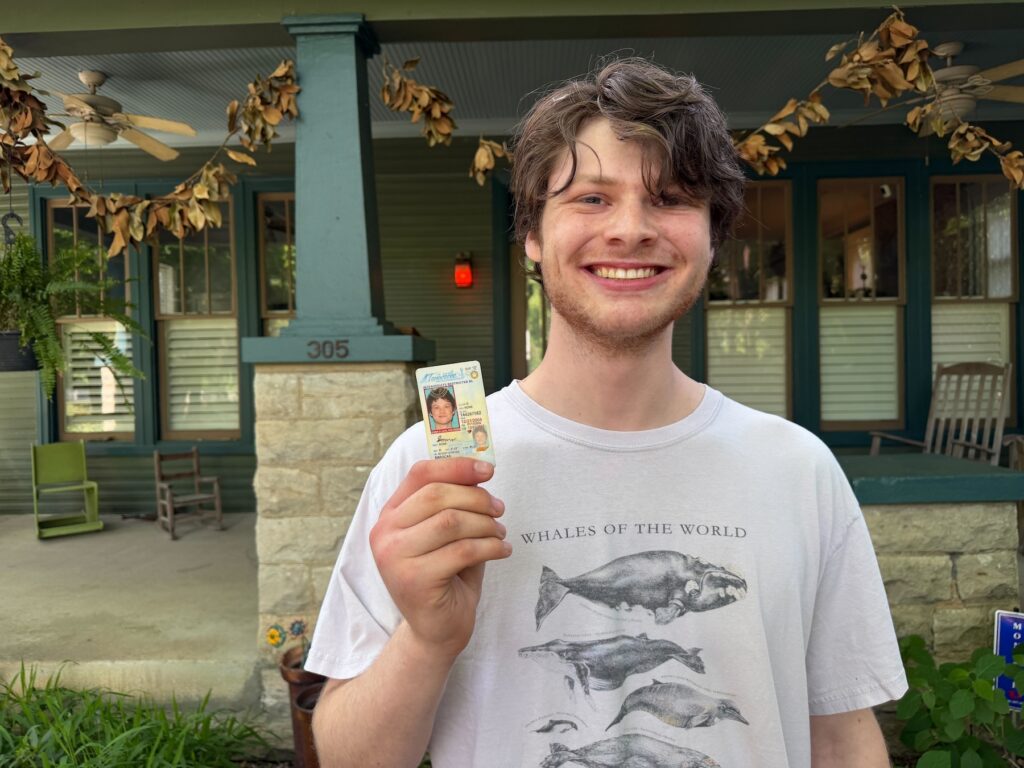
One afternoon, in an act of procrastination, 21-year-old Sam Barocas threw his Tennessee ID under a microscope and made a surprising discovery.
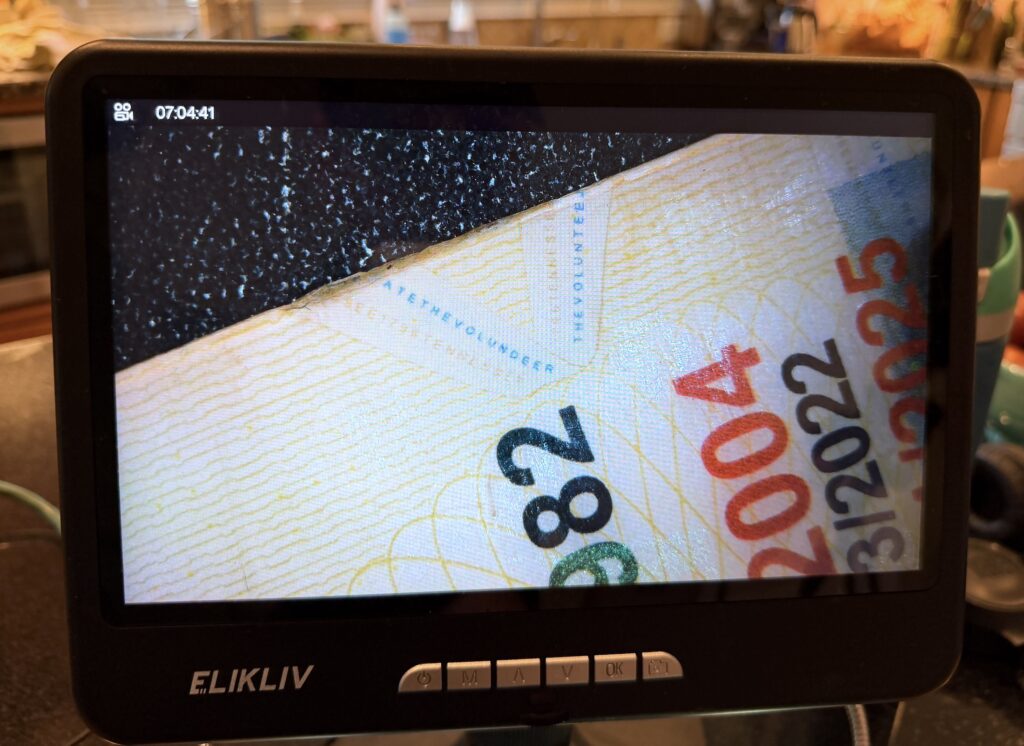
Throughout the license there is microtext that repeats, “The Volunteer State.” But in a ribbon next to his driver’s license number he found what appeared to be a typo. It reads, “The Volundeer State,” with a ‘d’ instead of ‘t.’
“That’s weird,” he thought. “Why is there a typo?”
 Justin Barney WPLN News
Some designs of the Tennessee driver’s license included a “typo” that refers to the “Volundeer” state. Curious Nashville sought to find out why.
Sam had three theories:
1. It’s a typo. There are dozens of lines of microprint script on the license. Maybe the person putting it together didn’t have an editor. It’s possible.
2. It’s intentional. IDs have become complex documents that have numerous security measures. Maybe the typo is one of them. But then, how would someone catch that? Is a bartender on Broadway pulling out a microscope to catch an underage tourist trying to slip into Tootsies? And wouldn’t the typo be transferred over to copies or scans?
3. It’s something fun. Maybe the person who designed it was bored — hunched over a desk, typing “The Volunteer State” over and over and decided they would include a little easter egg. A signature. Perhaps in hopes that, 15 years later, some bored kid would throw it under a microscope, see their work, track them down, and lets them know that their work has been noticed. Sam hoped for this one.
He put in the research, too. He found that this license was first announced in 2011 and was issued until 2024. It is currently being replaced. But even so, he calculated that upward of 10 million Tennesseans had an ID with a typo on it. The design is used on gun permits too. Over a million of those have been issued since 2011.
Curious Nashville: No progress on adding more languages for Tennessee’s drivers tests, but pressure is growing
He did have a bit of a lead. He found that the government office responsible for driver’s licenses is the Tennessee Department of Safety and Homeland Security. In 2011 the driver’s license design was announced under former Commissioner Bill Gibbons. He sent an email. Nothing.
So where to turn? Curious Nashville.
Finding the fine print
The first thing we did was to reach out to the agency. That led to a couple dead ends and unanswered emails, but there was a promising call. A spokesperson suggested that it was a security feature.
“I don’t think they are going to talk to you,” said Jason Pack, director of communications for the Department of Safety & Homeland Security.
In the call, he mentioned that they do not design the IDs in house. That design work out gets contracted out to the company IDEMIA.
“IDEMIA Public Security is a government contracting organization most people have never heard of before,” says Lisa Shoemaker, senior vice president for corporate relations at IDEMIA.
Getting someone to talk on record about security features on government documents felt like a small miracle. We’d been warned — reasonably — that too much detail about security features can undermine them.
And IDEMIA is cautious. Since state of Tennessee is a client, they couldn’t speak directly to the specific design, but could speak broadly about how they work and what they do — which is a lot.
IDEMIA says it’s responsible for 75% of all driver’s licenses issued in the United States. They own 36 of 50 state ID contracts.
More than that, they have been in the business for a long time. They are headquartered in France and operate on a global scale. Driver’s license design is just part of what they do. They develop credit card security chips, handle finger printing and have developed facial recognition technology.
This is when we get as close to our answer as we can.
‘Anything is possible’
Without actually speaking to the Tennessee driver’s license itself, Shoemaker said that there are many small security measures embedded within driver’s license designs to prevent fraud.
Counterfeiting isn’t only practiced by producing fake IDs to get into bars. White collar criminals forge and copy IDs to steal identities. There are places outside of a bar where people present their IDs, like at an airport. TSA takes the ID and puts it in a scanner that reads all the embedded security measures, as small and microscopic as some can be.
Also, the design is done by committee. It is not one guy in a room. She said that the designs go through rounds of redesign where multiple eyes are on the smallest details.
As to the single designer Easter egg theory, Shoemaker says, “Anything is possible. But I would tell you that there is much strategy and design and engagement from our state partners when these designs are happening. And that everything that you’re seeing or even not seeing in those cards is very much put there by design.
I would trust that the experts are doing what they know and are trained to do. Which is ensure that we are able to partner with the states to provide the most secure government-issued documents to hopefully protect folks’s identity as best we can against the bad guys.”
“So you’re not saying that it’s totally not possible,” I offered.
“I’ll just have to leave that up to yours and your listeners’ imagination,” she said.

 On Air - 90.3 WPLN-FM