

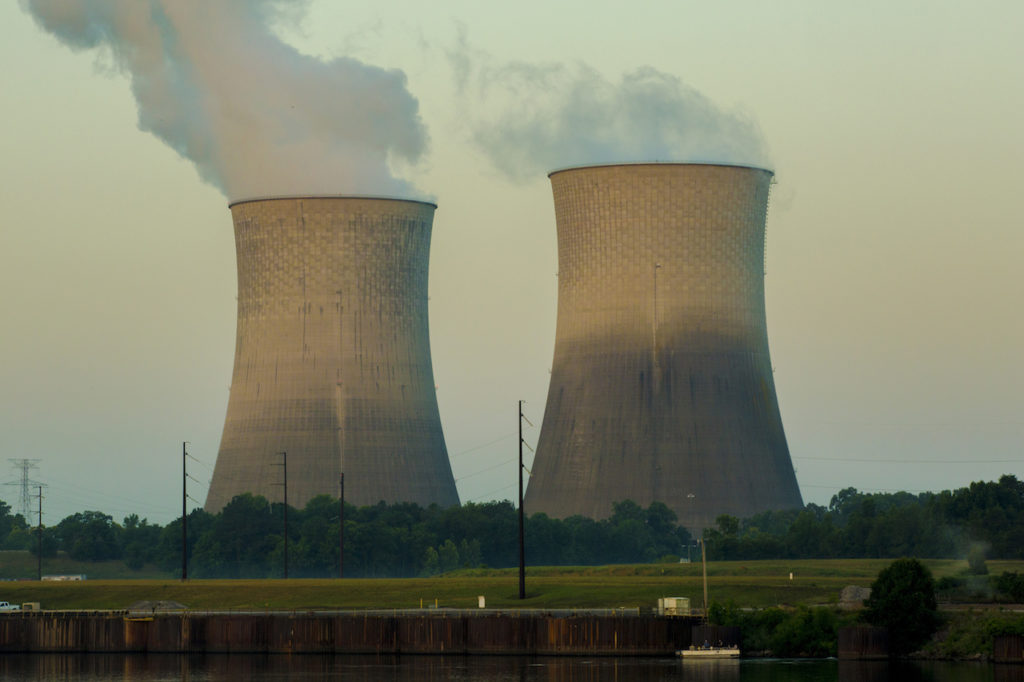
The Nuclear Regulatory Commission has granted its first operating license in nearly 20 years to run a reactor. The Tennessee Valley Authority will soon begin loading radioactive fuel, which is already being stored on site, into a protective vault.
The Watts Bar power plant, on a remote site in Spring City, has been under construction for more than 40 years. Work was abandoned in 1988 as public fears surged surrounding nuclear power.
CEO Bill Johnson addressed those lingering concerns standing outside the TVA plant at a press conference Thursday.
“Bringing a nuclear plant brings with it substantial responsibility. It’s one of the most profound responsibilities you could have in this life,” he said. “As we put to work the genius of people like Rutherford, Chadwick and Einstein and Fermi, our highest priority today — and will always be — the safety of the public and the safety of the people who work here.”
Watts Bar has two reactors. The first was completed in 1996. Before now, it was the
last unit in the country to get an operating license.
More:
See detailed timeline for Watts Bar Unit II construction
Unit II construction didn’t go smoothly, even after the restart in 2007. The original budget of $2.5 billion turned into $4.5 billion, and the completion date was pushed back several times. A TVA spokesperson says the project is still expected to come in under the $4.5 billion estimate.
The reactor will ramp up in the coming months before hitting full power early next year.
“We’ll do several tests including shutting the plant down safely several times to verify equipment is working correctly,” said Mike Skaggs, who oversees construction at Watts Bar.
While TVA is hailing the milestone, critics who would prefer investments in wind and solar power say there’s nothing to celebrate.
“This dinosaur of a reactor was supposed to be generating electricity in 1977 and TVA failed to bring it online on time and on budget,” Stephen Smith, of the Southern Alliance for Clean Energy, said in a statement. “The Watts Bar Unit 2 project…serves as the poster child for all that was and is still wrong with the nuclear power industry and the utilities that continue to ask ratepayers to support this extremely risky, expensive technology.”


 On Air - 90.3 WPLN-FM