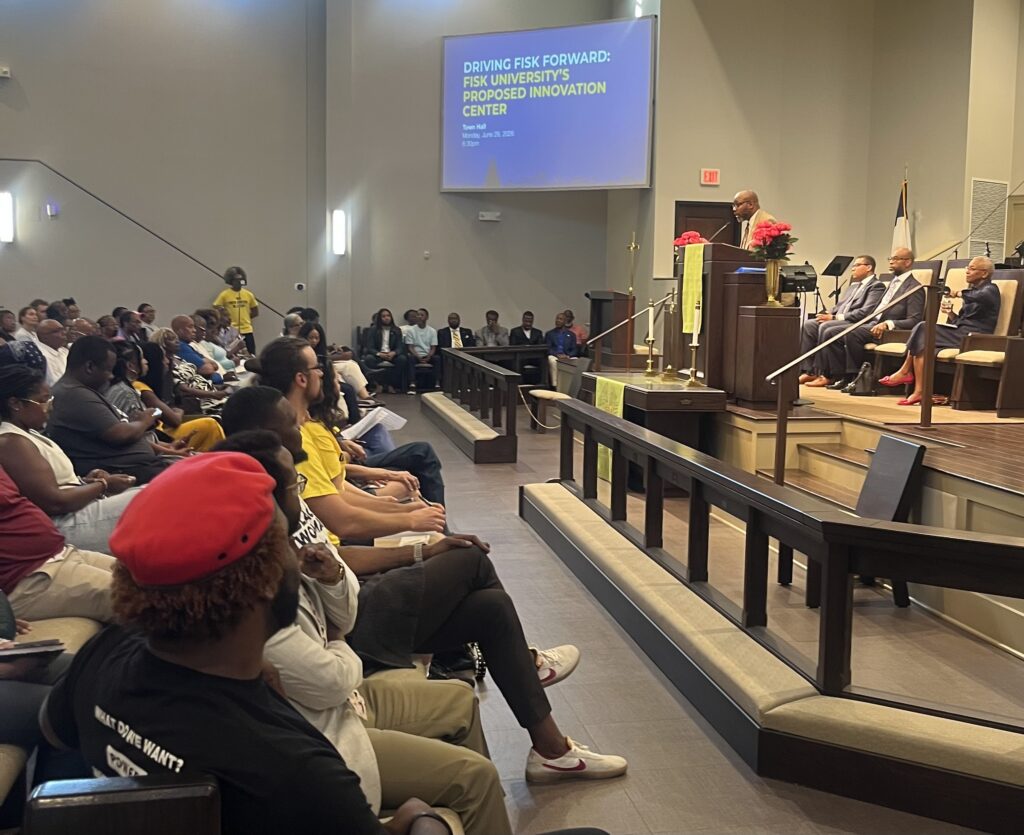
Hundreds turned out Monday evening seeking answers from Fisk University’s president and local lawmakers about their plans to ensure that a proposed data center won’t bring environmental harm to the North Nashville community.
The tense town hall at Lee Chapel A.M.E. Church came about six weeks after Fisk announced plans for a billion-dollar renovation project – dubbed the “Quantum Leap.” The plan includes a new academic center, revamped dormitories and a data center on campus.
Opposition was immediate – spurring a petition signed by thousands who argued that Black neighborhoods are routinely targeted by harmful infrastructure.
Fisk University President Dr. Agenia Clark told the packed crowd that not all data centers are created equal, Nashville is home to many – both good and bad – and what’s planned for Fisk is distinguishable from another facility proposed near the Nashville Zoo.
“I will tell you that it was the advent of the zoo project that seemed to have triggered an interest in what Fisk was doing,” she said before praising Mayor Freddie O’Connell who filed legislation on Monday seeking eminent domain on the South Nashville property near the zoo where a company is attempting to construct a data center.
Clark once again pledged that Fisk’s facility will be LEED certified, which stands for Leadership in Energy and Environmental Design. This is a grading system that rewards investment in sustainable and environmentally conscious technology.
She also referred to it as an “innovation center” and stressed that it’s just one component of a campus master plan designed to attract high quality students and help sustain Fisk’s financial future. Clark also pushed back against criticism that the private historically Black university should focus on other revenue generating avenues – stressing the challenges of fundraising.
‘There’s some education that needs to happen’
Many of the proposed data center’s detractors have cited a lack of transparency as the main culprit for their dissatisfaction. The town hall left many questions unanswered – most notably, what kind of data center it will be and who’s providing the funding. Clark previously told WPLN News that claims it will be an AI data center are false and that the university is meeting with potential funding partners to find the right fit.
She also vowed that Fisk won’t be selling any land – garnering applause from the audience.
However, some members of the crowd, like community organizer Poet Williams, took issue with not being allowed to directly ask questions. Rather, people were told to fill out questionnaires which the moderator read aloud. Still, Williams told WPLN News that he’s interested in learning more about the different kinds of data centers despite being one of about a dozen people wearing bright yellow t-shirts that read, “No Data Centers in 37208.”
“I came out because a lot of the things that I know about data centers are bad, right? So, there’s some education that needs to happen,” he said. “So, I’ve been sitting there and I was like, ‘Well, maybe the shirts should say no bad data centers, right?’ “
Another attendee, Jane Hussain who works with the Nashville Peace and Justice Center, said she doesn’t feel like Clark provided enough information about how the project will play out.
The uncertainty surrounding Fisk’s proposed data center is why Sen. Charlane Oliver, D – Nashville, said that she could not support it at this time because she does not know enough about it and is unsure if it will harm her constituents.
However, she along with Rep. Harold Love, D – Nashville, won’t go as far as proposing legislation that outright bans data centers in North Nashville. Love, who pastors the church that hosted the town hall, said these facilities come in many forms so banning them altogether wouldn’t make sense.
The panel noted that more community town halls are in the works and there is a public hearing about data centers on July 7.

 On Air - 90.3 WPLN-FM