

The state’s largest health insurance carrier, BlueCross BlueShield of Tennessee, will no longer offer coverage for about 130,000 customers in the state’s urban areas.
This decision affects people who buy their own coverage, either on the federal Marketplace or independently, in the regions around Nashville, Knoxville or Memphis. It will not affect people who buy insurance through their employer, the company says.
In total, the change means that one-third of people in Tennessee who buy insurance on the Marketplace will have to find a new plan under a new carrier, or they’ll be automatically moved over an alternative option.
BlueCross’s Reasoning
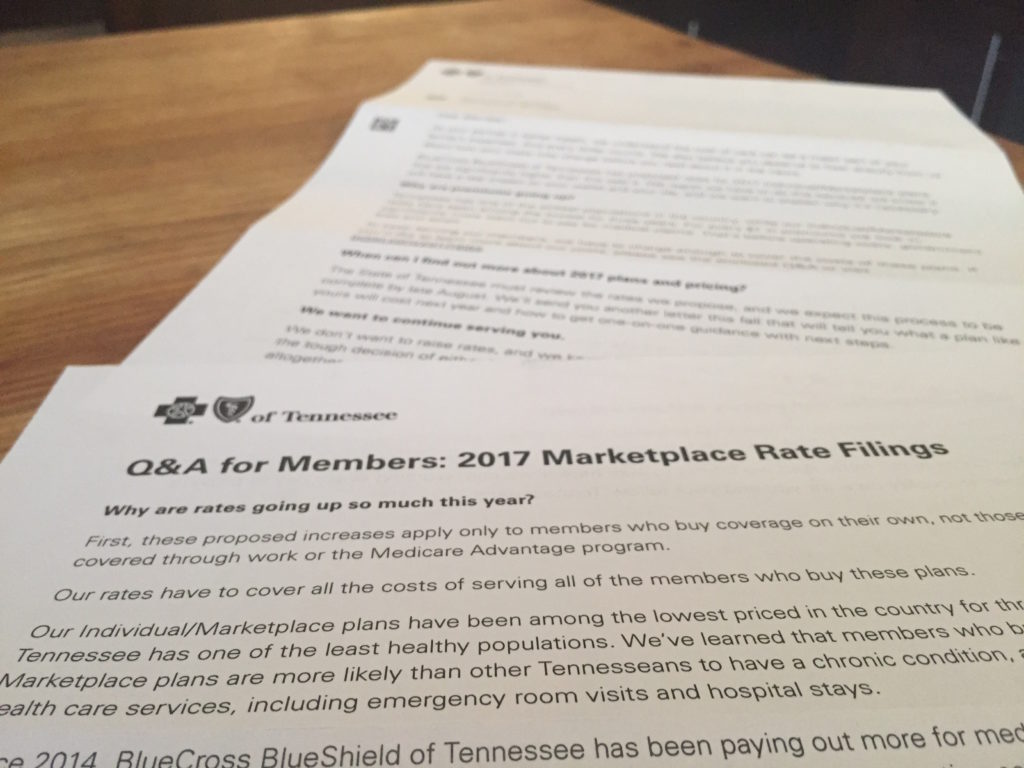
The insurer had said earlier this year it intended to raise rates by almost two-thirds. Its justification for the hike was that it was losing too much money to be financially sustainable, a point that the company reiterated in a statement Monday.
But Roy Vaughn, chief communication officer at BlueCross, says the company has also decided it’s facing too much uncertainty. He points to pending lawsuits and the upcoming election, saying changes stemming from those could lead to even bigger financial losses.
So rather than raising rates more — because “no one was happy about what we asked for in the beginning,” Vaughn says — BlueCross will simply stop providing coverage on Healthcare.gov in certain regions while it waits out the changes.
“This is essentially pushing ‘pause’ for at least some of the state,” he says.
The decision is not a total exit. The company will consider getting back into the Affordable Care Act game in 2018, Vaughn says, and it will continue to offer coverage in regions of the state where there are no other insurance carriers. But in the Nashville area, customers will have to switch to Cigna or Humana.
Customers’ Next Steps
This change was surprising but not entirely unexpected for Sandy Dimick, the program director of Get Covered Tennessee. The organization helps people sign up for coverage on Healthcare.gov.
She says switching plans has become almost routine for many consumers. Insurers have been popping in and out of the Marketplace ever since the Affordable Care Act passed in 2014.
“We’ve kind of been through this back-and-forth before,” she says. “There’s that last-minute change of what’s going to be available and what’s not this year.”
But the switch still presents a challenge: People might be forced to change doctors to stay in-network. Dimick says one of her organization’s top priorities now is to try to help doctors covered by BlueCross get credentialed under Cigna and Humana, too.
“Once physicians realize that they may be losing a lot of their patients, they’re going to go ahead and do the credentialing to become providers of these other carriers,” Dimick says.
The Future Of The Marketplace
This change follows months of discussion at the state-level about how much insurance carriers should be allowed to charge customers next year.
Insurance commissioner Julie Mix McPeak has defended Tennessee’s decision to approve the rate hikes, saying the alternative — having fewer options for health insurance — was worse. She said last month it would force the remaining insurers to pick up extra customers, which could lead more companies to drop out of the Marketplace.
Cigna did not respond to a request for comment, but in an email to WPLN on Monday, a Humana spokesman said the company “is currently in discussions with state and federal regulators following BlueCross BlueShield of Tennessee’s decision.”

 On Air - 90.3 WPLN-FM