
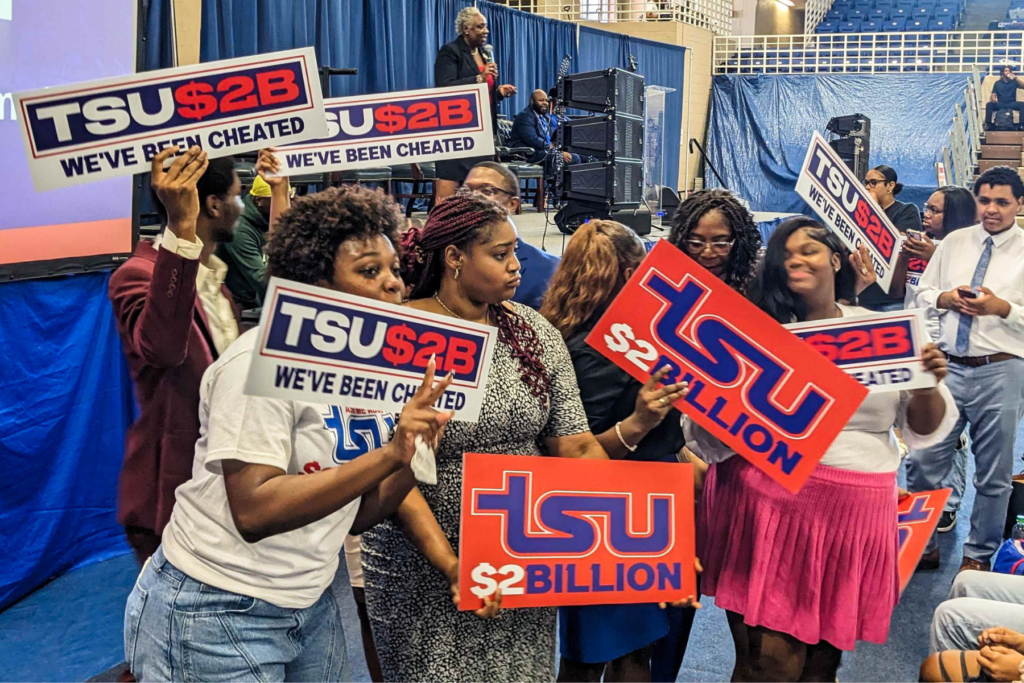
Former students of HBCUs have filed the first of several lawsuits against states for underfunding these schools by billions of dollars. Tennessee is one of the states that could face litigation.
A 2023 federal analysis showed that 16 states, including Tennessee, had underfunded their historically Black land grant universities by billions of dollars. In September 2023, the U.S. Secretaries of Education and Agriculture sent letters to the governors of these states urging them to rectify this chronic underfunding, which amounted to a total shortfall of $12.6 billion.
A group of attorneys with HBCU connections deemed this correspondence as a public record and formed the 1890 project to seek a legal remedy for this debt. Don Calloway, the group’s founder and lead counsel, told WPLN News that he hopes some of these cases can be resolved through settlements.
“We’ve opened conversations with every state,” he said. “We hope that the states are willing to negotiate and settle with us, understanding that the constitutional violation is there and the facts are there to support the violation.”
Land grant universities and lawsuits
In the late 1800s, Congress donated land or money to states so they could build colleges. These land grant universities, however, did not accept Black students, so Congress passed legislation – the Morrill Act of 1890 – requiring states to either admit Black people or establish separate schools for them. This led to the creation of many of the country’s historically Black colleges and universities – also known as 1890 institutions.
Federal law requires states to provide equitable funding for their land grant universities, but most states shortchanged their HBCUs, according to archival state budget records and data from the National Center for Education Statistics.
This is the crux of the 1890 Project complaint, which alleges violations of the Morrill Act of 1890, the Equal Protection Clause of the Fourteenth Amendment and Title VI of the Civil Rights Act of 1964.
The first lawsuit, filed Wednesday by former students and alumni of Lincoln University, sues the state of Missouri, the governor of Missouri, that state’s higher education coordinating board, the state’s commissioner of higher education and workforce development and the University of Missouri’s president.
They allege that the defendants intentionally discriminated against them on the basis of race “by funding Lincoln University, the institution Missouri designated for Blacks” at a lower level than the University of Missouri, the school’s other land grant university.
The plaintiffs claim that underfunding led to deteriorating buildings, absent of hot water, outdated computers, low-nutritional meals on campus, leaking plumbing, unsafe electrical wiring and insufficient staff to address the mental health needs of students.
They’re asking the state of Missouri to acknowledge that it failed to properly fund Lincoln, begin allocating the required funding, and provide plaintiffs with monetary damages for the diminished value of their education caused by underfunding.
‘Civil rights are enforced in the federal courts’
Students at Tennessee State University have made similar complaints over the years, and WPLN’s podcast special “The Debt” explored the HBCU’s decades-long fight for fair funding.
Federal data shows that Tennessee owes TSU $2.1 billion, which is more than the amount any other southern state shortchanged its HBCU. This is based on the disparity in state’s per pupil spending at its two land grant universities – TSU and the University of Tennessee, Knoxville – between the years 1987 and 2020.
As a land grant university, TSU gets federal funding for programs like agriculture and science, and the state is required to match it. However, between 1957 and 2007, Tennessee provided no matching funds for TSU, but always allocated its required funding, and sometimes more, for UT.
Republican state lawmakers largely ignored the federal underfunding data. Instead, Tennessee’s legislature determined that the state owed TSU $544 million using a different calculation based on state matching funds. Subsequently, Gov. Bill Lee appropriated $250 million for TSU to make infrastructure improvements in 2022.
Calloway said that’s a start, but doesn’t come close to fully covering the state’s debt to TSU based on his calculations, which consider both state matching funds and per-pupil spending. This is why, he said, the legislature – subject to budget restraints and agendas – isn’t always the best choice for recourse.
“Civil rights are enforced in the federal courts. It’s just that simple.” he said. “The constitutional rights of the current students as well as the alumni of Tennessee State University aren’t dependent upon the legislature’s political will to get things done.”
Calloway said he’s been in talks with Tennessee Attorney General Jonathan Skrmetti and hopes that a lawsuit against the state won’t be necessary.

 On Air - 90.3 WPLN-FM