
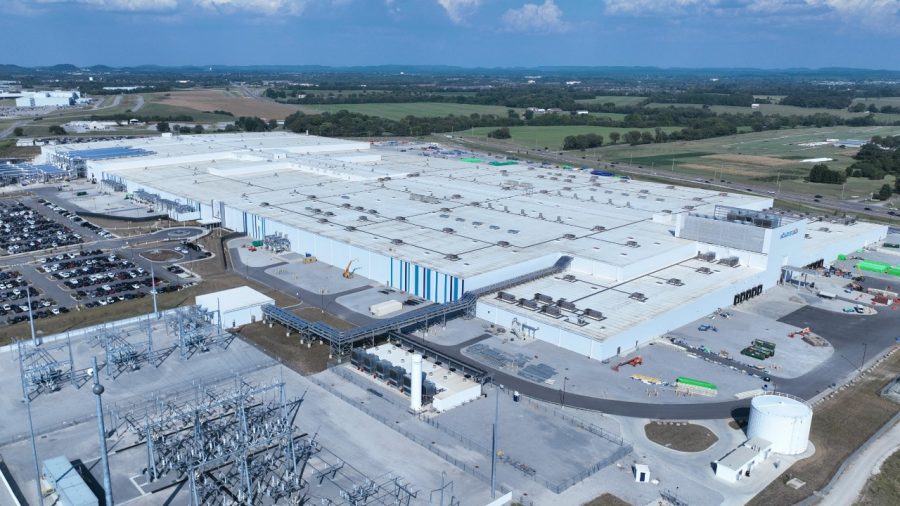
A manufacturing plant in Spring Hill will soon debut a new type of battery for electric vehicles.
Ultium Cells, a joint venture between General Motors and battery manufacturer LG Energy Solution, is transforming its factory to produce batteries made primarily of manganese.
Globally, most EV batteries are made from lithium iron phosphate. The lithium batteries with the longest driving range also have cobalt and a high concentration of nickel, which is more expensive. At GM, the Chevrolet Silverado EV currently boasts the longest range, up to 492 miles, and has a battery with as much as 85% nickel.
More: Volkswagen ‘dieselgate’ payout continues to fund EV charging in Tennessee | WPLN News
GM will now also make what are called prismatic lithium-manganese-rich (LMR) batteries, which have a concentration of about 65% manganese and 35% nickel. LMR batteries have a higher energy density than traditional lithium batteries, but they cost less than high-nickel batteries, according to the company, which said the Spring Hill factory will be the world’s first to produce LMRs at scale.
“High-nickel batteries will continue to give customers the highest range in our portfolio, while adding LMR positions us to leapfrog today’s more affordable chemistries and deliver lower costs with better performance,” Kurt Kelty, GM’s vice president of battery and sustainability, said in a statement.
GM is the second-largest EV seller in the U.S. after Tesla. The company plans to install LMR batteries in full-size trucks and SUVs that could offer a range upwards of 400 miles.
The facility expansion at Ultium Cells in Spring Hill will begin later this year and is expected to wrap up in 2028 at a cost of about $1 billion.
A tumultuous time for EV and battery companies
Ultium first announced the plant in 2021 with 1,300 jobs and added an expansion in 2022 with 400 additional jobs. Last October, the company temporarily laid off 700 workers in Spring Hill amid a broader staff reduction as GM reduced EV production. The move came just one month after Congress and President Donald Trump ended a $7,500 federal tax credit for buying or leasing new EVs — and GM’s sales have since dwindled. (The market for used EVs, in contrast, has continued to grow in the U.S.)
In March, Ultium announced that the furloughed employees would return to the plant to help launch a line of lithium batteries for energy storage systems to help with electricity demand from data centers. Ultium plans to employ 500 more people for LMR production, adding to its current staff of 1,200 people.
The broader manufacturing landscape has changed significantly in recent years. The Inflation Reduction Act passed under former President Joe Biden set up funding streams for numerous clean energy and manufacturing projects — Tennessee attracted $7 billion in clean energy business, more than 80% of all capital investments, during the first year of the law. The Trump administration has since attempted to claw back much of this promised funding, leading to thousands of disrupted projects nationally.
Dozens of planned projects in Tennessee lost taxpayer support or were stalled or cancelled, according to the Bluegreen Alliance’s latest tracker, representing a significant loss of investments.

 On Air - 90.3 WPLN-FM