
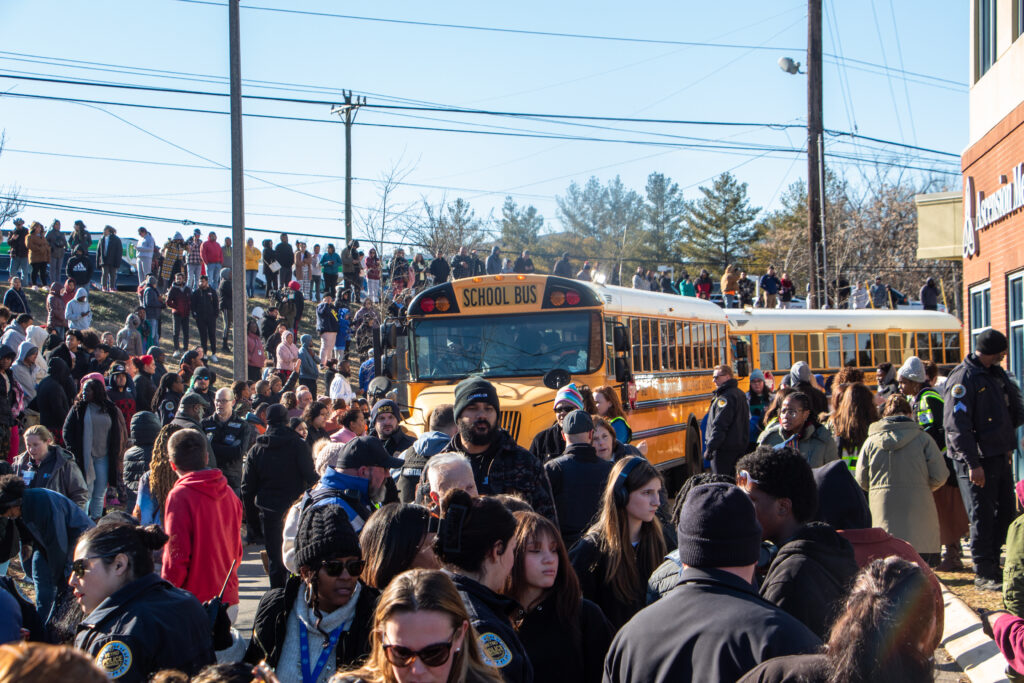
The memories in Antonyous Henin’s mind are still fresh more than a year later.
He was living through an average day at Antioch High School. He worked through some homework and walked to the cafeteria for lunch. That’s where he spotted another student he thought needed support.
He didn’t know the student had a gun.
“I looked at him again, and I decided to help him. When I just looked at him, he just shot me — for no reason,” Henin said.
Continuing coverage: Gun violence in Tennessee
That day, the teen killed another student before turning the gun on himself. He also injured Henin and wounded another student.
Henin has light scars on either side of his arm where the bullet entered and exited. It took him three months to heal, physically, but the visuals of that day in the cafeteria still linger in his mind.
“Everybody was on the floor. Girls, boys. Everybody running — screaming, scared. It was horrible,” he said.
That’s in part why he filed suit against a company named Omnilert, which contracted with Metro Nashville Public Schools. It placed the Omnilert technology on cameras throughout the school, including one in the cafeteria, that were designed to spot weapons and sound an alarm when it did.
That didn’t happen the day of the Antioch High School shooting, which his attorney Bishoy Fam considers a failure.
“It just shows you how bad AI can fail or cause harm more than good,” Fam said.
MNPS said the system didn’t work because the shooter was too far away from the cameras. In a statement to WPLN News, Omnilert expressed sympathy for those impacted, and said their software didn’t malfunction in any way. Instead, the company said its camera wasn’t pointed toward the shooting when it happened in the cafeteria.
“Omnilert has dedicated its business to helping prevent precisely these types of incidents,” the company wrote. “In the case of the Antioch school shooting, the visual AI gun detection system did not malfunction in any way – it simply was not present in the area of the shooting due to Metro Nashville Public Schools’ decision on where to install the technology on its existing cameras.”
The company notes that the same camera did alert on Metro police officers when they drew guns in the aftermath of the initial gunfire, “demonstrating that the system was fully functional and capable of identifying weapons and communicating alerts.”
After what happened, Fam argues the company changed the marketing on its website. He doesn’t want what he considers “broken promises” to negatively affect another life.
“We are doing this for our children and the community. I graduated from Antioch High School. That could have been me,” Fam said.
Since the shooting, MNPS has added Omnilert to additional cameras, and added another gun detection system in all middle and high schools.
The lawsuit awaits an answer in court from Omnilert.
Full statement from Omnilert:
We at Omnilert were devastated to learn of the Antioch school shooting, and we are sorry that the students, staff, and broader community have had to endure such a tragedy. For over 20 years, Omnilert has focused on helping organizations mitigate the impact of emergencies, first with our widely used notification system, and for the past three years with our visual AI gun detection system. In short, Omnilert has dedicated its business to helping prevent precisely these types of incidents. In the case of the Antioch school shooting, the visual AI gun detection system did not malfunction in any way – it simply was not present in the area of the shooting due to Metro Nashville Public Schools’ decision on where to install the technology on its existing cameras.
To explain further, most schools have installed security cameras, but their use is purely forensic, consulted only after emergencies have already occurred. A visual gun detection system can monitor these cameras for visible weapons and, upon detection, allow a response to be mounted quickly, with the goal of preventing harm. The system is exceptionally good at what it is designed to do, but is best used as part of a layered approach incorporating other technologies and trained staff.
In the specific case of the Antioch school shooting, MNPS and/or school officials chose to deploy the Omnilert system on approximately one quarter of the school’s cameras, including a single camera in the cafeteria, where the shooting occurred. Unfortunately, this camera was pointed at a different part of the room from where the shooter opened fire, making it impossible for the system to detect the gun, any more than a human monitoring agent could have. Our current understanding is that the weapon was concealed until the shooting and was not visible on school grounds at any point in time prior to the shooter entering the cafeteria. Following the incident, the Omnilert system detected police-brandished weapons on several cameras, including the one camera in the cafeteria where the technology was installed, demonstrating that the system was fully functional and capable of identifying weapons and communicating alerts.
We understand that this explanation may be of little comfort to those impacted by this terrible incident, but because Omnilert has been sued in civil litigation related to the shooting and has otherwise been the subject of false narratives related to its AI gun detection system, we felt it necessary to provide accurate information related to what occurred at Antioch High School.
Correction: An earlier version of this story incorrectly described the removal of Omnilert after the shooting. The district has added an additional system from the company Evolv.

 On Air - 90.3 WPLN-FM