RECOMMENDED FOR THE WEEKS OF 01/26-30/26, 02/02-06/26
PLEASE DO NOT AIR AFTER 2/07/26.
HealthQ Medicaid for Pregnancy Cut Copy Script
HealthQ Medicaid for Pregnancy Feature Script (with host intro and outro)
HealthQ Medicaid for Pregnancy Webpost Copy
HealthQ Medicaid for Pregnancy Webpost Image
HEALTHQ_Medicaid for Pregnancy Cut Copy Script
TRT: :50 (without tag), :55 (with tag)
Americans starting the year without health insurance will have an easier time qualifying for Medicaid if they’re pregnant.
State agencies that administer Medicaid prioritize pregnant people since prenatal care helps both parent and child. The income threshold to qualify is much higher if you’re pregnant, compared to single, able-bodied adults. Cara Anthony is the co-host of our/the HealthQ series.
MEDICAIDPREG_CC.wav …. quickly, sometimes even that day.” :12
You’ll likely have to have your social security number and proof of residency. You’ll also need proof of income. If you have what you need and qualify, you can usually get coverage quickly, sometimes even that day.
Some people covered by Medicaid don’t pay anything for healthcare during pregnancy, although benefits vary by state. While the benefits can exceed what’s typical with a private health plan, it can also be hard to find providers who accept Medicaid – and are taking new patients.
OPTIONAL TAG: We’ll have more from HealthQ on what to know if you’re newly pregnant and uninsured, later in the hour.
HEALTHQ_Medicaid for Pregnancy Feature Script
AMSN STATIONS:
TRT: 3:47
HOST INTRO: If you’re newly pregnant and haven’t been able to afford health insurance, there’s a good chance you qualify for Medicaid in our state. The government insurance program has a special application process for those who are pregnant. We bring you a new series called “HealthQ” [Health-Q] through the Appalachian Midsouth Newsroom. Reporters Cara [CARE-uh] Anthony and Blake Farmer are approachable guides to an unapproachable health system. (:20)
HealthQ_MEDICAIDPREG_Feature.wav … also a little scary.” 3:17
See transcript below.
HOST OUTRO: That’s Blake Farmer and Cara [CARE-uh] Anthony of HealthQ [Health-Q] — from WPLN and KFF Health News. This series comes to you through the Appalachian Midsouth Newsroom. (:10)
PARTNER STATIONS:
TRT: 3:45
If you’re newly pregnant and haven’t been able to afford health insurance, there’s a good chance you qualify for Medicaid in our state. The government insurance program has a special application process for those who are pregnant. We bring you a new series called “HealthQ” [Health-Q]. Reporters Cara [CARE-uh] Anthony and Blake Farmer are approachable guides to an unapproachable health system. (:20)
HealthQ_MEDICAIDPREG_Feature.wav … also a little scary.” 3:17
See transcript below.
HOST OUTRO: That’s Cara [CARE-uh] Anthony and Blake Farmer of HealthQ [Health-Q] — from WPLN and KFF Health News. (:08)
TRANSCRIPT:
CARA: Blake, fun fact, August is the month with the highest birthrate in the US. So do you know what that means for right now?
BLAKE: Well, having a child born in that timeframe, I don’t even really have to do the math. I think it means a lot of people are just now finding out they’re pregnant.
CARA: That’s right. And when I hear ’pregnancy,’ I think: healthcare. Because we know from decades of research that prenatal care can make a huge difference for the long-term health of both mom and baby.
BLAKE: I don’t think I appreciated just how much prenatal care mattered until my own little ones were on the way.
CARA: I remember going in for regular check ups when I was pregnant with my daughter, Lily, nine years ago. I always felt better seeing the doctor. But to be honest, I struggled to pay our medical bills. I had a job but didn’t make a lot of money at the time.
And I wish I had known back then that Medicaid might have been an option. Every state has a program to get pregnant moms with low-incomes coverage through Medicaid.
BLAKE: There’s actually research that suggests not everyone who qualifies for Medicaid knows they do.
CARA: I spoke with Matte’a Brooks in Illinois, and that was the case for her. She went to a nonprofit when she found out she was pregnant.
MATTE’A: “ They asked if I had insurance. I didn’t know anything at the time, so I was just like, ‘Um, no, I don’t think so.’ And I guess I seemed a little timid and scared. They were just, you know, real helpful, like, ‘here are some phone numbers to a Illinois Department that could help you with that.’ ”
CARA: She called the state agency and went in person to apply. Her coverage started that day.
BLAKE: OK, but we’re talking about a government program here, so I’m sure there is a lot of paperwork?
CARA: Of course. It takes some research. Each state has different requirements but to apply, you’ll likely have to provide: Your social security number, proof of residency, and proof of income.
But it’s good to know that when you’re pregnant, you can make what some might consider a decent amount of money and still qualify for Medicaid.
BLAKE: I know here in Tennessee, if you’re pregnant, the income ceiling to get coverage more than doubles compared to other eligible groups.
CARA: One more thing to keep in mind: you will have to prove you’re pregnant. But they might take your word for it at first and then confirm with your provider later.
BLAKE: Ok, once you’re in, what exactly does Medicaid cover?
CARA: It really depends on the plan which we say a lot with Medicaid. Mattea didn’t have to pay for any of her appointments, medication or delivery.
And I talked to another new mom, Ashely Farrell. She lost her job when she was pregnant and applied for Medicaid in Georgia. Her plan offered mental healthcare and other benefits.
ASHLEY: “Mine gave me a free breast pump. You can get postpartum supplies. Also, you get rewards for going to your appointments. They give you, like, grocery cards or gas cards. Some of them give car seats or strollers.”
BLAKE: That sounds like a really positive experience. But I know from my reporting that not everyone feels this way about Medicaid.
CARA: Right, it can be complicated and stressful even if you qualify. Because it can be hard to find healthcare providers who accept Medicaid– and are accepting new patients. But if it works out, it is one less thing to worry about in a season that it’s exciting and also a little scary.
HealthQ Medicaid for Pregnancy Webpost Copy
HED Options:
HealthQ: What To Know About Finding Healthcare if You’re Pregnant and Uninsured
HealthQ: If You’re Pregnant and Uninsured, Medicaid Might Be Your Answer.
BYLINE:
Blake Farmer, Nashville Public Radio
Cara Anthony, KFF Health News
Emily Siner, Nashville Public Radio
When she noticed an unusual craving for hot dogs, Matte’a Brooks suspected her body was telling her something, so she decided to take a pregnancy test.
She took two just to be sure. Both were positive.
“I was definitely scared,” said Brooks, 23, who was uninsured when she got the news last winter. “I was like, OK … I’m pregnant, so where do I go from here?”
Until then, she hadn’t thought much about health care, but that changed when she found out that her daughter was on the way.
The mix of joy, anxiety, and excitement she felt mirrors what many new parents feel at this time of year. August is the month with the most births in the U.S., according to CDC data from 2023 — which means January and February are when a lot of Americans find out they’re expecting.
A growing body of research shows that prenatal care can make a huge difference to the long-term health of both the parent and baby. This is part of why every state offers health coverage to pregnant women who meet income requirements and might otherwise go uninsured.
As a result, Medicaid pays for more than 40% of all births in the U.S. and an even higher percentage in rural areas, according to KFF. But Medicaid also comes with limitations, and providers may restrict how many Medicaid patients they take since the payments are substantially lower than other insurers’.
Here are three things to know about signing up for Medicaid when pregnant.
1. Pregnancy makes you a priority.
Usually, to sign up for government health care, you have to meet a number of requirements that vary widely by state. Your income has to be below a certain threshold. And in several states, most adults cannot qualify, regardless of income, if they’re not disabled or the parent of a child.
But the math is different for pregnancy. In Tennessee, for example, the income cutoff for coverage more than doubles if you’re pregnant compared to some other eligible groups. So if you didn’t qualify for Medicaid previously and are now pregnant, it’s worth double-checking your state’s requirements.
2. Getting coverage can be surprisingly easy.
To apply, you’ll likely need to provide proof of income, your Social Security number, and proof of residency. Brooks, an Illinois resident, told HealthQ that she found the sign-up process surprisingly easy. She learned about Medicaid from the provider at her initial prenatal visit.
“ They asked if I had insurance. I didn’t know anything at the time,” she said. The nonprofit clinic gave her some phone numbers for the state Medicaid agency. She called and went to an in-person appointment to complete her application. She walked out of the office with coverage. In 28 states, pregnancy results in “presumptive eligibility,” which provides immediate coverage — even without confirmation of the pregnancy — while the application goes through the approval process.
3. Coverage can go beyond standard medical care.
Medicaid provides all prenatal care at no out-of-pocket cost and usually a full year of postpartum care. That’s what happened to Brooks: Her appointments, medications, and delivery were completely free for her.
Benefits vary by state, but many also cover dental, vision, and mental health care. Ashley Farrell, who lost her job when she was pregnant and applied to Medicaid in Georgia, said she received “rewards for going to your appointments,” including grocery cards and a breast pump.
People and policy: Some maternal health advocates are worried about how proposed Medicaid cuts, part of the One Big Beautiful Bill Act last year, will affect pregnancy coverage. Though it’s unclear when or how, some states could choose to scale back their coverage eligibility or offerings for expecting mothers.
HealthQ is a health series from reporters Cara Anthony and Blake Farmer, approachable guides to an unapproachable healthcare system. It’s a collaboration between Nashville Public Radio and KFF Health News. Katherine Ruppelt contributed to this reporting.
HealthQ Cold and Flu Webpost Image
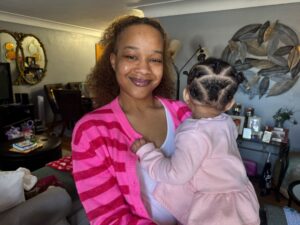
CAPTION: Matte’a Brooks takes care of her daughter inside of their home in southern Illinois. Brooks signed up for Medicaid after finding out that her daughter was on the way. (Cara Anthony/KFF Health News)
 On Air - 90.3 WPLN-FM