

Tennessee expanded its voucher program to families of all income levels this year and has been met with mixed reactions. Some praise them in the name of school choice, while others say they undermine public education.
The division is extreme. On one end, some families are suing the state over how the program allows the use of taxpayer funds to go toward the costs of private school.
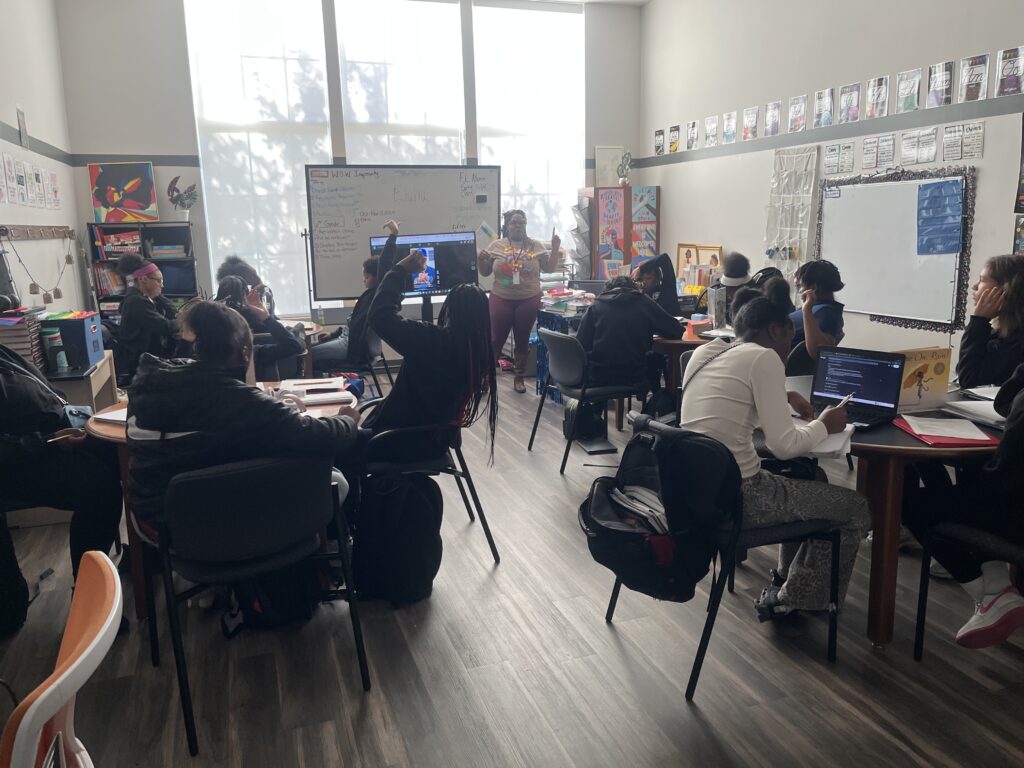
On the other — like at the all-girls B.E. Academy in Nashville — the school’s founder says her school tailored to serving Black students wouldn’t exist without vouchers.
‘I’m gonna open my own all-girls school’
B.E. Academy’s founder, Tee Wilson, tells WPLN News that her own experience at a New Orleans private school shaped her vision.
“I was one of the few girls of color there. And I didn’t always feel accepted for being who I am,” she said. “And I remember one day saying to myself then at 14, I’m gonna open my own all-girls school.”
She made that dream a reality last fall and said she couldn’t have done it without vouchers.
“A lot of my girls, their parents, and their families would not be able to afford to come to a private school.”
She credits the Education Savings Account program for getting her school off the ground in 2024. This was the state’s pilot voucher program year, when the dollars were only available for low-income students zoned to attend a school in Davidson, Shelby and Hamilton counties.
The program has since expanded statewide and no longer has an income cap.
Wilson pushes back against the critique that vouchers take money away from public schools. She believes the focus should be on the child.
While some students may thrive at a public school, Wilson insists that some need something different, like smaller classes and more community.
“You might have a student who really feels like she needs less distractions with boys and wants to be in an all gender environment,” she said. “Those students should be able to take the dollars that are attached to them and choose the school that is best for them.”
A family’s finances, Wilson said, shouldn’t limit their options when choosing a school. This aligns with Gov. Bill Lee’s position that vouchers expand private school access.
Half of the 20,000 available vouchers for this school year were reserved for families that earn less than $173,000.
Critics point out that the state isn’t tracking where voucher recipients previously attended school — a point that some lawmakers have called out during requests for more transparency. So, it’s not entirely clear if the governor’s contention holds up.
Wilson stresses that at B.E. Academy, however, about 70% of the girls live in low-income households and most have moved from public to private school.
Private school that offers cultural validation
One of the unique offerings at B.E. Academy is its cultural validation, according to math teacher Tiana Sharp. She says she wishes there was a place like it when she was a kid.
“I definitely think I would have bloomed a little bigger had I been in a space that was cultivated intentionally for me,” Sharp said. “I would’ve loved to have that sense of community, somewhere I want to come back to, some people that I just feel connected to. I think I missed out on that a little bit.”
Research shows that being one of a few Black students in a school can lead to mental health struggles — including feelings of isolation, depression and anxiety.
“We are the majority. We are the standard,” Sharp said of her school. “So, I think you don’t have to think about all of those other things, even just being all girls,” she said. “It takes away another level of trying to be a certain way for someone else.”
The staff prioritizes exposing the girls to different career paths — like when a photojournalist visited Sharp’s class.
“I would have never thought to do something like that. And she was just a beautiful brown girl and she’s doing her thing and I’m very proud,” she said. “And I’m like, ‘Our girls need to see that this is a job. You like to take pictures anyway. Look at what she could do.’ ”
These kinds of connections also drew teacher Destiny Williams and her daughter — who left a different private school despite its stellar academics.
“But what they were missing was the culture. They were missing people that looked like her. And the people that did look like her were in the cafeteria,” she told WPLN News. “And I remember her when I first started here. She said, ‘Oh my gosh, mommy, if that school was like this one, I would have stayed. I wouldn’t have wanted to leave.’ ”
She hopes the voucher program expands to support more schools like B.E. Academy and to give families more flexibility.
“And not necessarily lean on the (school) lottery,” she said. “It’s accessible.”
The governor has announced plans to increase funding for vouchers next year.

 On Air - 90.3 WPLN-FM