
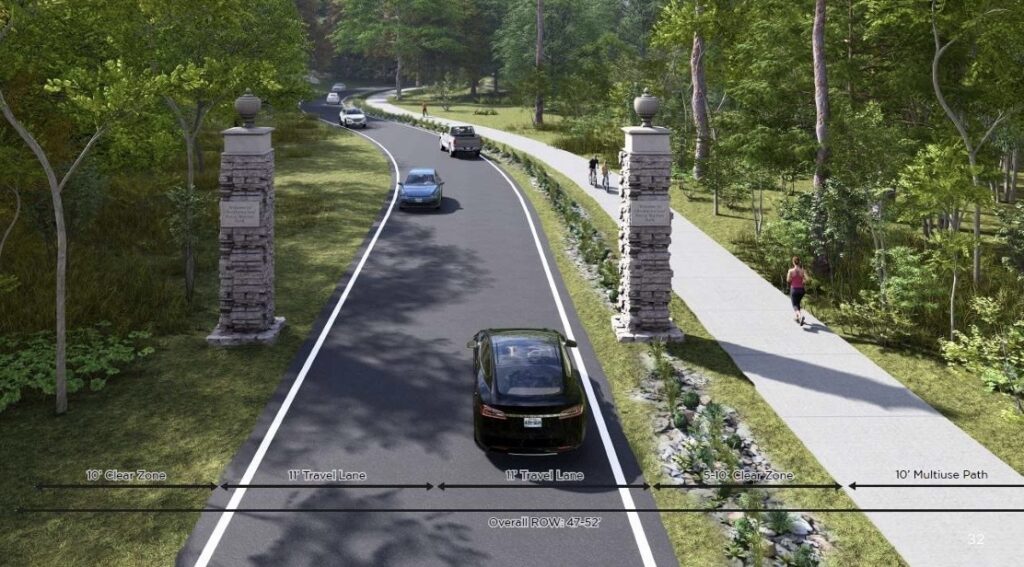
Beyond enjoying elegant displays of resplendent florals, people go to Cheekwood Estate and Gardens for education, concerts and private events like weddings.
Sometimes, lines of cars back into the surrounding neighborhood.
The garden has one entryway connected to residential streets, which has led to friction with neighbors that has dragged on for years.
It is at the heart of a new legal tussle.
Hundreds of residents in the Belle Meade-Highlands neighborhood brought legal action against the city this week to target traffic caused by Cheekwood — through both a lawsuit and an appeal the nonprofit fears could shut it down.
The group of residents, called Neighbors for Safety BMH, argues in the lawsuit that they tried to engage with Cheekwood over the past two years to resolve issues for both traffic and construction “before turning to litigation to force Metro to engage.”
“What the residents of the Belle Meade Highlands want is to be able to exist in their neighborhood safely,” said Chanelle Acheson, an attorney from Waddey Acheson who is representing the group in the lawsuit. “They would like to be able to walk their dogs, to ride their bikes safely in their neighborhood.”
The basis of their argument is that Cheekwood is operating illegally — because its events that draw large crowds are outside its zoning arrangement with the city.
Why a neighborhood is suing the city
Cheekwood opened to the public in 1960 as a botanical garden and art museum. In 1981, the garden entered into an agreement with the city to use Warner Park property for occasional overflow parking. In 1996, Cheekwood began renovations and expansion, setting up another agreement with the city to operate as a “nonassembly, cultural” operation, meaning attendance would be passive, as opposed to large groups of people gathering for a timed event like a concert.
The group argues that the nonprofit’s growth since that time has been substantial, bringing in large amounts of traffic for timed events. Cheekwood now averages close to 400,000 annual visitors.
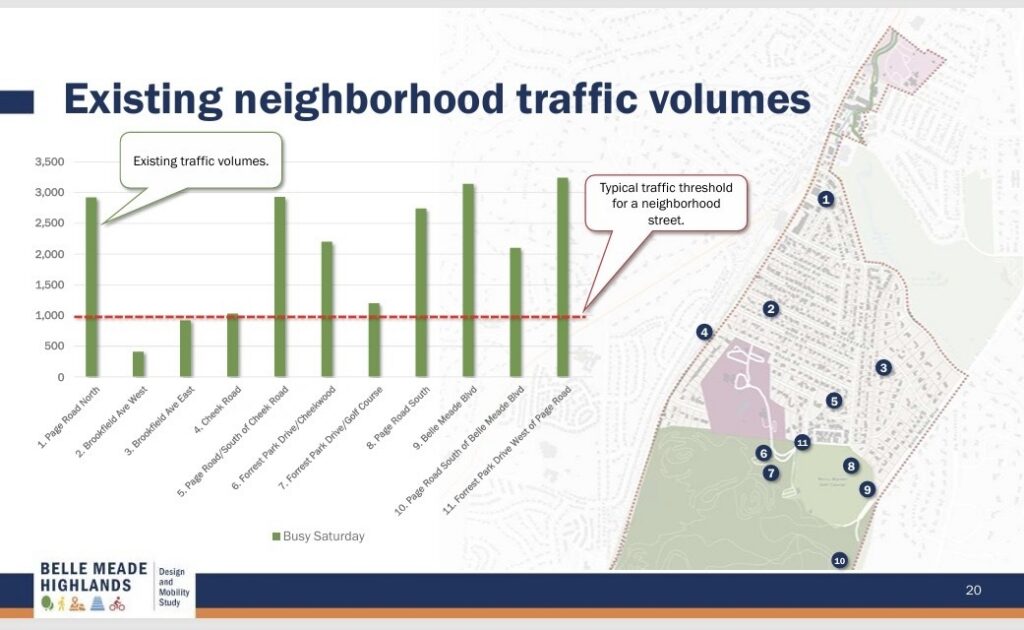
On a busy Saturday, seven nearby residential streets average as much as two or three times the recommended traffic volumes, according to a 2024 study on neighborhood traffic from consulting firm Kimley-Horn.
 Courtesy Kimley Horn
 Traffic volumes on some Belle Meade-Highlands neighborhood streets can exceed two to three times a typical threshold, according to consulting firm Kimley-Horn.
In 2025, the city adopted the study, which recommended the nonprofit create a new access road from Highway 100, on the eastern side of the estate, to address traffic.
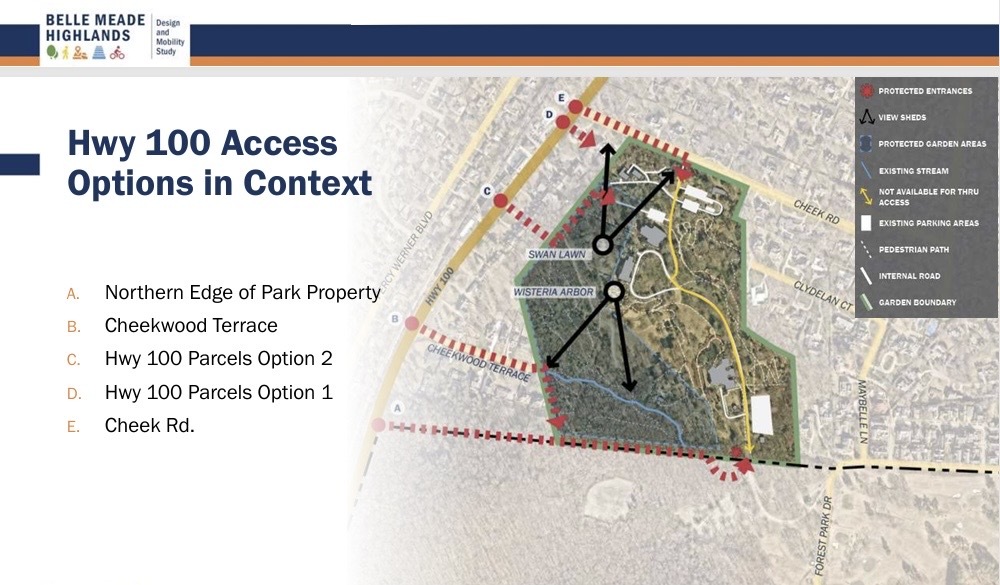
The study identified five options for new entryways, noting a preference for a road that would cut through part of the Warner Park forest and a mountain biking trail to also serve the Percy Warner Golf Course. Metro legal counsel Tom Cross said last year that the city could not acquire park property through eminent domain.
The option to use public land for a road faced pushback from parkgoers, the local mountain biking community, conservationists and the family of Luke Lea, who originally donated the land for Warner Park. The family filed a lawsuit, still ongoing, stating that land should only be used for park purposes.
More: In the forest between Warner Park and Cheekwood, Nashville wants to build a road | WPLN News
Cheekwood has only stated a preference for a “shared access” road through Warner Park. The nonprofit even purchased a $1.1 million home in the preferred path one month after the city adopted the Kimley-Horn study.
The neighborhood group argues that, given the pushback that option faced, Cheekwood could choose one of the other ways in.
“They are more accessible geographically and topographically, but Cheekwood does not appear inclined to pursue those options,” Acheson said.
 Courtesy Kimley Horn
 A 2024 study by consulting firm Kimley-Horn identified two “shared access” road options that would cut through part of the Warner Park forest to a parking pavilion underway.
Could Cheekwood build a different road?
Price could be a factor. If Cheekwood and the Metro Nashville government decided to construct a shared access road that will partially serve public facilities, then Metro could be on the hook to pay for part of it.
Kimley-Horn did not respond to WPLN’s questions about Cheekwood’s ability to construct one of the alternative routes or whether Cheekwood would be solely responsible for the costs of other road options.
Metro Parks directed WPLN to Cheekwood to discuss legal options. The parks department has not identified an additional road into either Warner Park or its golf course as a priority. The department has more than $127 million in deferred maintenance projects, according to its latest planning document.
Cheekwood said the Nashville Department of Transportation is responsible for determining where roads go. Cheekwood did not directly respond to a question about whether cost was a concern with the other routes.
“Cheekwood has no authority in deciding whether, where or when a highway access road can be built,” spokesperson Emily Luxen said in an email. “A road going only to Cheekwood would not solve the neighborhood traffic issue.”
 Courtesy Terry Cook
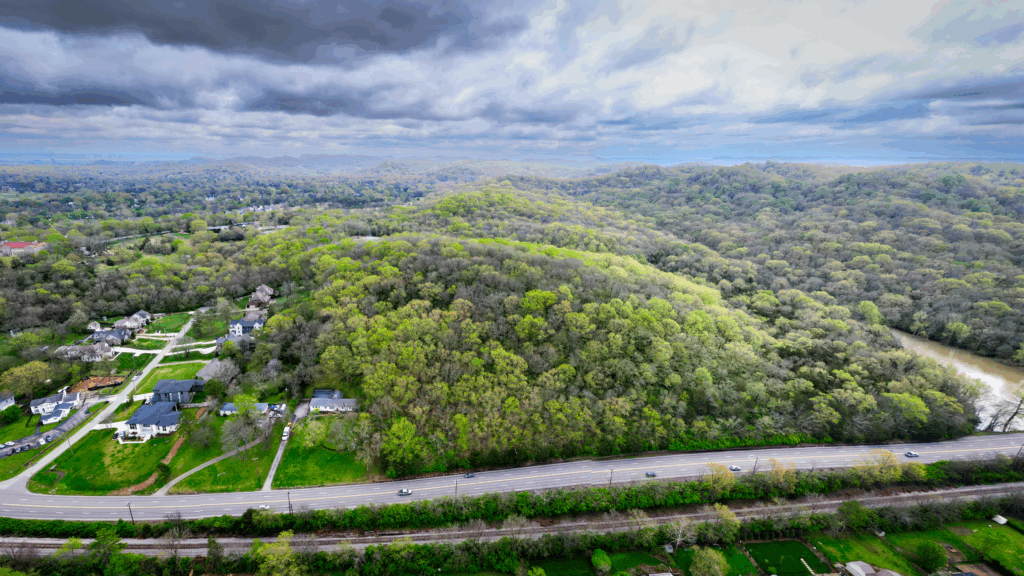
 A proposed road would cut through tree canopy at the border of Warner Park and Cheekwood Estate and Gardens.
The other challenge for Cheekwood is parking. The city mandated the cultural landmark stop using the neighboring Warner Park for parking by the end of 2027, allowing Cheekwood to choose how it created new parking on its campus.
Cheekwood obtained approval from the city to begin construction of a parking facility in May. The $25 million garage will create a total of 750 parking spaces, combined with about 75 existing spaces on campus, and represents roughly the same amount of parking that Cheekwood has offered through off-site options.
The Neighbors for Safety BMH are seeking a stop-work order on construction until other issues are resolved. The lawsuit directs Metro to “suspend, revoke, reconsider, stay, or otherwise halt permits and approvals associated with the Parking Pavilion unless and until compliance with applicable zoning and access requirements is demonstrated.”
In response, Cheekwood launched a “Save Cheekwood” petition that had about 25,000 signatures on Thursday afternoon.
The legal action “would literally close our doors,” said CEO Jane MacLeod.
MacLeod said Cheekwood is following the rules with Metro and underscored that the new parking facility will ultimately maintain the same capacity.
“We don’t want Cheekwood to become a place that’s not peaceful and bucolic and the wonderful place that it is,” she said.

 On Air - 90.3 WPLN-FM