Voters in the historically Black neighborhood of North Nashville won’t all cast a ballot in the same congressional race this November. Tennessee’s mid-decade redistricting plan has split the neighborhood near where Interstate 40 initially cut through North Nashville decades ago.
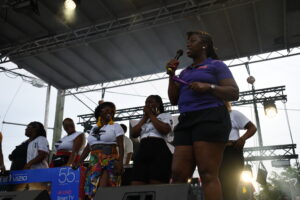
At the Equity Alliance’s annual Black on Buchanan block party, state Sen. Charlane Oliver told WPLN News that the new map intentionally dilutes Black voting power; Republicans have said redistricting was just about party politics and not about race.
 Marianna Bacallao WPLN News
Sen. Charlane Oliver, D-Nashville, speaks at the Equity Alliance’s Black on Buchanan block party.
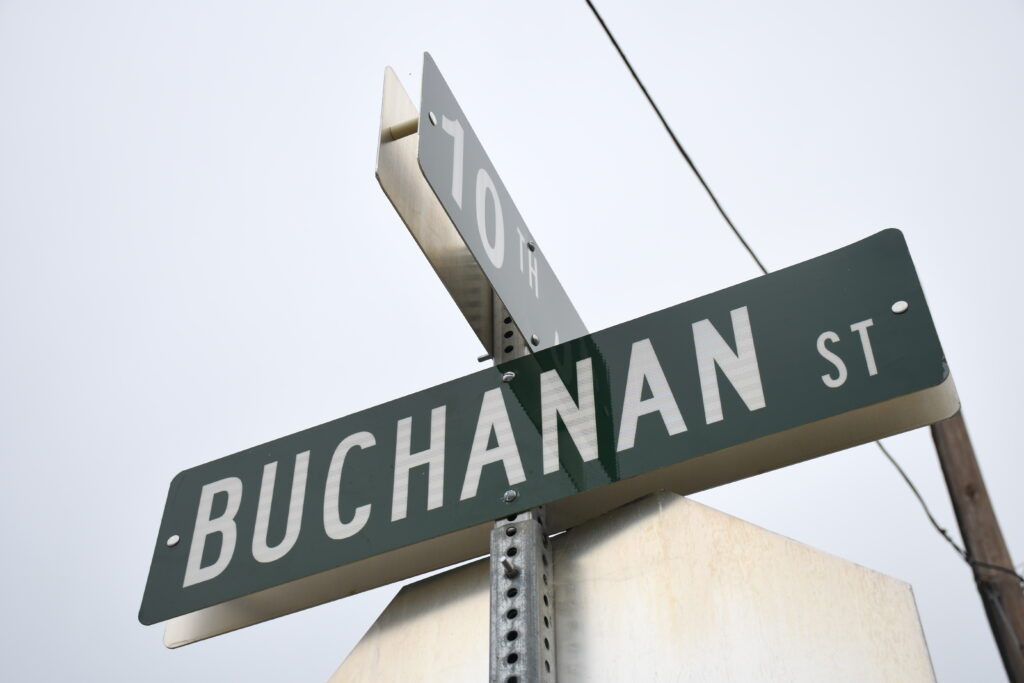
“It’s unfortunate, but it’s also a telltale sign where they split the districts,” Oliver said. “Look at where we are. We’re on Buchanan Street, the heart of North Nashville, historic North Nashville. Jefferson Street is right around the corner.”
From where Oliver stood on Buchanan, she could cross districts by crossing the street. A few intersections down Buchanan is a bridge overlooking I-40.
MORE: Tennessee GOP removes Democrats from House committees over redistricting protest
North Nashville’s divided history
In the 1960s, construction of I-40 cut through the heart of the city’s Black commercial and cultural center, displacing thousands of people and hundreds of businesses.
“That area held considerable political power,” said Learotha Williams, professor of African American and Public History at Tennessee State University.
Along with art and commerce, Williams said I-40’s construction stifled the burgeoning political power of North Nashville. Much of it was concentrated in churches like First Baptist, Capitol Hill, where many civil rights leaders prepared for the Nashville sit-ins.
“But with the interstate, a lot of these centers become displaced, because now a lot of those folks that went to those churches, they might not be going to these churches anymore,” Williams said.
The highway also undercut Black powerbrokers like Henry “Good Jelly” Jones. He held court at his Jefferson Street restaurant, which was half barbecue joint, half unofficial town hall.
“And the white politicians knew this. So, every so often, they would creep there, and they would talk to Good Jelly and get in good with him, so that he could drum up support in the Black community for these various politicians,” Williams said.
Now, Good Jelly’s restaurant is a luxury apartment complex, advertising rents upward of $2,000 a month. The Voting Rights Act of 1965, which protected the Black vote, was weakened by a Supreme Court decision last month. And Tennessee’s new congressional map now traces some of the same lines as I-40.
Split districts
Jamel Campbell-Gooch, a community organizer in North Nashville, told WPLN News that having two congressional districts in the same area will make it harder to run an issue-based campaign.
“If people don’t know who their representatives are, then they actually don’t know who to target or who to work with to improve their community,” Campbell-Gooch said.
MORE: U.S. Rep. Cohen drops from Tennessee congressional race after redistricting, others join
Tennessee Republicans have said that their map only considers partisan data, not racial data, but the specifics aren’t public.
Recently, a mathematician at the University of Chicago tried to reverse-engineer that mapping process to see how Tennessee made its decision. The resulting report found partisan data alone didn’t explain the new congressional districts, but feeding the computer racial data generated a map a lot like Tennessee’s.
In a statement to WPLN News, Lt. Gov. Randy McNally said race “played absolutely no role in the decision-making process.” House Speaker Cameron Sexton did not respond to a request for comment.
More changes could be coming. Republicans are considering another mid-decade change to state House and Senate districts, like the one in North Nashville that Sen. Oliver currently represents.
Correction: This story previously referenced the Civil Rights Act instead of the Voting Rights Act.
 On Air - 90.3 WPLN-FM