
Time and money.
Two things that, for most working Tennesseans, there’s never enough of.
Tony Kinkel, the president of Motlow State Community College, says it’s hard to decide which is the bigger hurdle.
“For adult students, it is fifty-fifty.”
There are high school football games. Band concerts. Work and other commitments.
“Plus, then you’ve got to go to school yourself. It is really hard to find the time. So it’s both.”
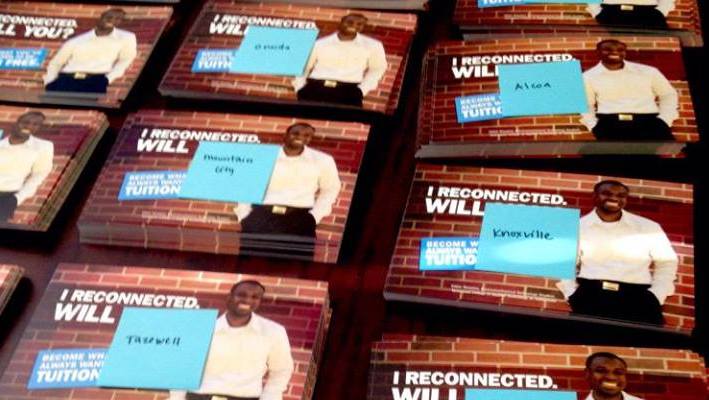
Earlier this week, Governor Bill Haslam announced Tennessee Reconnect, a plan to get adults back in school by offering community college degrees, tuition-free.
It’s an extension of Tennessee Promise, the free community college program for graduating high school seniors. But making Tennessee Reconnect work will mean more than just covering the cost.
Community colleges learned this harsh lesson when they tried out Tennessee Reconnect as a pilot. Few people took part.
One reason was because adult students had to take at least three courses a semester. That was too much. So now, state officials are planning to cut the number to just two.
And schools like Motlow State expect to offer more of those courses at non-traditional hours and locations.
“I mean, working adults work,” says Kinkel. “It’s not like these adults are laying around watching TV all day long.”
Flexible scheduling is just one of the ways higher education officials are trying to rethink community college from an adult’s perspective. Other ideas include giving credit for work experience and holding clinics to help adults sign up for federal financial aid.
That help with financial aid forms is important because Tennessee Reconnect is what’s known as a “last-dollar scholarship,” meaning the state government is only going to cover what students owe after they’ve received money from federal sources.
Which leads to another big hurdle: the FAFSA. That’s the form every person who applies for federal financial aid has to fill out.
Even the head of the state’s community college system, Mike Krause, says it’s hard.
“Oh my gosh, it’s 108 questions. If you were going to design something to keep people out of college, you would design the FAFSA.”
But Krause says adults can be very motivated. Unlike young students, who tend to fall off track if they don’t carry a full load, older students often make it to graduation when they take a few courses at a time.
“It’s doable. I did it, actually. I worked while I went to college after I was in the Army as an adult student. I did not take a traditional route to college. And I think a lot of adults have made it work.
“But Tennessee Reconnect, we hope, really creates an influx of adults who try to make it work.”
State officials expect to get Tennessee Reconnect off the ground in time for adults to start enrolling in the fall of 2018 — early enough to help them toward their overall goal of getting 55 percent of Tennesseans to have a degree by 2025.
And they’ll be working hard to spread the word. Ads could appear on television, radio and social media, and education officials will be urging everyone from the parents of community college students to people seeking unemployment or welfare aid to go back to school.


 On Air - 90.3 WPLN-FM