


Once a country artist has established their name, scored radio hits and built a loyal audience — like John Anderson did throughout the 1980s and early ‘90s — they’re well positioned to continue stepping on stage and singing their signature songs for as long as they want. That is, so long as their health permits them to continue performing.
Anderson had every intention of carrying on with his own bluesy, downhome crowd-pleasers like “Black Sheep,” “Swingin’ ” and “I’m Just an Old Chunk of Coal (But I’m Gonna Be a Diamond Some Day)” among them.
Then hearing issues stopped him in his tracks.
Roughly 25 years ago, he first had an issue with an ear that had been scarred by numerous childhood ear infections. The doctor he initially saw was doubtful he could perform the procedure Anderson required.
” ‘I’m afraid to do any work on this ear at all,’ ” the singer paraphrases, ” ‘but I have a colleague who, if anybody can fix it, he might can.’ ”
That colleague was Dr. David Haynes, professor of otolaryngology, neurosurgery, hearing and speech sciences at Vanderbilt Health. He’d already encountered Anderson — his music anyway — when he was a medical resident with an unreliable vehicle years earlier.
“There was a friend of mine who had his CD in her car, and I had to borrow her car,” Haynes recalls. “I really fell in love with his music. I listened to it every day, and I’ve been a fan ever since.”
‘Dire straits’
After Haynes did successful surgery on Anderson’s ear, the artist went right back on the road. But when Anderson fell seriously ill in 2017 and faced hospital stays in multiple cities, both of his ears were profoundly affected. “Not only did I lose hearing in that ear that he did his surgery on,” Anderson recounts, “but I lost hearing in my other ear, which was all I had. For a while there, it was really dire straits for me, as I was facing probably not being able to sing or play again.”
Understandably, he looks back on it as “a very very dark and depressing time in my life.”
Anderson again sought the care of Haynes and his Vanderbilt colleagues. But this time, the doctor says his patient was suffering from a far more critical condition.
“The kind of inner ear hearing loss that he had, if you don’t get it back within a few weeks, it’s not gonna come back months later,” Haynes said. “So we knew we were on a timeline.”
Though he’s careful not to ever guarantee patients a particular outcome, Haynes was especially concerned about Anderson’s prospects, “because of the amount of loss and because of who he was: one of my favorite performers.”
Haynes decided the best course of action was to try injecting steroids into Anderson’s ear drum. “It wasn’t pleasant, really, but it really wasn’t that painful,” recounts the singer, who’s inclined to understatement.
Anderson had to make the 90-minute trip from his home in Smithville to Nashville for repeated treatments. During visits to Vanderbilt’s clinic, hearing tests conducted with state-of-the-art equipment showed his progress. But he’d also do his own unscientific testing at home by picking up his acoustic guitar. Only when he was satisfied that he could make it through a song did Haynes consider the treatment a success.
“He would come in and say, ‘I can hear now, I can play music now, and I could hear these notes now,’ ” the doctor says of Anderson. “And that’s what’s most important.”
On the record
As remarkable as his recovery was, Anderson required a lot of convincing when producers Dan Auerbach and Dave Ferguson urged him to resume writing and recording new material. One of the underlying themes of “Years,” the stirringly reflective 2020 album they made together for Easy Eye Sound, was savoring hard-won resilience.
And his vocal attack carried profound feeling and perception.
Anderson was so grateful that he’d been given his music back that he invited Haynes to attend the 2024 Country Music Hall of Fame medallion ceremony, an occasion generally reserved for the inductees’ friends and family and dignitaries of the country music industry. “He’s in the friends category, for sure,” says Anderson of his physician. “And he’s played an important part in my life, as far as me continuing to play music.” Anderson said as much in his speech that night.
He was hardly the only member of the Country Music Hall of Fame to benefit from Haynes’s care, as indicated by the mementos on display around his office. Says Anderson, “I found I was in pretty good company.” Along with his signed CDs hang various pictures and plaques from Merle Haggard, Tammy Wynette, Brooks & Dunn and others.
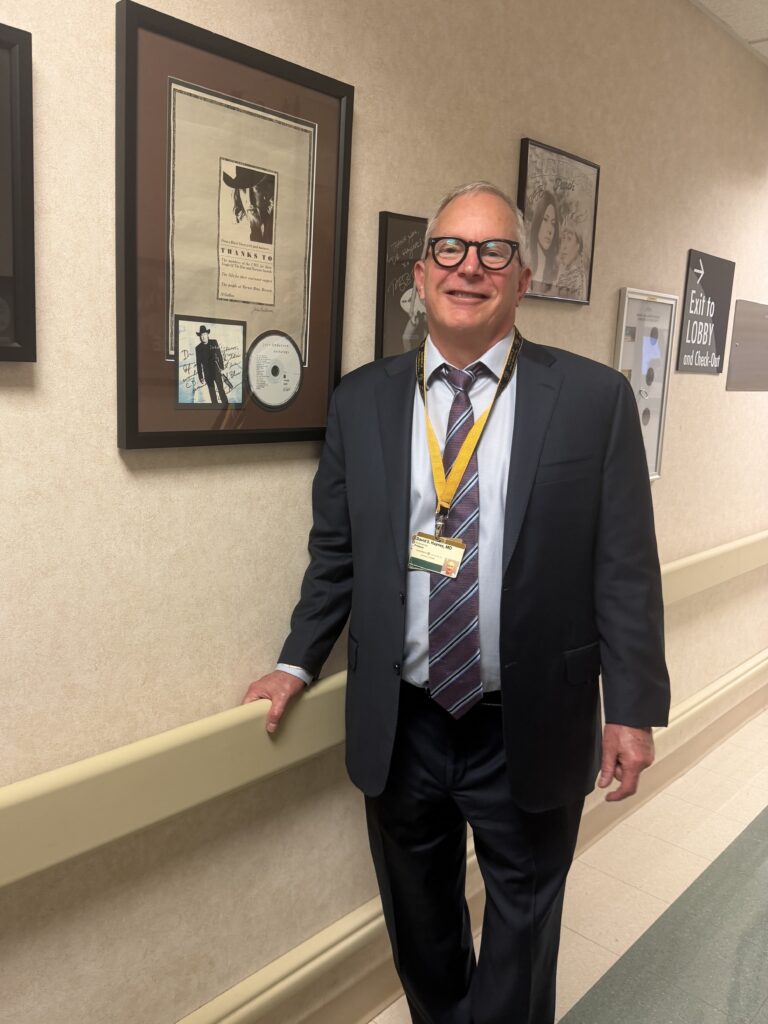
Dr. David Haynes next to a memento presented to him by John Anderson
That wasn’t all that Anderson had noticed during his Vanderbilt visits.
“I remember I walked in and I was feeling pretty down and sorry for myself,” he says. “And then I started paying attention to all these folks coming and going. Old folks coming in on walkers as well as young parents carrying their children. You could see the fear as well as the hope in the parents’ eyes. And it really, really affected me. I got very emotional.”
That was when he resolved to do what he could to help. The way he saw it, “about the only thing I have to offer is the music and the show.” So he proposed a benefit concert to Haynes, and kept on repeating the offer for a few years straight, until they were finally able to make it happen at the Ryman Auditorium earlier this year.
“John was persistent,” Haynes says. “This wasn’t like me chasing him around to do this. He was the one really wanting to see this through.”
The Ryman show was Haynes’s opportunity to offer remarks of recognition.
“It’s not a coincidence that the top hearing and ear programs are here in Nashville,” he declared from the podium, praising those who partner with him in that work at Vanderbilt. “There’s a marriage between hearing and music in this city that’s been going on for quite some time.”
He concluded with a heartfelt introduction: “We all wouldn’t be here without our friend, a great performer, but an even greater human being, John Anderson.”
In Haynes’ mind, the benefit was an “extremely generous” gesture from Anderson. “It got the awareness out there for what we do,” says Haynes. “We know we’ll help people because of the exposure he’s given and funds he’s raised. It’ll help identify these barriers, but also help to overcome these barriers.”
Barriers to receiving treatment like Anderson received, or an array of other options, including hearing aids and cochlear implants, can be towering. People may have to travel even further than Anderson did to reach the Vanderbilt clinic. They may be unable to afford to take off work, or lack sufficient insurance, or face any number of other challenging realities.
But if anyone understands the stakes they face, it’s Anderson. “When you need care like I needed it, if you had to drive to Anchorage, Alaska, you would.”
 On Air - 90.3 WPLN-FM