
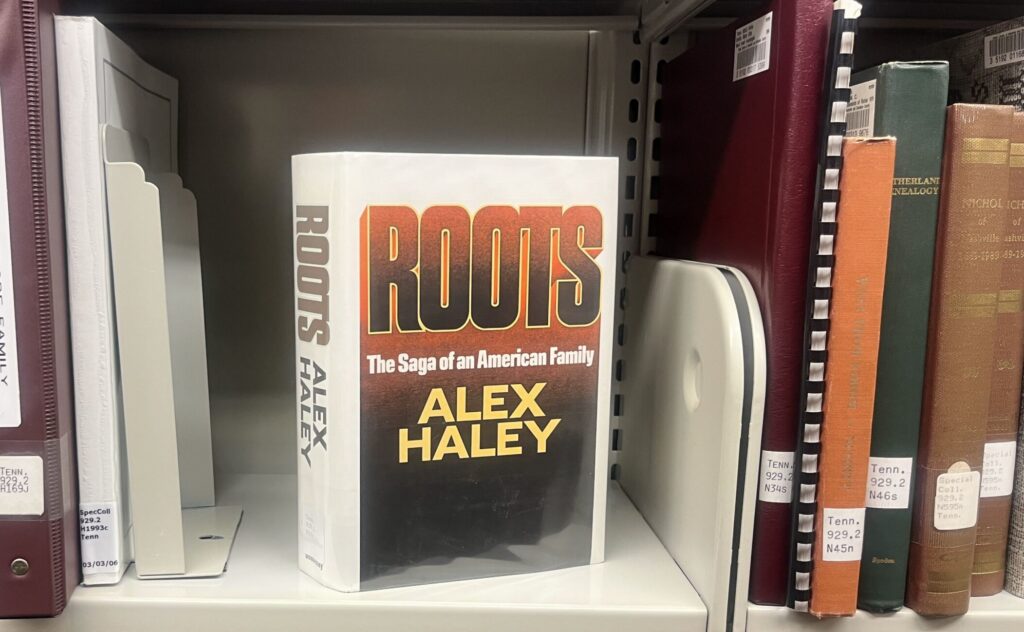
Knox County recently backtracked its decision to remove the critically acclaimed book “Roots” from school libraries. Now, education leaders are asking that the law spurring the removal be revised. And many community members stress that students should read literature that shows the impact of slavery.
Alex Haley’s 1976 “Roots” is about the horrors of the slave trade in America – chronicling the life and legacy of Kunte Kinte who was forced from his home in Gambia into slavery. Two years ago, Gov. Bill Lee designated it as an official state book.
The Knox County school board removed the book because it found that a passage depicting the rape of an enslaved woman showed “sadomasochistic abuse” – a violation of Tennessee’s 2022 Age Appropriate Materials Act. The legislation imposes restrictions on school library content, and Knox County has banned 124 books since the law was enacted.
The removal of “Roots” sparked immediate nationwide backlash before Superintendent Jon Rysewyk reversed the decision on May 26. The controversy is the latest in a string of book bans throughout the state – spurring a lawsuit and the ousting of a library director. The banned books typically touch on sexuality and race.
Remembering Roots
Lucas Johnson, journalist and author of “Remembering Roots: How an American Classic Transformed the World,” insists that Haley’s work is needed in school libraries because it sparks dialogue between students, teaching them empathy and a better understanding of the economic and psychological consequences of slavery.
“They can see how horrific hatred is. Just like the Holocaust, it should continually be talked about because of the atrocity that happened,” Johnson said. “You see how people were treated. In your life going forward, as you go through the day, try to be kinder to people.”
An assignment as a reporter covering Fred Montgomery – the first Black mayor of Henning, Tennessee, and Alex Haley’s childhood friend – led to Johnson penning “Remembering Roots.” The book includes commentaries from people of all ages about how Haley’s work impacted them, anecdotes from his family members and former students, and excerpts from the 912-page original version of “Roots.”
One of Johnson’s favorite stories from his book is about a twelve-year old boy who visited the Alex Haley Museum. The preteen was so moved by what he learned that he wanted to give the museum curator something to show his appreciation. But all he had was a stick of gum.
“The curator to this day, it was about three years ago, he still has a stick of gum in his drawer because he wanted to remember the power of oral history and the impact it had on this young man, talking about ‘Roots,’ ” Johnson told WPLN News.
The state law restricting school library content may stifle some authors’ writing, he says, because they fear their books could be banned. However, he noted that others might welcome the controversy as a means to draw more interest.
What is age appropriate?
“Roots” is back on school library shelves in Knox County, but the temporary removal reignited concerns that the law is vague and subjective.
At a recent school board meeting, Sherri Garrett, the chapter chair of Moms for Liberty in Knox County, said that the Age Appropriate Materials Act was not intended to remove books like “Roots” because it does not center or promote abuse, but rather depicts the cruelty of slavery.
“There’s a major difference between exploitative sexual content and historically significant literature that tells the truth about a difficult part of history,” she told the board.
However, others supported the removal of the book, calling it “inappropriate.”
School board member Anne Templeton introduced a resolution to amend the law so that the same standard of “appropriateness” doesn’t apply to all grade levels. Other changes include restoring contextual review so books are judged in their entirety rather than on a single passage along with lengthening the review period from 60 to 90 days to allow for public input before a book is removed.
The board narrowly voted to approve the resolution with a 5 – 4 vote.
(Lucas Johnson’s book “Remembering Roots: How an American Classic Transformed the World” will be released on June 16, following a launch event on June 14 at the Z. Alexander Looby Theatre.)

 On Air - 90.3 WPLN-FM