

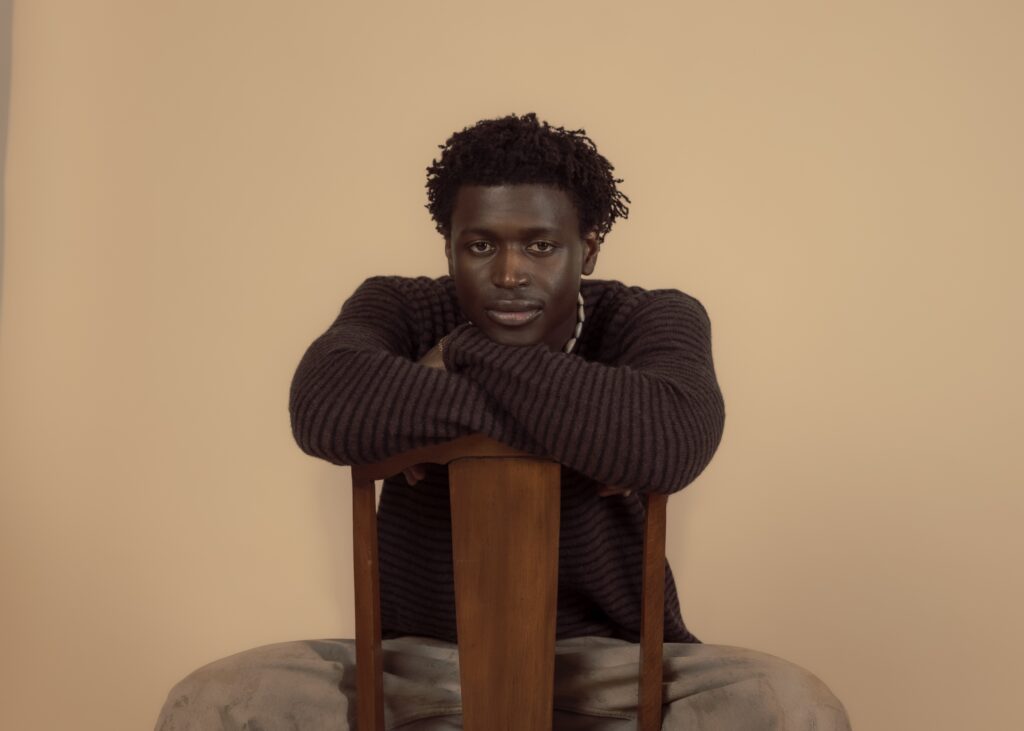
Mon Rovîa is a little worried that his older model Toyota Forerunner won’t start, since the winter cold has affected its reliability. But once he’s satisfied that it’s running alright, he steers away from the busy parts of Chattanooga until we turn onto a winding, two-lane road with no other traffic and reach the tree-lined entrance to the Reflection Riding nature preserve. Mon Rovîa is a frequent visitor.
“A beautiful spot, a good place to think,” he calls it.
He first arrived in Chattanooga over a decade ago to play soccer at Covenant College, which sits atop Lookout Mountain. We can make out its steeple in the distance, since the park sits at the mountain’s base.
“The stillness, if you’re looking for it, it’s definitely here,” Mon Rovîa observes as we begin to stroll. He and his friend and manager Eric Crowmartie found this to be an ideal setting for filming performance clips. We pass by a field of dry brush where he once shot a solo version of his song “crooked the road” on ukulele.
Posting videos on social media was how Mon Rovîa first gained a sizable audience and industry interest. That song alone has been streamed more than 44 million times on Spotify. But watching his music career begin to take off didn’t make him want to move where the action is. Neither did his first experiences recording in Los Angeles.
“Every day you could have someone hitting you up like, ‘Let’s go to the studio,’” the artist explains. “Which is a beautiful thing. But the way my art works and where my mind is, I have to just leave music. And when it decides to give to me in my everyday life, I do my best work.”
Still processing
He began his life in the West African nation of Liberia, then bounced around the U.S. and Caribbean with the missionary family that adopted him. And though his music’s tranquil power has earned him a following and tour dates all over, he still returns to the pastoral charm of Chattanooga.
He wanted to be able to make his debut album in peace too, so he released a series of four EPs to tide fans over, “to give us time for me to grow, to think, to understand what Mon Rovîa is. Because [in] those beginning stages, I did not know.”
And no wonder. He’d had a lot to process.
His Liberian family struggled to survive a savage civil war, and as a small child, he’d had to leave his siblings behind when he was placed with a white, American family.
There were ample gaps in Mon Rovîa’s knowledge of that history, and he’s sought to fill them in by reconnecting with his Liberian sister, and studying everything he could, including the documentary “Pray the Devil Back to Hell.” The heroes of the film are the Liberian women who organized across ethnic and religious and rose up together to insist the fighting come to an end.
Milestones and bloodlines
He’d had no grand professional ambitions for music — just the inclination to fashion his profound questions into delicate songs.
And there was even more history to unpack when he learned that he’d joined an Appalachian folk lineage that could be traced back to West Africa. “People would ask me questions about Appalachia,” he says. “It’s been hard for me at times to be someone that the fans will look to for these answers, as I still wrestle and try to learn as well.”
Mon Rovîa’s trying to adjust to the industry accomplishments coming his way too. Last year, he got to play both the storied, scenic Colorado amphitheater Red Rocks and the Grand Ole Opry.
“I don’t know much about venues,” he says. “So when we make these achievements, my band will be super excited: ‘This is a milestone!’ And I’m just like, ‘Oh, this is cool.’ It’s been interesting to learn how to kind of manufacture a joy for things that are supposed to be important.”
But he didn’t have to generate any enthusiasm for the news he just received from the Liberia Music Awards. In recognition of his global reach, he was named 2025 Outstanding Artist of the Year. “I didn’t see it coming and it honestly brought joy to me,” he says.
Mon Rovîa named his debut album, and its title track, “Bloodline.” In the song, he reflects on his quest to restore his sense of connection to the people and place he came from.
And the reassurance he’s arrived at isn’t meant for him alone: “This goes for people that have come to America as immigrants or feel estranged from their land. They feel like, ‘I have no part in my country, because I was raised here.’ No, everything that you touch, that is generations of people that have poured their life into something. And that’s still a part of you.”
 On Air - 90.3 WPLN-FM