

As Nashville struggles to house its ever-growing population, a new report has proposed a solution: zoning reforms.
The study, a product of Washington D.C.-based think tank The Urban Institute, points out that in 2023, Nashville grew by more than 31,000 people. And the city’s planning department has estimated that to accommodate demand, Nashville will need to add upwards of 80,000 housing units by 2040 — but that under the current zoning code only 50,000 are likely to be built.
Currently, almost all of Nashville — 90% — is zoned for single-family or two-family homes. One suggestion from the institute — which it is calling the “plexify” reform — is to alter the code to allow for up to four units on these parcels.
But a major focus is on where other zoning reforms could happen. Development patterns have left a mere 13% of Nashville’s housing units located within walking distance of major transit corridors (which the Urban Institute has defined as a quarter mile).
Coming off the overwhelming approval of Nashville’s transit referendum last fall — which saw two-thirds of Nashville voters approve a half-cent sales tax increase to fund $3.1 billion worth of transit improvements — the institute finds that now is the time to tap into transit-adjacent development.
The report proposes two other options for zoning reforms, limited to areas located within a quarter mile of the transit plan’s “all-access corridors.” All-access corridors are upgrades — like increased service, and, in some areas, transit-only lanes — along ten of Nashville’s most-trafficked routes. In these areas, the report proposes either:
- the “legalize” reform: allowing multifamily housing to be constructed on any lot that is currently zoned for commercial or business uses and that does not currently permit multifamily residential units within a quarter mile of all-access corridors; or
- the “intensify” reform: allowing high-density, multifamily residential development in all residential zones within a quarter mile of all-access corridors.
According to the study, making these changes would not only increase the number of possible units by hundreds of thousands, but could also provide financial stability for the growing transit system by establishing a built-in ridership base.
However, adjusting the zoning code can be difficult and, often, contentious.
Nashville’s has remained largely unchanged since 1998. Last year, two Metro Council members proposed a package of zoning reform legislation that would have opened parcels zoned for single- or two-family housing to quadplexes, among other changes. The bills met swift pushback from the community, with the most substantial proposals deferred until later this year.
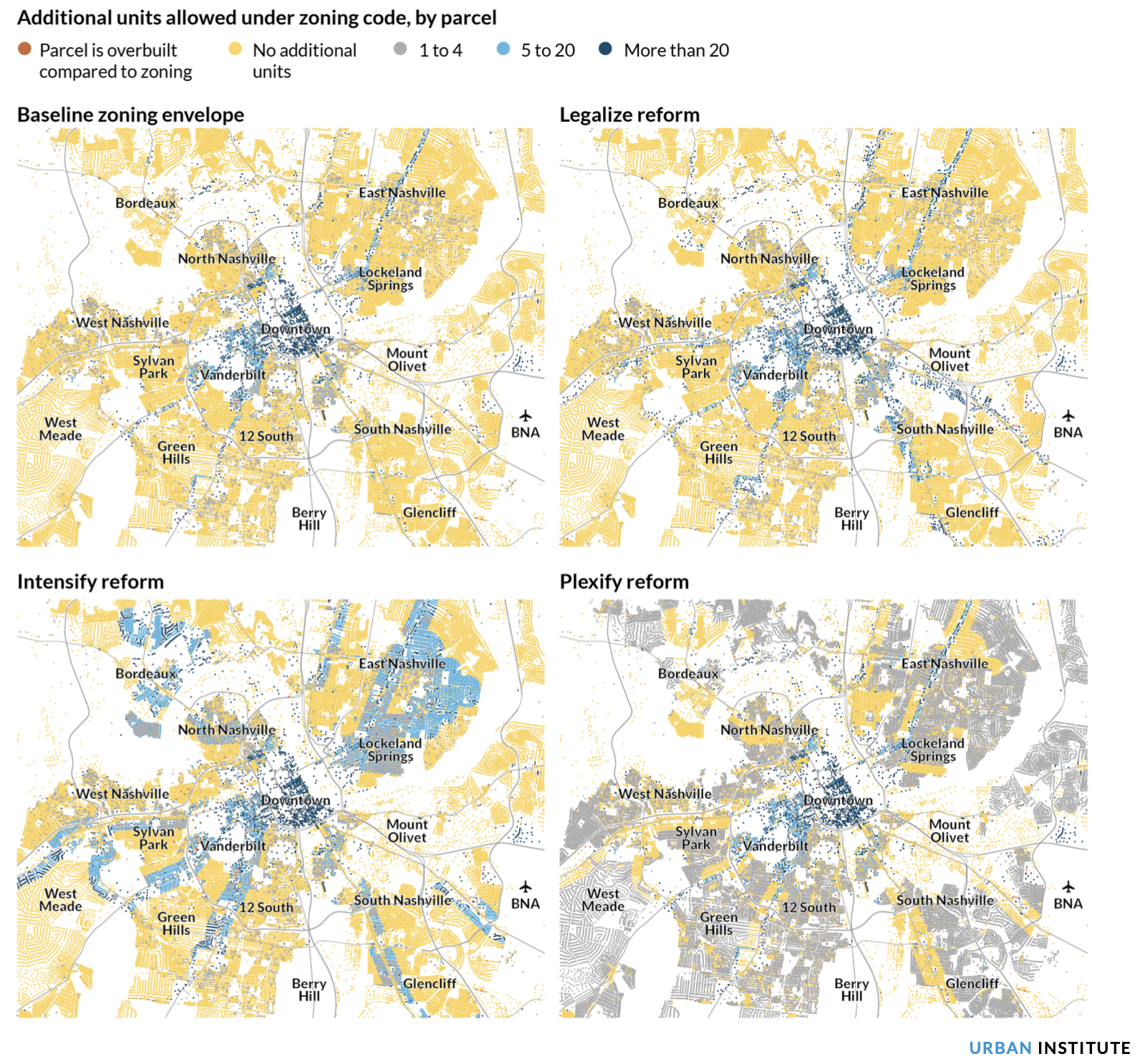
The Urban Institute illustrates how various proposals for zoning reform could alter Nashville’s housing supply. The baseline zoning envelope demonstrates how many units could be constructed in Nashville currently, under the existing zoning code. The “legalize reform” illustrates how many units could be constructed if, within a quarter mile of all-access corridors, multifamily units were allowed on any lot zoned for commercial or business uses. The “intensify reform” demonstrates the units that could be built if, within a quarter mile of all-access corridors, the code allowed for higher-density, multifamily residential development in all residential zones. And the “plexify reform” shows the units that could be constructed if all parcels currently zoned for single- or two-family homes permitted construction of four units.

 On Air - 90.3 WPLN-FM