

What role did Tennessee play in the advent of airport security?
A hijacked passenger jet and the threat to crash it into a Tennessee nuclear facility are what prompted the first-ever passenger screenings in American airports. Plus, the local news for November 10, 2025, and the end of participatory budgeting in Nashville.
Below is a partial transcript of the episode:

It’s November 10, 2025. On this day in 1972, hijackers took control of a passenger jet. For the next 29 hours, including a large chunk of time in Tennessee airspace, they issued demands — and made a threat to crash into Oak Ridge if they didn’t get their way. That incident changed the way we fly in America.
A lot of air travel security in the U.S. these days stems from 9/11. That’s why you usually have to be a passenger to even go through security and back to the gates. That was the start of having to take off shoes or limiting the amount of liquids in a carry on.
But that was a ramping up of security. It wasn’t the start of it. For decades before the attack on the World Trade Center, airports still had metal detectors and x-ray machines to screen bags. Those have been around for so long that now that it just seems natural.
This summer, my husband and I took a cross-country trip on Amtrak, and we were able to just walk onto the train. Sure, we had to show a ticket, but nobody ever even glanced at our bags.
And air travel was originally that way, too.
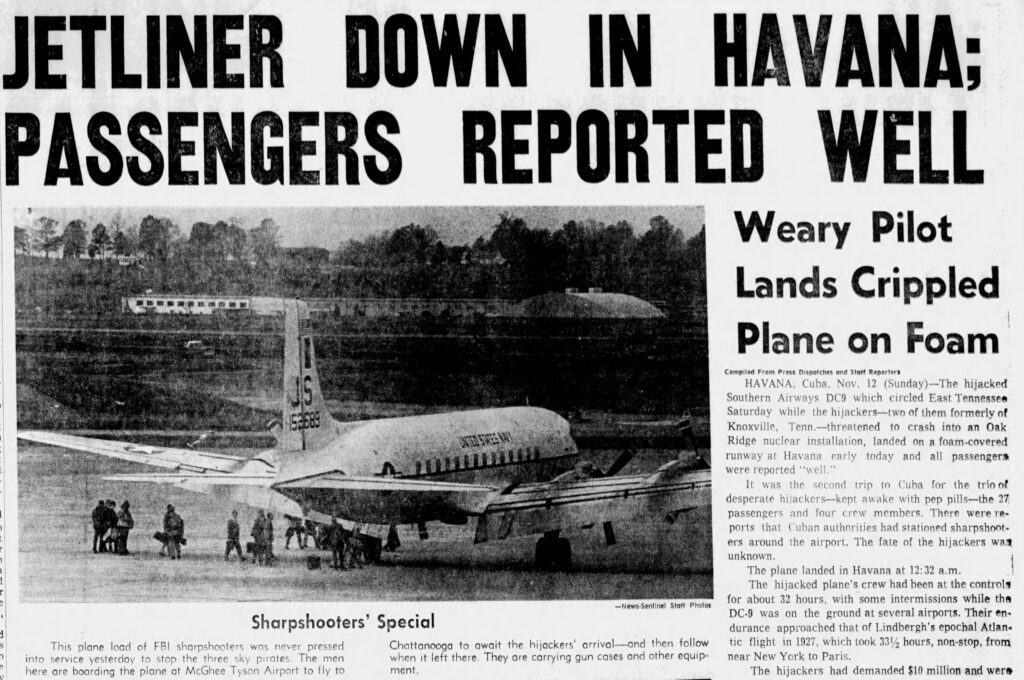
The incident that changed it all was Southern Airways Flight 49.
The intended route started in Memphis, ended in Miami, with stops in Birmingham and Montgomery, Alabama. And the first leg went fine. Nothing out of the ordinary. But shortly after takeoff in Birmingham three men pulled out guns and hand grenades and commandeered the plane.
One of them was a 27 year old Black man named Louis Moore. He’d been outspoken in the ongoing struggles over Civil Rights in Detroit. The year prior, he’d sued that city over police brutality. And then, that October, Detroit police charged him and a friend with sexual assault. Moore says those charges were trumped up, a kind of retaliation for daring to challenge the way the police had treated him. He didn’t feel at all confident that there was a way to be treated fairly under the judicial system. So he, his friend, and his half brother decided to get back at the city in spectacular fashion.
Once they had control of the plane, they ordered the pilot to make a refueling pit stop, then fly to Detroit. And there, while circling over the city at an altitude of 20-thousand feet, they issued their demand: 10 million dollars from the city. A huge contingent of police arrived at the airport, city leaders were on the phone, trying to talk through the situation. Everyone was in a standoff for an hour and a half before a heavy fog made it clear that, even if the city agreed, they couldn’t actually land in Detroit. So they headed across Lake Eerie to Cleveland.
And once they were out of Michigan airspace it seems like everyone on the ground shifted into looking at this hijacking as a problem the airline needed to fix. It was up to Southern Airways to try and scrape together the ransom money to get these guys to put their guns away and leave the plane. But the thing is Southern didn’t have that kind of cash on hand.
And so it turned into a crazy sequence of flying from place to place, refueling, taking off again, tweaking the demands. All while nearly 30 passengers sat in their seats on the plane, wondering what was going to happen to them.
The whole ordeal had started around 7:30 on a Friday evening. As it stretched into Saturday, the hijackers directed the pilot to fly to Moore’s hometown, Knoxville. Again, they have the plane circle around the city for a long time. They’re still insisting on the money, but they’ve escalated to wanting the White House involved, saying they need some kind of official document from the President calling the money a “government grant.” Evidently they thought that might make it possible to actually keep the cash and not just be arrested and jailed right away. I don’t know.
And it was over Knoxville that their threat escalated: the hijackers weren’t just implying that the plane’s crew and passengers could be killed, they said that if they didn’t get what they wanted, they’d crash the plane into the nuclear facility at Oak Ridge National Laboratory, seemingly hoping to trigger a mushroom cloud over East Tennessee if they didn’t get their way.
At this point, the airline decided it had to try and at least fake it. The company had pulled together 2 million in cash. The pile of money weighed 150 pounds, and executives hoped that the sheer mass of bills would trick the hijackers into thinking it was the full 10 million they’d demanded.
The message went out that the men could have the money they’d asked for, along with a handful of items they’d demanded along with the cash: medical supplies, helmets, bulletproof vests.
The handover took place in Chattanooga. The plane landed, everything was handed over, along with fresh food for everyone on board. And sure enough, Moore and his compatriots didn’t bother trying to count the money. They grabbed wads of cash and handed it out to everyone on the plane. But they didn’t let anyone get off the plane. Instead, they gave the pilot a new destination: Cuba.
There was a whole additional layer of drama then with Cuba. They ended up flying to Havana, then Florida, before finally heading back to Cuba again. At one point, American authorities managed to shoot out the tires of the plane’s landing gear, to make it impossible for the hijackers to keep forcing a sequence of land-refuel-take-off (all at gunpoint). They made unsuccessful demands to get President Nixon on the radio. Finally then, in Cuba, they had a nightmare of an emergency landing on a runway that had been prepared with some kind of foam.
And in a rare moment of international solidarity, the Cuban and American governments cooperated. Cuban authorities recovered the ransom money and returned it to the airline. They cared for the one member of the crew who had been shot. Everyone on board, aside from the hijackers, was given safe passage back to the U.S.
But the three who commandeered the plane were taken into custody there in Cuba. Fidel Castro said he’d make sure they lived out the rest of their lives in “small boxes.”
And they did stay in a Cuban jail for the next eight years. In 1980, Cuba agreed to extradite the men to the U.S. The ringleader, Louis Moore, served another 7 years in an American prison, then settled back in the city where he grew up: Knoxville.
The year after the hijacking, airports in the United States began screening people for weapons.
Credits:
This is a production of Nashville Public Radio
Host/producer: Nina Cardona
Editor: Miriam Kramer
Additional support: Tony Gonzalez, Mack Linebaugh, LaTonya Turner and the staff of WPLN and WNXP
 On Air - 90.3 WPLN-FM