

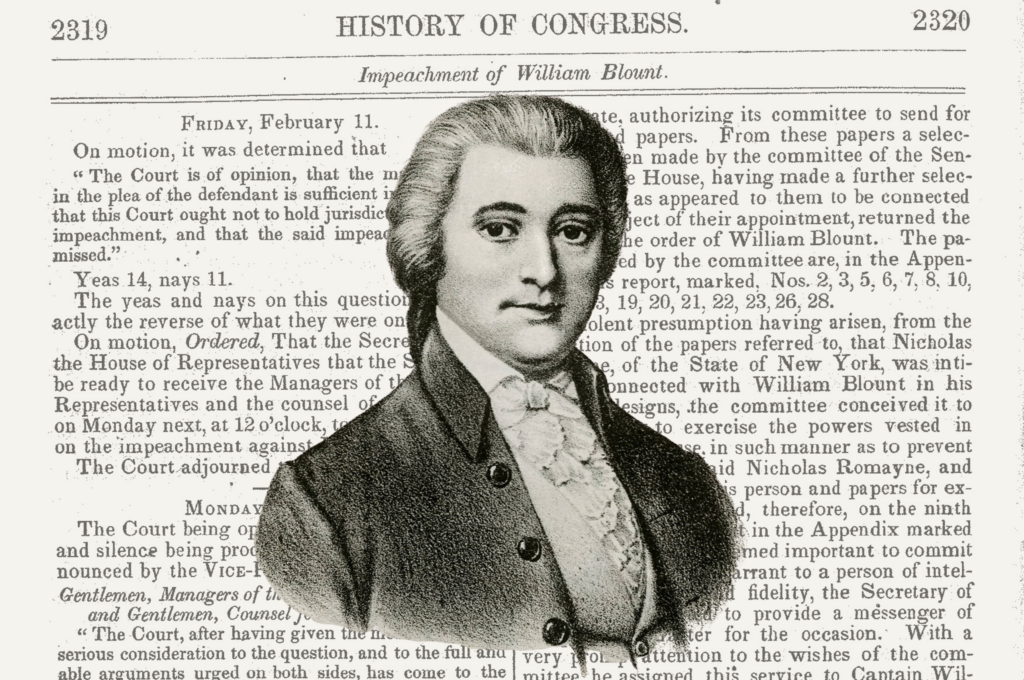
How did a founder of Tennessee make history as the first U.S. Senator expelled from office?
Tennessee’s early days were kind of wild and lawless, but one lawmaker really pushed those boundaries. Plus, the local news for July 8, 2025, and the queer exodus from Tennessee.
Below is a partial transcript of the episode:
 It’s July 8th, 2025.
On this day back in 1797, the U.S. Senate expelled and impeached one of its own members. It was the very first time that disciplinary mechanism was ever used. And the man they kicked out was basically brand new to the job, representing a state that had only just joined the union the year before: Tennessee.
Growing up in Tennessee, I was taught several times over in school that the first president to be impeached was one of our guys. Not that my social studies classes got too deep into it. But sure, Andrew Johnson, the president who was impeached was a Tennessean, and that was a fact that was always out there. Let’s be honest, that’s almost certainly why the TPAC theater named for him is the little black box in the basement.
And I certainly learned the name William Blount. He was one of founding fathers. Yes, a founder of the state, but also of the nation. He was one of the signers of the U.S. Constitution. He helped write the state constitutions of both North Carolina and Tennessee. He named Knoxville and he was the kind of guy who ended up with places named for him, too: Blount County, Blountville. And other places were named for his wife, Mary Grainger Blount: she’s the Mary of Maryville, and then, of course, there’s also Grainger County, Tennessee.
So, when I discovered just yesterday that William Blount was impeached and expelled from the U.S. Senate for trying to plan a military action with an enemy nation, to say I was shocked would be an understatement. Y’all, my jaw dropped. I had to walk around for a moment to take it in. I knew our state’s founders were wild, and maybe I shouldn’t be surprised at this point…but this is just something else.
And, of course, the whole thing boils down to money and land.
Blount made his money as a land speculator. And his success in that field helped bolster his other career as a politician.
One of his first acts in politics was to sponsor a bill in North Carolina granting lands west of the Appalachian Mountains to Revolutionary War soldiers in appreciation for their service. Most of the people granted that land didn’t actually have any interest of moving west, so Blount and some of his friends (including another Tennessee founder, John Sevier), went around buying that property from the war veterans on the assumption that they could eventually sell it for a lot to more people who did want to make the move. That made them a lot of money, and it made them some of the most influential people in the new territory. So when North Carolina ceded its jurisdiction over what is now Tennessee, Blount became the territorial governor.
That experiment in land speculation worked out so well for Blount that he kept buying land in areas that he predicted would open up to American settlement and expansion. He built up a real estate portfolio that stretched from the Carolinas to the Mississippi River and all the way down to the Gulf. Some of the land was in areas already controlled by the United States. And some wasn’t.
And by 1797, when Blount was a Senator representing the brand-new state of Tennessee, some of those holdings in Spanish-controlled areas we now know as Florida, Mississippi and Louisiana had been sitting on his balance sheet for too long. He was fighting off creditors, quite literally trying to use his status as a legislator to convince them to give him more time.
None of that is too unusual. But what he tried to do next is both extremely of his time and over the top.
I think the best place to start this story though is at the beginning of its end:
July 3rd, 1797. That day the Senate was wrapping up a very normal day of legislative business, hoping to finish that year’s session, when a letter came from the office of President John Adams. It announced that his Cabinet had been investigating a troubling situation and discovered a conspiracy to help the British take control of Spanish land. At the time, the US was allied with Spain. We’d just fought a bloody war with the British and were in a tenuous enough situation with them that another war was coming down the pike. So, this was in absolute opposition to the young nation’s foreign policy stance. But from a business point of view, that kind of power change would make the area more attractive to English-speaking settlers. And those were the people most likely to buy land from American land speculators. Like Blount.
And the evidence that served as the smoking gun was a letter written by William Blount himself. He had tried to be careful. The last line of the letter instructs the recipient to burn it after reading. And, even so, Blount doesn’t actually say, in writing, “we’re going to join with British soldiers to stage a coup against the Spanish, and we’re getting groups of Creek and Cherokee Indians to stage a separate action at the same time so we can all work together to divide and conquer.” That conversation had happened in person earlier. But Blount’s letter did lay out the timing of the plan, which was to be carried out that fall. He clarified that a representative of their group was in England at that time hammering out details with officials there. He gets into the strategy for manipulating Creek leaders, which seems to have included lying to say that George Washington was in on it. The letter discusses ways of making sure the government’s official representative to Native groups in this part of the country doesn’t mess things up for them. And Blount says in the letter, quote, “I shall myself have a hand in the business, and probably shall be at the head of the business on the part of British.” I’m not sure if that meant running the military action or governing the new territory once all was said and done, but his resume would suggest the governing business is what they might think he was qualified to do.
So, in other words, Blount, while serving as a United States Senator, was actively conspiring with an enemy nation to gain control of territory immediately adjacent to our own. So he could sell his land holdings more easily. And pay his overdue bills.
The message from President Adams laying out the whole thing was delivered to the floor of the U.S. Senate while Blount was sitting right there, doing his job as a legislator. And for the first time ever, the people running America’s government had to figure out what it really looks like to react to a lawmaker doing something that’s majorly out of bounds. And the response was swift. Right away, committees met to discuss the matter. Within three days, they settled on a proposal to expel Blount from the Senate. Two days after that, that part was done.
But they actually didn’t hold the impeachment trial as part of that process. Again, this was the first time around. The legislators decided to handle expelling Blount as one thing and his impeachment on charges of high crimes and misdemeanors as another. On this date, the Congressional Record shows that the Senate kicked Blount out, but he wasn’t actually there to hear the news. The day prior, he’d been told to pay two thousand dollars in what was essentially bond money to ensure that he’d come back the following February for the impeachment trial. And once he paid that money, he hit the road. He had no interest in sticking around for the vote on expelling him.
And by the time February rolled around, legislators had started going all different directions about how these kinds of things should be handled. Remember, the Constitution was still fairly new and it just speaks in broad terms about who has jurisdiction over Senators, not the ins and outs of how disciplining them actually works. Instead of a trial, they had a nearly year-long debate on what the process should be and whether or not Blount was actually still subject to impeachment given that he wasn’t actually in the Senate anymore.
Ultimately, the charges against Blount were dropped, not because anyone changed their minds about what he’d done or how grossly out of line it was, but because lawmakers had figured out how impeachment should work…and that they’d essentially missed the chance to really take on his case.
By that point, Blount had moved on to a seat in the Tennessee Senate, representing Knoxville. And, as it turned out, he was nearly at the end of his life. He died in March 1880, less than three years after sending out that treasonous letter.
Credits:
This is a production of Nashville Public Radio
Host/producer: Nina Cardona
Editor: Miriam Kramer
Additional support: Mack Linebaugh, Tony Gonzalez, LaTonya Turner and the staff of WPLN and WNXP
 On Air - 90.3 WPLN-FM