

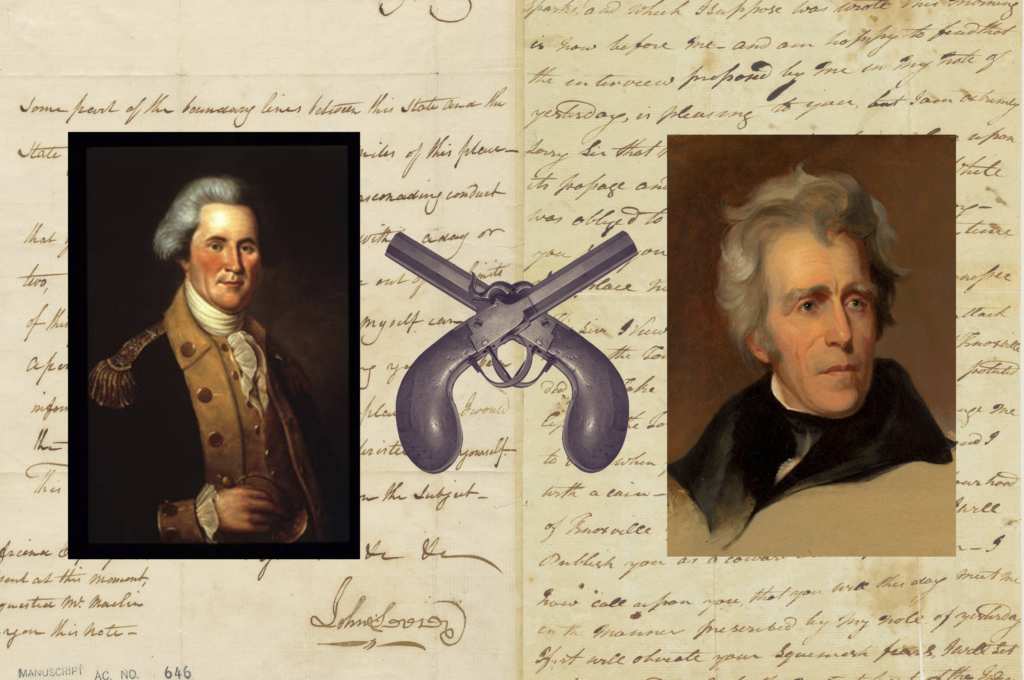
What happened when Sevier and Jackson met to duel?
On this episode, we dive into the wild saga of the (almost) duel between John Sevier and Andrew Jackson. Plus, the local news for February 25, 2025 and a look at services for unhoused people in our area.
Below is a partial transcript of the episode:

It’s February 25th, 2025. I’m Nina Cardona. And the podcast is going to be just a little different today. In a moment, you’ll get the usual news update from one of my colleagues at WPLN News, plus a longer story from Nashville Public Radio. But there’s something I think about often that I figured I’d talk about here.
You know I usually start this podcast with a snippet from history… and, somehow, there always seems to be something from the past that lines up at least a little bit with what’s going on today. Well, there’s nowhere that I notice that more consistently than bad behavior by politicians. “Not all lawmakers” of course, but at any given moment, there seems to be someone in public office whose actions are making people see red. And I don’t mean in their official stance. I’m talking about their personal behavior. People in power doing things that nobody should do.
Our response to that kind of behavior, quite often, is “what have we come to? How did we get to the point that our elected leaders think they can act like…that?” I’ve certainly said those words myself. But history reminds me that it’s one of those things where, well, the more things change, truly, the more they stay the same.
Case in point: a drama that played out in the early days of Tennessee. It involves the state’s first governor, John Sevier, and Nashville’s own Andrew Jackson, who at that point, was a judge on the state’s Superior Court (Tennessee’s judicial system worked on a different model then, but suffice it to say that was basically the highest bench for a judge at the time).
Now, Jackson and Sevier did not like each other. At all. They clashed on a laundry list of issues, both personal and political.
On October 1, 1803, both men were in Knoxville. Jackson was there for court hearings, and just outside the courthouse, on a public plaza, Sevier was giving a speech. His first term was almost up, and he was running for reelection. Well, Jackson walked outside to see what was going on, Sevier noticed him in the crowd, and his campaign messaging just went totally by the wayside. Evidently, he pointed Jackson out and ripped into him. At some point, Sevier insulted Jackson’s wife, Rachel, which was always guaranteed to get a rise.
Things turned violent on the spot. Sevier pulled out a sword. Jackson lunged at him with a cane. Friends pulled out their pistols, and shots were fired.
Can you imagine being one of the other people on the plaza that day? They came for a speech, and instead they had to duck for cover. The people running the state were acting out in the worst way, right in front of their faces.
And it wasn’t over.
The next day, Jackson sent a letter to Sevier, challenging him to a duel. Sevier accepted but insisted that he be able to name the time and place – which was basically the accepted etiquette – the person who challenged was supposed to let the other guy pick the place. And for more than a week, they went back and forth in increasingly heated letters arguing over where this duel would happen…until Sevier accused Jackson of being a coward who was using the argument to avoid actually dueling. And Jackson issued a public letter calling Sevier a, quote “coward and poltroon.” Which was just another word for the highest degree of coward.
Now, it’s tempting to retell a story like this just for the drama of it all, and then to wave it off by saying “but that was a different time. It’s just what people did back then. We can’t judge them by modern standards.” To assume that wasn’t really bad behavior then, even if it sounds horrible to our ears. To take the fact that two of a state’s highest officials wanted to duel as evidence that it was considered OK.
Dueling was definitely a thing in 1803. But it was not broadly accepted by society. It was against Tennessee law. And that was nothing new. A few years before this incident, this area was part of North Carolina, and that state gave the death penalty to men who killed someone else in a duel. Ben Franklin and George Washington were strongly opposed to the practice. Preachers were speaking out from the pulpit and publishing circulars about how evil it was to engage in duels. One person who delivered a particularly scathing take-down of it was John Catron, the first Tennessean to serve on the U.S. Supreme Court…who was nominated to the bench by none other than Andrew Jackson. He was Jackson’s friend, no less. As a judge in Tennessee, Catron disbarred an attorney for dueling.
All that to say, this story of the argument between John Sevier and Andrew Jackson is absolutely one of state leaders engaging in really bad behavior by the standards of their time. They upset a lot of Tennesseans. And they likely assumed they could get away with attempting to kill each other because they were in positions of power.
The two men did end up meeting with the intention to duel. Their friends managed to diffuse the situation and both walked away alive. Two years later, though, Jackson got into a similar situation with a Nashville lawyer. That time, he won the duel and killed the other guy.
So what does this say about life now? Well, for one thing, it’s a reminder that there will always be a subset of powerful people who think the rules don’t apply to them. It’s easy to look at an example of it happening as just one bad apple, deal with that particular guy, and move on. But that’s not true. It never has been, and it probably never will be. We do have to always be on the lookout for leaders who cross some kind of ethical line. That’s part of our job here at WPLN News. It’s one of the things journalists must watch for.
Believe it or not, I actually take a little comfort from this knowledge, too. Because the other side of the coin is that history also shows us ways that the people before us have ended these kinds of behaviors. In the case of the story I just shared, the proof is in Tennessee’s second constitution. In 1834, the state decided to dramatically revise its foundational document for a number of reasons. One of the things they added was a very clear statement that people who participated in duels, or even sent a challenge to duel, were not eligible for public office. It was too late for that to apply to Andrew Jackson. He was already president at the time. But they did set a guardrail that seems to have worked from that point on. And when we find ourselves tearing our hair out because someone voters trusted to be a leader has turned out to be a real problem, well, you know what…we can put our collective foot down, too.
Credits:
This is a production of Nashville Public Radio
Host/producer: Nina Cardona
Editor: Miriam Kramer
Additional support: Mack Linebaugh, Tony Gonzalez, Rachel Iacovone, LaTonya Turner and the staff of WPLN and WNXP
 On Air - 90.3 WPLN-FM