

When is our city’s birthday?
Nashville’s history as a city is a complicated one, and today, it looks far different than its founders ever could have possibly imagined. Plus, the local news for April 24, 2025, and taking a look at Tennessee farmland.
Below is a partial transcript of the episode:

It’s April 24th, 2025. And you could say this is Nashville’s 245th birthday.
Now officially, technically, our city was founded on Christmas Eve of 1779. That’s when a group of men led by James Robertson arrived by land at a spot on the Cumberland River that scouting teams had come to know as French Lick. That group of men picked the spot for a settlement on the river bluffs, where downtown is now. They got to know the area, finding plenty of trees to cut for wood and open grassy spaces that were kept clear by the trampling of large animals.
They hunted bears, panthers, wolves, foxes, buffalo, deer, elk. To start off, they lived in rude huts in a clearing, using bear oil as their only cooking fat. Then they formulated a plan to build several fortifications in the area, including where Goodlettsville, Gallatin and Donelson are now. They set aside pasture areas for the livestock they’d driven with them on their journey. They began to build the cabins that would come to form the heart of Fort Nashborough.
They got things ready. But let’s be honest. That was just the advance team.
That initial community couldn’t really be whole until this day in 1780. In some ways, those men might as well have just been on an extended hunting trip until the boats arrived.
And by boats, I mean the fleet of flatboats lead by John Donelson. They had taken the much longer river route from near the spot where Tennessee, North Carolina and Virginia now come together: they’d travelled a thousand miles by water. And on those boats were the wives and children of the men who’d come by foot and horse. Those boats held the possessions needed to furnish the structures they’d been building, to make them homes instead of just shelters. And enslaved people were also brought on those boats: the laborers who would be forced to do much of the physical work of turning a rough encampment into a town and cultivating the fields on the land the white settlers had divvied up for farms.
This day, April 24th, is when the boats landed and this place really became a community, in good ways and in troubling ones. This is when they really started the work of figuring out the complexities of living together for the long haul.
Which is not to say that they hadn’t known each other before this day. They’d been part of a different community together around Kingsport, at least for a little while. They were families, friends, loved ones, drinking buddies, hunting pals, co-conspirators in a mad scheme to start fresh in what they considered to be an untamed frontier.
But in the months since the Robertson and Donelson parties had last seen each other, they’d been through a lot, separately. They’d had the kind of experiences most of us would consider life-changing.
The Robertson group that came by land had that head start during what seems to have been a bitterly cold winter. How cold? Well, they had no trouble getting to the bluff side of the river because the Cumberland was frozen solid when they arrived. It was a difficult existence for those first few months.
And as for the families arriving by boats? They’d had first-hand experience to counteract the claims of the scouting teams who’d said this new land was empty of humans. And their experiences provided what they probably should have taken as proof that the agreement they considered a green light for white settlement in this area wasn’t seen that way by most Cherokee and Chickamauga people.
At several points during the journey, Native groups attacked the fleet that they saw as an invading force of land thieves.
And honestly, the settlers should have seen it coming. In a piece of history that is rarely taught these days, during the years immediately leading up to the journey to found Nashville, what is known as the Second Cherokee War had been fought over land that was supposedly sold for settlement. A lot of blood had already been shed. The Native peoples had made it very clear that they did not actually agree to the treaties and purchases that were so often touted: sometimes because they had actually agreed to much more limited terms, sometimes because greedy speculators had knowingly signed deals with rogue individuals who didn’t have the authority to speak for the Cherokee Nation, sometimes because the laws in effect at the time flat out did not allow for the kinds of agreements that the settlers were treating as permission to move into Native territory.
From the Cherokee perspective, the war was still ongoing, and these people had just floated onto a battlefield. And battle is exactly what they got at several points along the trip.
And so, on this day in 1780, when the Robertson and Donelson parties reunited, they were not the same people they’d been the last time they saw each other. Not everyone had made it, either. And as much as they were triumphant and relieved to be together again, they knew that there were far more challenges ahead of them. In Donelson’s journal, he wrote that they experienced “pleasure” and “satisfaction” at the reunion, but he also looked around at his new home, described what Robertson’s crew had been able to do in their four-month head start and summed it up with these words: “our prospects at present are dreary.”
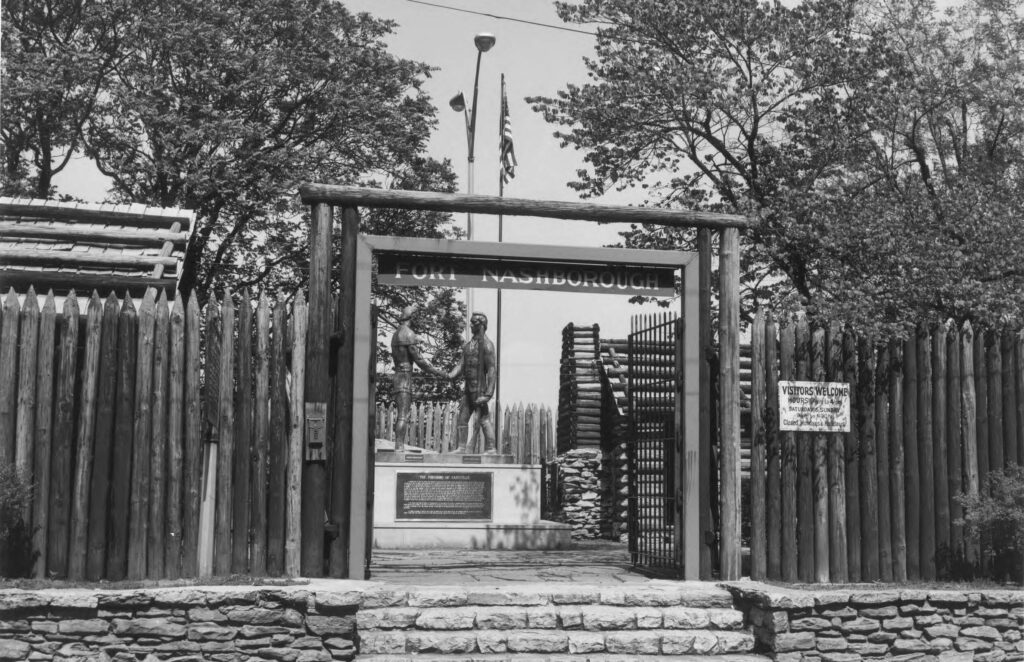
Things certainly turned around for Donelson. Those bluffs now house a city far beyond anything that group could have imagined. More bustling, more developed, certainly more diverse, with all the joys, challenges, triumphs and heartaches that those factors have combined to make through the years. The city has developed a sort of personality and brand that I’m sure its founders couldn’t have imagined in a thousand years. But if you walk along the bluffs, near the recreation of Fort Nashborough, you can find a statue commemorating the start of this ongoing municipal journey: Robertson and Donelson greeting each other with a handshake just above the Cumberland.
Credits:
This is a production of Nashville Public Radio
Host/producer: Nina Cardona
Editor: Miriam Kramer
Additional support: Mack Linebaugh, Tony Gonzalez, Rachel Iacovone, LaTonya Turner and the staff of WPLN and WNXP
 On Air - 90.3 WPLN-FM