
How did a boy from Belle Meade become a notorious drug runner?
An abandoned plane leads to the colorful story of a Nashville man who broke bad before finding God. Plus the local news for April 20, 2026 and grassland restoration.
Below is a partial transcript of the episode:

It’s April 20th, 2026
And I’m not going to lie. It feels a little wrong to be the person at WPLN telling you the story that I’m going to tell you today. Because back when it happened, starting on this day in 2012 and developing bit by bit for the next few years, my boss, News Director Tony Gonzalez, covered the story for The Tennessean. He was the first one in town to put the pieces together. And let me tell you, what he found was a story and a half!
But I’ll do my best to do him proud.
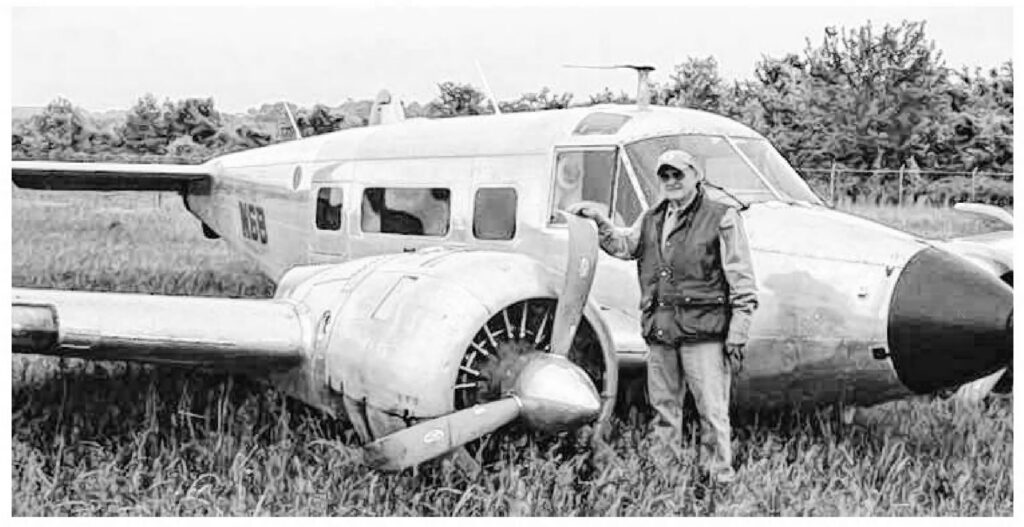
Our story starts on a Friday night, right around midnight. The man piloting a small plane over Nashville used the lights around Opryland as a guide to find his way to an old airfield he’d used plenty of times before. But as he descended towards the runway, the landing gear didn’t deploy. The pilot managed the situation with skill, aiming for the grass just beside the surface, controlling the angle of the aircraft as it hit the ground, making it slide on its belly so softly that it didn’t trigger a crash locator beacon even as it travelled two-tenths of a mile before stopping.
He called his wife, who was at their home in Dickson County. She picked him up. They left the airplane behind.
Now, one thing to understand about the airfield is that it wasn’t supposed to be used by planes anymore. When it was operating, the Cornelia Fort Airpark in East Nashville was a privately-owned facility. For about 60 years or so, it was a place folks could land light aircraft like the one in our story. You know, the kind of planes that only hold a few people, at most. The property was on the banks of the Cumberland River, with the runway situated parallel to the water. It flooded badly in 2010, and that was pretty much the end of the airpark.
It officially closed in 2011. The city bought the property to be an extension of the Shelby Park Greenway. The runway was painted with giant yellow Xs, a signal to pilots saying “don’t land here.” And that was the state of things on April 20th, 2012.
So, you can imagine the surprise the next morning when a Parks department employee spotted a shiny, silver, twin-engine Beechcraft in the grass. The worker didn’t call the police right away. But when the plane was still in the same spot the next day, law enforcement was brought in.
A press release issued at the time by MNPD and the FAA says they examined the plane and didn’t find any kind of cargo or contraband on board. There wasn’t any sign of injury. They noted that the pilot hadn’t been in contact with Nashville’s air traffic control tower. But they did say they had reason to believe the pilot may have previously housed the aircraft at Cornelia Fort. Most importantly, they said they didn’t know whose plane it was, but were hoping someone in the community could provide more information.
Well, as it turns out, it was a very recognizable plane. In fact, by the time the press release was circulated identifying the plane’s owner, our own Tony Gonzalez had already identified that the pilot who crash landed and walked away must have been Russell Brothers. And Tony had actually already interviewed him for the Tennessean. Yes, Brothers had frequented Cornelia Fort Airpark through the years.
Except, of course, for the eleven years he spent in prison.
You see, Russell Brothers was a Nashville native who grew up in Belle Meade and went to Montgomery Bell Academy. He was offered a football scholarship to Vanderbilt. But instead of making a career in medicine or banking or law, he became an international drug smuggler. In 1988, he was found guilty of sneaking 1.5 tons of cocaine into the United States. At the time, he owned a small fleet of air- and watercraft, which he used to pick up the drugs in South America, fly them to the Bahamas, get the cocaine into Florida on boats, and then drive it here to Nashville, where he’d meet up with people who then took the cocaine to Canada. At least, these are the details we’ve heard from prosecutors. All of those vehicles were taken in what was, at the time, the biggest seizure in Florida history. His sentence was actually much longer than the time he ended up serving: the judge wanted him to stay in prison for 60 years.
In 1992, while he was in prison, prosecutors filed more charges against Brothers. This time, he ended up striking a deal to tell what he knew about another smuggler. And that’s how he ended up getting out of prison after just under a dozen years.
He stayed out of the attention of law enforcement for more than a decade. But in 2010 he was charged with stealing someone else’s airplane from John C. Tune airport, on the West side of Nashville.
But back to 2012.
Less than a week after the crash landing, Brothers’ home in Burns was searched. Authorities say they found 16 firearms: revolvers, rifles, a shotgun, and they said out he’d given other guns to friends and asked one of them to lie to investigators. Given his prior conviction, Brothers didn’t have the legal right to own a single one of those guns.
And so, in 2014, Russell Brothers, by this time a 77-year old man, agreed to plead guilty to felony gun charges. Under the terms of his deal with prosecutors, he was sentenced to 15 more months in prison.
Brothers said he knew that if he tried to fight the charges, he could have ended up dying in prison. Instead, the man who’d said he found God and turned his life around during his first go at serving time said he would keep his head down, read and study until he was freed again.
Tony’s reporting from the time says Brothers tried to donate the shiny silver airplane for display in the park where he crash landed it, but Metro wasn’t interested in keeping that souvenir.
Credits:
This is a production of Nashville Public Radio.
Host/producer: Nina Cardona
Editor: LaTonya Turner
Additional support: Mack Linebaugh, Tony Gonzalez, Megan Jones and the staff of WPLN and WNXP
 On Air - 90.3 WPLN-FM