

How did a vicious attack on Black people in Tennessee relate to landmark constitutional protections?
The same part of Tennessee where the loss of Voting Rights Act protections could be felt first was once the sight of a brutal event that spurred passage of the 14th Amendment. Plus, the local news for May 1, 2026, and RaDonda Vaught.
Below is a partial transcript of the episode:

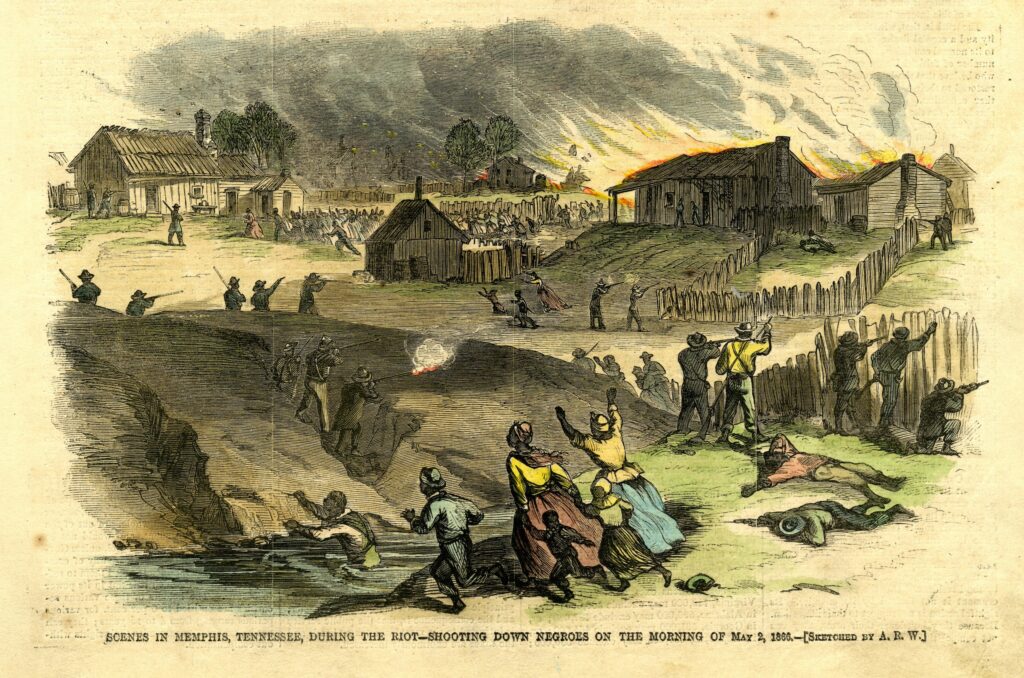
It’s May 1, 2026. A really awful thing began in Memphis on this day in 1866. It was the most intense racism in action: a massacre of Black people that lasted several days. In the years since, it’s been largely forgotten. But at the time, it horrified and galvanized the nation. It’s credited as one of the events that spurred passage of the 14th Amendment.
The brutality of what happened in Memphis proved how badly the United States needed to recognize everyone born in this nation as citizens with full rights – and full protections – under the law.
Sometimes, trying to understand a specific event in history can be complicated. Even if there was an official investigation, people didn’t always keep clear or detailed records, so you might have to piece together accounts, some of which weren’t put on paper until well after the fact.
The Memphis Massacre was different. It was shocking enough to merit a Congressional investigation very soon after it happened. A select committee travelled from D.C. to Tennessee and interviewed nearly 200 people over the next couple of months. Their report was entered into the public record, and you can read the whole thing now online, along with the initial report filed that month by an officer with the Freedmen’s Bureau who investigated in the days immediately following the massacre.
Those reports are full of references to generals and the Army. This was just over a year after the end of the Civil War, but that just meant an end to the fighting, not an end to the military presence in the former Confederate states. The South was deep in Reconstruction.
Anyplace with a heavy Union Army contingent had become a place for now-free Black people to gather as they began creating new lives for themselves – on the hope or assumption that the Army would offer a degree of protection from folks who were unwilling to recognize their emancipation. The Black population of Memphis quadrupled to 20-thousand. There was also a large contingent of Black Union soldiers posted to the fort in Memphis.
But with it being a year out from the war’s end, it was time to start thinning the Army back down and returning soldiers to civilian life. The day before the massacre, that Black unit in Memphis started the process of decommissioning troops and paying them for their service. So now, in addition to the thousands of new Black civilian residents, there was also this group of Black men walking down the street with a decent amount of money in their pockets.
I assume you have a pretty good idea of what kind of grumbling was going on in the parlors of white households and how it probably reached a fever pitch.
So, against that backdrop, there was an incident on the first day that Black soldiers were decommissioned. A group of Black men were forced off the sidewalk by a group of white police officers. One of the Black men fell, an officer tripped over him, the two groups started to fight, but pulled away. According to the Freedmen’s Bureau report there was some exchange of words along the lines of “just wait, next time I see you you’re really going to get what you deserve.”
Now, that’s just one, isolated fight, right?
Well, word spread.
The next day, May 1st, police stopped a group of newly discharged soldiers who were celebrating the end of their service with a few drinks. They were arrested on accusations of being drunk and disorderly. And that encounter erupted. The officers began firing their guns, not just at the men they were arresting, but into the crowd. This was a Black neighborhood, so it was Black onlookers and passersby being shot at by white police.
And from there, it was like a dam broke.
Word reached white neighborhoods, where men started gathering in the streets eager to join in. One city official gave an impromptu speech to those crowds, specifically saying they should grab their firearms and use them to kill any and all Black people. Whoever they didn’t kill, they should run out of the city. He didn’t imply it. He said it outright.
His marching orders were followed for three solid days.
Whatever horrible thing you can imagine was done to the Black people of Memphis, it happened. Some of the things that were done are probably worse than what you can imagine. It was utter brutality. No one with dark skin was exempt from vicious attacks, theft, arson, rape or murder.
There were at least 46 killed and 75 injured, but that’s just who could be counted afterwards. The accounts say a lot of people just ran and never came back. There’s no telling how many of them were wounded. Men and women, children and old folks, no one was spared. 100 homes were destroyed. Every Black church and school in Memphis was wiped out. All of them.
As word spread around the nation, people recoiled in horror. They said, “this kind of thing can’t be allowed to happen.” That’s why Congress stepped into investigate.
But then, just days after that committee’s report was published, a similar massacre happened in New Orleans.
It took horrible abuse and death for the nation’s leaders to recognize that it wasn’t enough to carry out a probe and talk about how to deal with the specific individuals in the specific community where the violence first erupted. A systemic problem needed a systemic solution.
And that’s what the 14th Amendment was supposed to be.
I think we all know the amendments passed after the Civil War did not end racism or violent acts targeting Black people. Roughly a century after they were added to the constitution, the Civil Rights movement ushered in a new wave of laws meant to further shore up the rights and protections of citizens, regardless of race. They were supposed to make sure minority groups weren’t frozen out of a chance at representation or maneuvered out of the right to have a say. The Voting Rights Act of 1965, signed 99 years after the Memphis and New Orleans massacres, was carefully designed to break down the de facto apartheid that kept the halls of power overwhelmingly white – because that imbalance had clearly made it easy for the powers that be to ignore the cruelties that were still taking place.
And just a few years after that, as racial tensions continued to boil, Martin Luther King Jr. was shot and killed just blocks away from the spot where the Memphis Massacre had started.
This week, the Supreme Court issued a ruling that essentially eliminates a key provision of the Voting Rights Act. And within hours, one of the first reactions to that ruling was one that would directly impact the exact neighborhood, the exact Black community where the massacre happened so many years ago.
Before the end of the day, Tennessee senator and gubernatorial candidate Marsha Blackburn presented a map for potentially redrawing the Congressional district lines in West Tennessee. Her plan would do to Memphis what was done to Nashville a few years ago: carve the city into pieces, diluting the impact of an urban and heavily Black community by putting its neighborhoods into districts where those residents are outnumbered by rural, primarily white communities in other counties. To make it work, her map makes long, skinny districts that stretch as far as 200 miles from one side to the other.
She can’t make that call. Neither can the governor. District lines are set by the General Assembly, which just adjourned for the year. But Blackburn is suggesting they reconvene for a special session. If that happens before this year’s midterm elections, Tennessee could lose its only reliably Democratic seat in Congress before the end of the year.
Credits:
This is a production of Nashville Public Radio.
Host/producer: Nina Cardona
Editor: LaTonya Turner
Additional support: Mack Linebaugh, Tony Gonzalez, Megan Jones and the staff of WPLN and WNXP
 On Air - 90.3 WPLN-FM