

Why is there so little to remind us of the way Native nations were displaced via Tennessee routes?
Thousands of people from five Native nations were forced to leave their ancestral lands on foot, and many of them walked through our communities on their way West. Plus, the local news for May 28, 2025, and this week’s edition of What Where Whens-Day.
Below is a partial transcript of the episode:

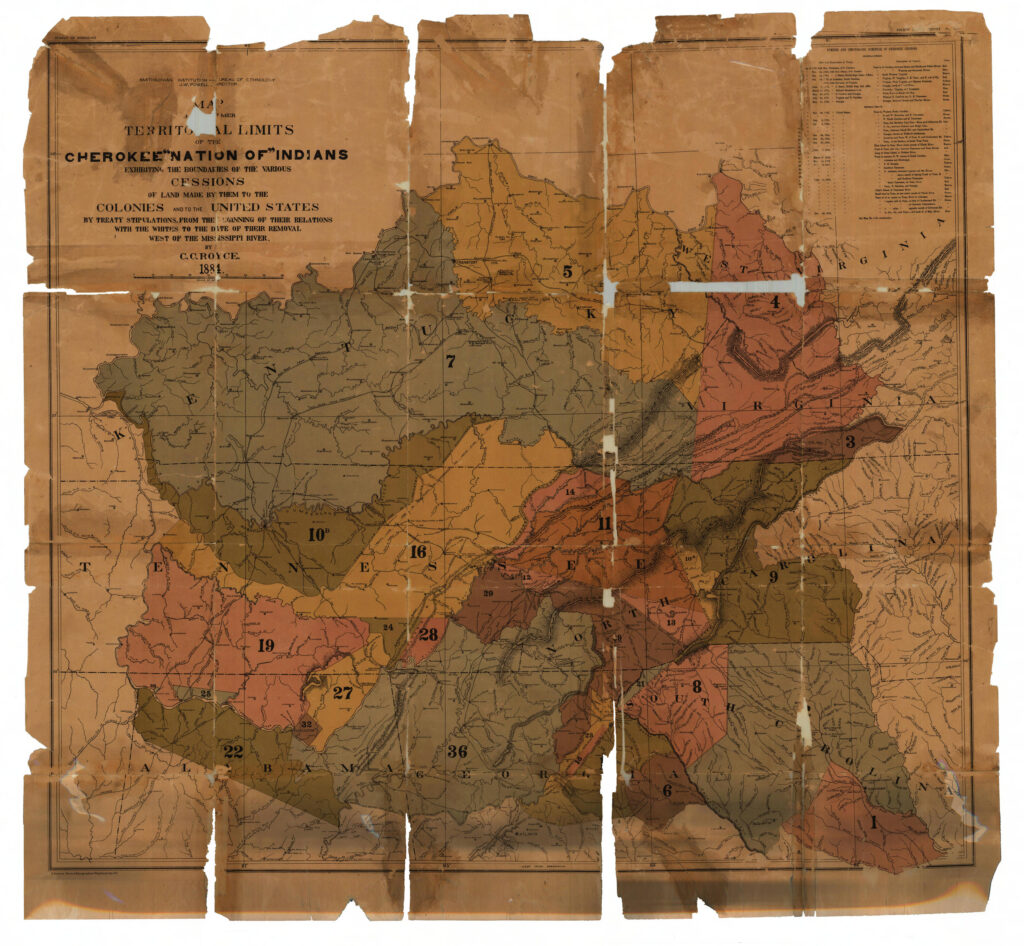
It’s May 28th, 2025. On this day in 1830, President Andrew Jackson signed the Indian Removal Act into law. That law opened the door to what we now call the Trail of Tears: the forcible removal of several nations of Native groups, from their ancestral lands in this part of the United States to what is now Oklahoma. And part of living in Middle Tennessee now is that you’ve very likely travelled or crossed at least one portion of the trail taken by the Cherokee people who were displaced – even if you didn’t know it.
The Trail of Tears was not just one path. The people being moved out west were all headed to one specific zone: beyond all the land that White people wanted at the time, into the wilderness that might as well have been labelled “there be dragons” on the map. They shared that destination. But they came from all over the Southeast. Tens of thousands from the Cherokee, Creek, Chickasaw, Choctaw, and Seminole nations. They were made to leave their homes in Georgia, Tennessee, Florida, Alabama, the Carolinas.
There were mountains and hollers and rivers to navigate around, which necessitated many different routes. And the variety of folks in charge of leading those groups had various opinions about which way was the best for whatever time of year they happened to be making the journey. Altogether, that means the actual trails that make up The Trail, so to speak, are many. And they are all over this area.
Here in Nashville, for example, one of the paths followed Murfreesboro Road and Lafayette into downtown, then along Second Avenue, and North on Whites Creek Pike.
Down in Rutherford County, the main gate of the old Air Force base in Smyrna stands at roughly the same spot where one of the trails turned after following a branch of the Stones River for a while.
These trails are everywhere, with few if any signs left to show that one of the most significant events in American history took place there.
From the very start, the people who settled these lands, the ones who stood to gain from them being opened to farmers and people wanting to start new communities and businesses — those folks didn’t really want to look at the removal face-on. There are very few mentions of it in local newspapers from that time.
The fact of how the land became available for white folks to use tends to be left out of the stories passed down through families. It certainly was in mine. It was only a few years ago that the penny dropped for me, and I realized that the dates when my ancestors first moved into Southwest Tennessee and Mississippi aligned almost perfectly with when the native people were forced out of those areas.
But the Midstate residents of that time had to have been very aware of exactly what was going on, even if they didn’t want to be.
On average, each traveling group had about a thousand people. A thousand, most of them on foot. That’s a very large group moving very slowly. Walking right through towns and cities.
Nashville was the biggest community in this area by far, and its population was only about 6,000. Most of the other places where the trail passed through, the traveling group far outnumbered the locals. Imagine the impact it must have made. For those who watched them go by, it must have been the kind of sight that sticks with a person their entire life.
But how many just closed their doors, pulled the curtains tight, and essentially shut their eyes? They believed what they were told, that all of the Native people, no matter their nation, were the same. And what they were, according to the propaganda, was trouble. Violent. Savage. They were told to be scared, and they were.
And once all was said and done with the Trail of Tears, it was out of sight, out of mind. The Southeast as a whole seemed to agree to basically pretend it never happened.
But, of course, it did happen. And, of course, it had a profound and lasting impact on the thousands who were forced to leave their homes. To those who lost loved ones on the way. Who had to figure out a new landscape, new ways of finding food, making shelter and starting from scratch on the other end of that long, painful walk. They and their descendants have never forgotten what took place.
Each year, there are gatherings in various places along those trails to remember what happened. There’s a memorial walk for members of the Choctaw Nation in Oklahoma. A huge motorcycle rally follows close to one historic route from North Carolina down to Huntsville and back up through Memphis and Arkansas, all the way to the Seminole Nation’s reservation in Oklahoma.
Here and there, you can still find remnants of the original footpaths to walk and remember on your own. I’ve hiked along one section in David Crockett State Park near Lawrenceburg. Which is sadly, fitting. Crockett was basically run out of Tennessee politics because of his opposition to Indian Removal. And when it finally happened, officials pointedly made sure one of the paths cut through that property, which was Crockett’s homestead. The message was loud and clear: “you want these people around? Well, see how you feel when they’re marched through your land a thousand at a time.”
That kind of ugliness and disdain was the prevailing attitude for a long time. But with the passage of time, more and more people in our area are interested in raising awareness of that part of our history. And one by one, markers and monuments are being added to spots along the routes. In Pulaski, for example, there’s now a Trail of Tears Memorial Interpretive Center, with a museum, a park, and bronze statues depicting a Cherokee family.
After all, just because previous generations tried to turn a blind eye doesn’t mean we should.
Credits:
This is a production of Nashville Public Radio
Host/producer: Nina Cardona
Editor: Miriam Kramer
Additional support: Mack Linebaugh, Tony Gonzalez, LaTonya Turner and the staff of WPLN and WNXP
 On Air - 90.3 WPLN-FM