

Why was Tennessee once the prime example of how the United States should (or shouldn’t) handle a major issue?
These days, Tennessee is treated as a foregone conclusion in national political campaigns, but there was a time when this state was at the very center of the biggest dispute of the day. Plus the local news for July 24, 2024 and this week’s edition of What Where Whens-Day.
Below is a partial transcript of the episode:

It’s July 24th, 2024, the anniversary of a big event in Tennessee history. On this day in 1866, Tennessee was officially readmitted to the United States of America after the Civil War.
Sometimes in presidential election years like this one, Tennesseans kind of wonder how much our state really matters. We watch the news coverage that shows maps of swing states where the campaigns efforts are focused, and, for better or worse, Tennessee tends to be shaded in whatever neutral background color they’re giving to the states that aren’t getting the rallies, ad blitzes and on-the-ground campaigning. It was kind of exciting the other day when this state’s Democratic party was quick to commit delegates to Kamala Harris for the simple novelty of Tennessee being in the headlines as part of this news cycle.
Well, things were different after the Civil War. Tennessee was right at the center of the national conversation about how to reintegrate the former Confederate states. In fact, Tennessee was the very first one to rejoin the Union.
That’s in no small part due to the fact that, for much of the war, the majority of the state was under control of the Union Army. People lived under martial law and were expected to make loyalty oaths to the United States. A lot of conditions placed on other states during Reconstruction were sort of piloted in Tennessee while the war was still underway.
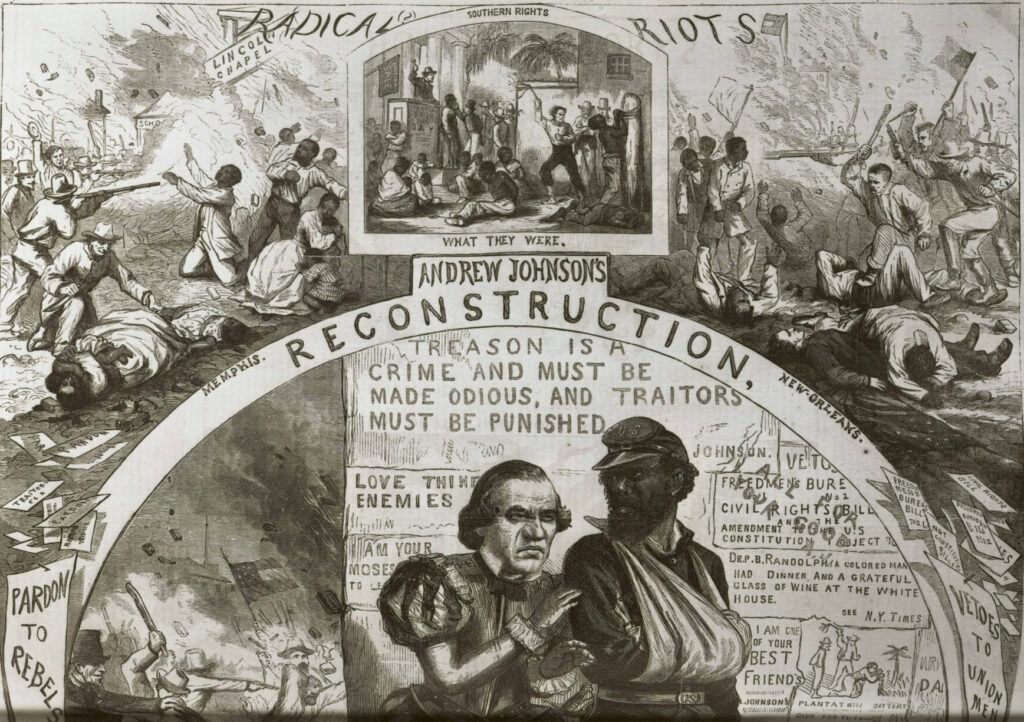
And of course, during that time, President Lincoln appointed a military governor over Tennessee, a man who had formerly led this state as a regularly-elected governor. And by the time the war ended, that man was Lincoln’s vice president. Which meant that in 1866, due to Lincoln’s assassination, Andrew Johnson was in the Oval Office, attempting to lead the nation through the hard and politically loaded work of reintegrating the South.
On this day, as he formally gave his approval to the resolution making Tennessee — his home state — a U.S. state again, Johnson made remarks saying Tennessee leaders had done what was needed. They’d agreed to the Constitutional amendment outlawing slavery, they’d agreed to submit to the leadership of the Federal government, they’d held new elections to select a new, representative government under U.S. guidelines. “What more could you want?” he seemed to be asking. And he explicitly said that Tennessee was the model to follow when bringing the rest of the former Confederate states back into the fold.
Turns out, there was still quite a bit of disagreement over what should be expected of those states. The fighting over those matters would lead to Johnson’s impeachment about a year and a half later.
Credits:
This is a production of Nashville Public Radio
Host/producer: Nina Cardona
Editor: Miriam Kramer
Additional support: Mack Linebaugh, Tony Gonzalez, Rachel Iacovone, LaTonya Turner and the staff of WPLN and WNXP
 On Air - 90.3 WPLN-FM