


Watching how an artist operates in the studio can be revealing. On a chilly November night, Nashville R&B singer-songwriter Shelldhn has brought an unfinished instrumental to his producer KJ’s home studio. As KJ adds synth pads and a punchy kick drum pattern to the track’s Spanish guitar, Shelldhn becomes the hype man, chanting “Wow! You’re a genius!” on the rhythm pattern’s syncopated accents.
Then the artist steps up to the mic in the corner and begins murmuring a snaking, wordless melody. One phrase at a time, he fleshes out a chorus and verses that plea with a love interest not to take advantage of him, then begins punctuating phrases with precipitous vocal runs and layering on precise, multipart harmonies. Shelldhn has a naturally exuberant demeanor, but it’s when he’s improvising this vocal arrangement that he’s at his most dynamic.
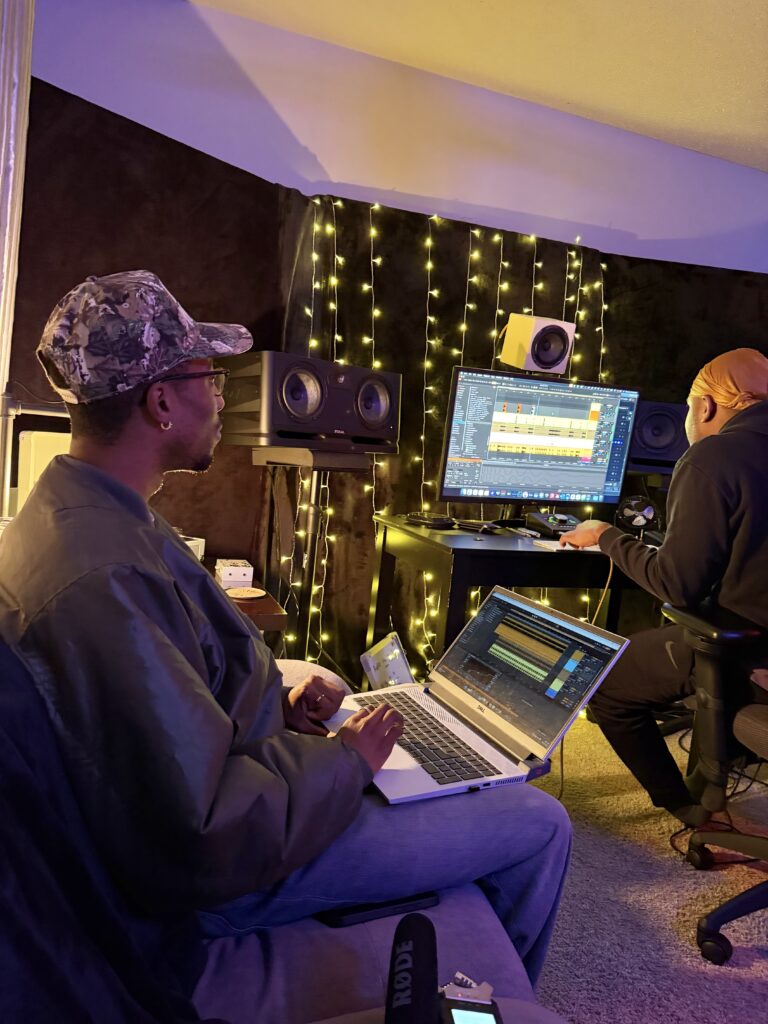
Shelldhn and producer KJ in the studio; photo credit: Jewly Hight
“It goes back to the church,” he explains in an interview weeks later. His mother directed church choirs for local congregations, and he was eight when he got his first solo. “That was the first time I ever sang in public,” he recalls. “Seeing people’s reaction to that that, and seeing how the spirit moved, I’m like, ‘Wow, you can actually compel people through your voice.’”
His parents, who met in the theater program at Tennessee State, also put him in their church theater productions, “so everything I know about performing and entertaining and giving your best comes from how I was raised,” he says.
Shelldhn really did have the makings of a showbiz kid: “If it were up to me, I would have been on the Disney Channel at age 10 with my own sitcom, music and movies.” But the Hannah Montana or Raven-Symone path to stardom seemed inaccessible to a kid watching his city sell itself as the destination for people with country music dreams. He didn’t know any Black performers in Nashville who’d achieved the success they sought, so he figured that wasn’t an option for him either. Plus, he had other interests.
“I’m a big nerd,” he grins. “I love biology. I love science. I love the intricacies of the human body and how miraculous it is, and so I’ve always wanted to see how I could do that.”
‘I’m gonna build my own foundation’
Shelldhn was on track to go to medical school, until the pandemic interrupted his plans and he shifted to IT. It was then that he took note of the growing number of Nashville hip-hop and R&B artists and producers who were improvising their own paths. Among the names he reels off—Chuck Indigo, Mike Floss, Brian Brown, Tim Gent, Bryant Taylorr, Jamiah, Lo Naurel, A.B. Eastwood, Coleman and others—are shining examples of what it can look like to take your craft seriously, practice solidarity and cultivate a scene outside of the industry.
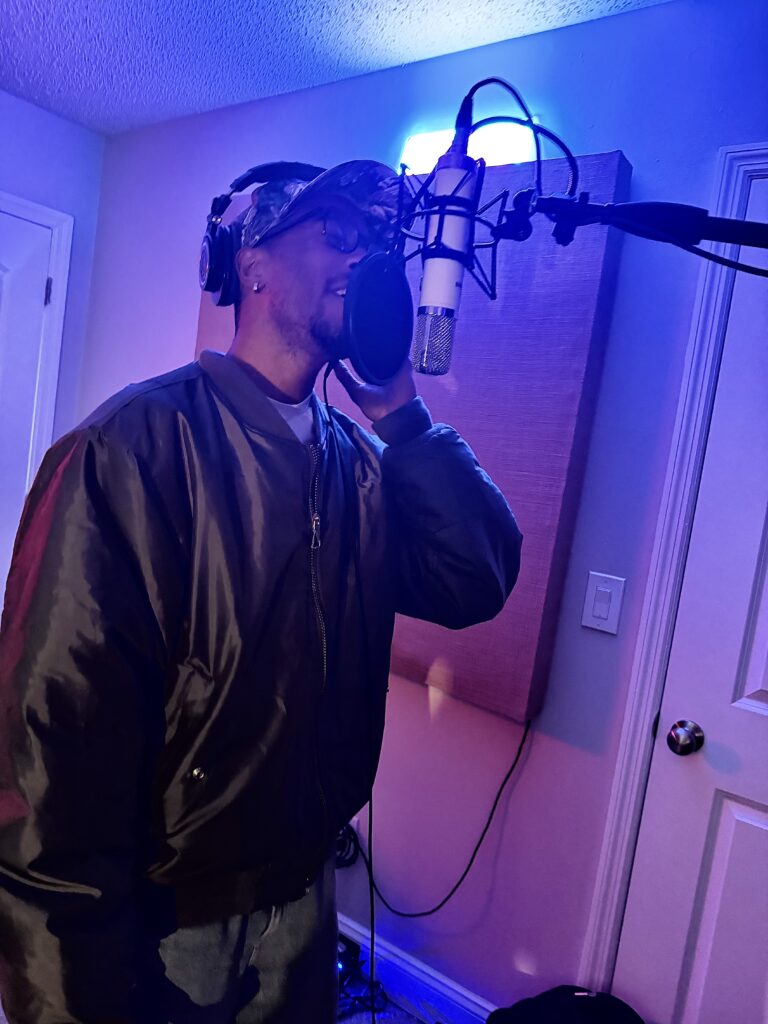
Shelldhn improvising multipart harmonies during a recording session; photo credit: Jewly Hight
“They showed me that in order to really do this on a local level, you’re going to have to continue to push yourself and you’re gonna have to be okay with being uncomfortable, be okay being frustrated sometimes,” says Shelldhn. “Especially as a Black artist here in Nashville who’s not doing indie or pop or country, we’re always continuously trying to find our footing. But what I [decided] is I’m not trying to find any footing. I’m gonna build my own foundation.”
When he started writing songs at age 21, he simultaneously applied his studious scientific mind to beatmaking, production and recording and every aspect of professional musicianship that he could. The community he admired helped him along. Some invited him to open their shows. Eastwood and Coleman let him use their studio to experiment. And Lo Naurel extended a career-launching offer.
Shelldhn was driving home from his cybersecurity gig one day when she called asking if he’d like to fill in for her singing backup on the road with a successful Christian group. Having witnessed him in action, Naurel felt confident that he had both the pipes and personality required. She’d seen, as she puts it, “how amazing and talented he is, and supportive of other artists in the city.”
Naurel was pleased that Shelldhn became her permanent replacement on the tour when she left Nashville for good. “He’s gone above and beyond just making me proud as someone who’s recommended him,” she says.
‘I did my job’
Shelldhn crammed in sessions for his debut album, ‘That’s Hot,’ between tour dates. But there were additional reasons that the recording process was a particularly involved one and stretched across three years. His vision for the project required meticulously dissecting pop-R&B production from the early 2000s: the sleek danceable bounce of groups like 112, B2K, Destiny’s Child and the oh-so-suave and fly loverman posture and dance floor dominance of Usher, Sisqó and Ginuwine. Shelldhn wanted to echo what made their hits feel indelible.
To their templates he brought a tenacious sense of melody. He positioned most of his taut, circling hooks in his upper register and delivered them with airy, lowkey swagger. And he heavily favored club bangers; only one of the 12 tracks is a bona fide slow jam. Shelldhn introduced himself as a frisky showman and seducer, while also nailing the sweet spot of Y2K nostalgia.
So much so that he says the record labels he played the album for declared it “too dated.” He was unfazed: “When people said that to me, I was like, ‘Well, that means I did my job.”
‘That’s Hot’ was a bit of an underground release when it came out in May, since Shelldhn steered clear of Spotify and its competitors and uploaded the album to just one platform, and a new, obscure one at that. It’s called Even. Like the more established site Bandcamp, it enables listeners to buy music directly from those who created it. “Let’s be real,” he reasons. “On these streaming services, you’re just leasing. You don’t own any of the music unless you’re purchasing it. I’m big on ownership.”
Shelldhn’s about fair compensation too. He tells me that when I spent 20 bucks to buy his album on Even, he and his collaborators really did see that money. And that, he points out, is more beneficial for his thoroughly independent music scene.
‘Let’s be about it on all fronts’
I first heard about Shelldhn’s music from his fellow artists Kyleigh and Amber Ais talking him up in an interview, suggesting to me that he’s a singer’s singer and an active participant in his community. All of that turned out to be true. He’s booked R&B nights around town to champion voices he believes in—with more such events planned for next year—and he doesn’t take their validation for granted.
“It’s different when people on the outside respect you,” he says, “but when somebody who is doing this with you respects you, who is also doing excellent work, that means everything to me. Because that means I’m on the right trajectory.”
Shelldhn’s spent much of his life in pivotal cultural spaces of Nashville, and his sense of musical lineage goes all the way back to the Fisk Jubilee Singers and the R&B powerhouses of Jefferson Street: “Let’s bring it back to the actual core, which is Black and brown bodies who helped shape this city just as much as our non-brown and Black counterparts did. I’m just really grateful to be specifically a Black artist from Nashville, making R&B.”
“If we are really about music, like we say Nashville is,” he goes on, “then let’s be about it on all fronts.”
 On Air - 90.3 WPLN-FM