
Transcript:
MICHEL MARTIN, HOST:
Parts of Texas, Louisiana and Tennessee are still trying to recover from a winter storm in January and the ice that downed thousands of trees. Caroline Eggers with member station WPLN reports on how Nashville is trying to rebuild its urban forest.
UNIDENTIFIED PERSON: Thank you.
UNIDENTIFIED WORKER: Thank you.
CAROLINE EGGERS, BYLINE: Jen Yurhousen (ph) walks up to a table to get her order.
UNIDENTIFIED WORKER: Hey. How’s it going?
JEN YURHOUSEN: Hey.
UNIDENTIFIED WORKER: First name?
YURHOUSEN: First name is Jen.
EGGERS: She’s picking up native trees. Well, really, tree saplings. They’re only a year or two old and look like thin, fragile twigs. Yurhousen carefully holds a young red oak and two elderberry saplings.
YURHOUSEN: These are really tiny. I’ve never planted a tree this little, so I’m going to have to baby them and give them some good dirt to grow in.
EGGERS: This is a tree sale coordinated by a nonprofit called the Tennessee Environmental Council. Yurhousen intends to replenish what the ice storm took out.
YURHOUSEN: We lost a bunch of trees at our house. Our neighbors lost a ton of trees, a bunch of branches. We actually just had our final branch cut down last weekend.
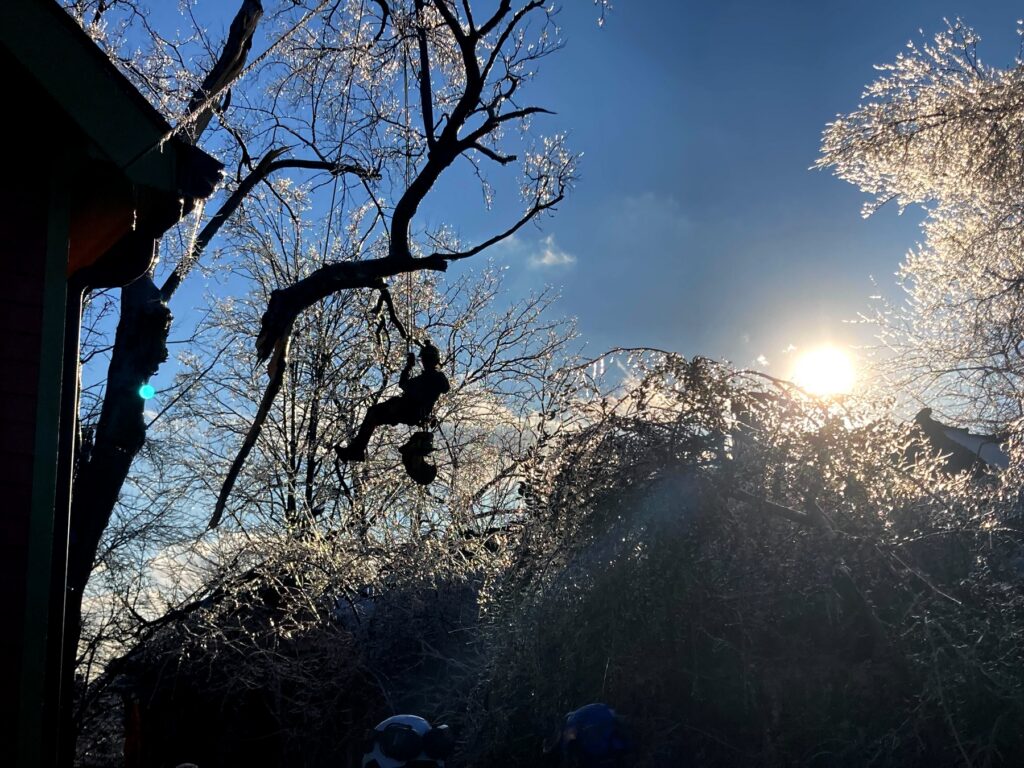
EGGERS: In just one night in January, some of Nashville’s oldest trees died. It happened fast, not just from wind, but from ice. Frozen water smothered every twig and branch. Before dawn, people woke to thunderous cracks as limbs and trees fell all over town.
(SOUNDBITE OF BRANCH BREAKING)
TERRY COOK: We were in the house, and we could just hear bombs hitting the roof.
EGGERS: That’s Terry Cook (ph). He’s a local naturalist. In the days and weeks after, he surveyed damage across the 3,000 acres of Nashville’s Warner Park, the city’s largest.
(SOUNDBITE OF DRONE BUZZING)
EGGERS: He used a drone to capture footage and counted. He estimated that 2,000 trees, mostly oaks, fell along pathways through the forest.
COOK: Which I think is really – it’s an underestimate. You could either see that double or triple or quadruple in terms of when we think about the entire park.
EGGERS: He says the forest will largely heal itself over the next few decades with some human help. Across town, city planners are replacing lost trees. The effort is led by city arborist Eric Kuehler. He says they’re very intentional about where and what to plant, in part because falling trees and limbs caused record power outages for as many as half a million people in Nashville. Some folks went without heat for 12 days. Kuehler says they’re also planting more varieties to get a resilient tree canopy because in the last five years…
ERIC KUEHLER: We’ve had tornadoes, we had in-line winds, we’ve got flooding. Now we’ve got this ice storm. We just don’t know when it’s going to happen.
EGGERS: Ice storms are rare on the threat list, and scientists are working to understand whether climate change is making them more probable in southern cities. But this one caused the most damage to Nashville’s trees. Jo Brichetto (ph), a longtime local naturalist, says some people may be spooked to plant big trees in their yards.
JO BRICHETTO: I spend so much of my time trying to soothe the fears of people about anything to do with nature, about bees and birds and critters and trees. And this is going to be hard to get people to want to plant trees again, but we have to do it.
EGGERS: Three months out, woody debris piles linger on neighborhood streets. And most trees that survived bear some scar from the storm. Nashville will know the full extent of the damage in 2028, when its next tree canopy assessment is due.
For NPR News, I’m Caroline Eggers in Nashville.
(SOUNDBITE OF THE CURE SONG, “A FOREST”)

 On Air - 90.3 WPLN-FM