

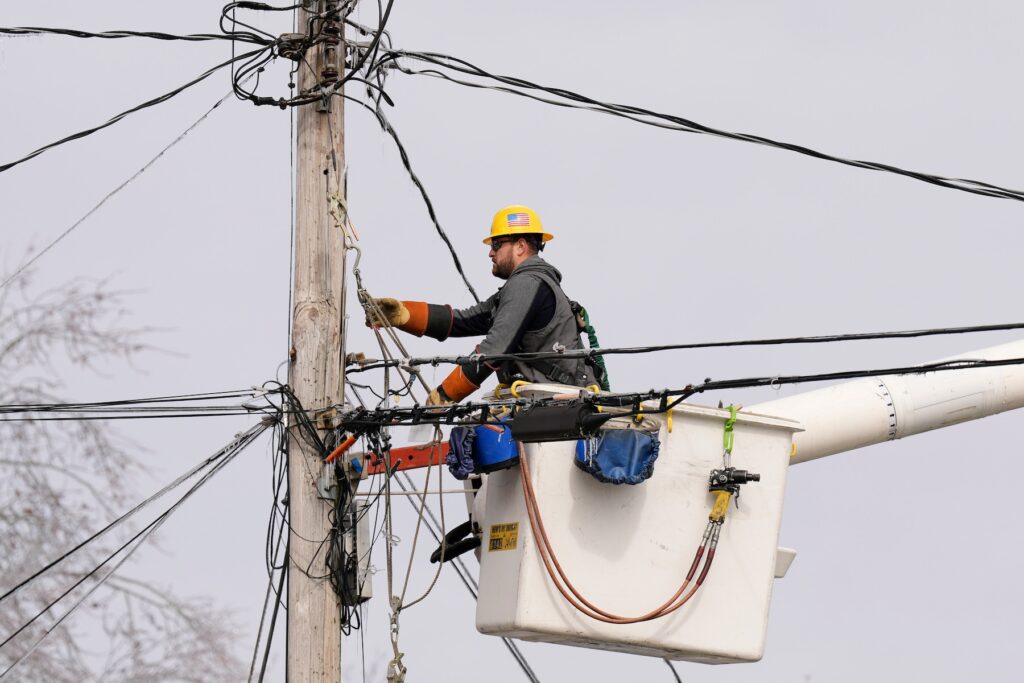
Winter Storm Fern knocked out power for about half-a-million people in the Nashville Electric Service coverage area, destroying hundreds of miles of power lines and about 400 utility poles. Now, the utility is bracing for repair costs. To cover them, customers could see higher bills.
The utility’s board had an emergency meeting at 8:30 a.m. Monday, which appears to have been announced over the weekend. That means it wasn’t the board’s normal monthly meeting, where materials are released days in advance and those wanting to offer public comment have ample time to prepare.
During the meeting, NES CEO Teresa Broyles-Alpin said the numbers haven’t been finalized, but it’s likely damages totaled between $110 and $140 million. And it’s unlikely normal revenues can cover the tab.
“While NES is in a strong fiscal position, this generational storm will require us to consider a range of options — like bridge financing or accelerating our planned bond issuance — to be able to avoid or minimize any impacts on rates,” she said.
Bridge financing is basically a quick loan for big organizations. It has a shorter payback period and higher interest rates. Bonds are a typical form of government debt; governments sell bonds to investors, who then get a small but reliable amount of interest over several decades. Metro took out $367 million in bonds for NES maintenance two years ago.
Repairs won’t be the only expense related to the storm. NES also brought in hundreds of contracted linemen to get power restored across the city. Broyles-Alpin said the total price tag hasn’t been nailed down.
But the meeting offered some clues. Under current rules, top NES executives can increase payments in major contracts by $500,000 without taking the issue to the board for a vote. She and NES proposed raising that cap to $5 million — saying it would be used only for winter storm labor costs. The board unanimously supported it.
Laura Smith, the top attorney for NES, said it would mostly be used for contracted labor on the powerlines.
“I know of three companies that brought in contract line workers — at a minimum — that will be included in that,” she said. “They are GMB, Delta, and Upper Cumberland. There may be others, but it really is limited to Winter Storm Fern recovery and for restoration.”
GMB Powerline Services is based in West Virginia that organizes for-hire line workers during major outages. It focuses mostly on utility customers. Delta Services is based in Louisville and focuses on industrial and commercial electric companies. Upper Cumberland is an electric cooperative based in Carthage, Tenn.
The cap increase was among concerns for Metro Councilmember Emily Benedict. The Madison and Inglewood representative spoke during the brief public comment period.
“That increases the expenditure authorization by the CEO by 10 times,” she said. “I think a 2X increase is acceptable, but I would ask that you reduce that … $5 million down to $1 million.”

 On Air - 90.3 WPLN-FM