

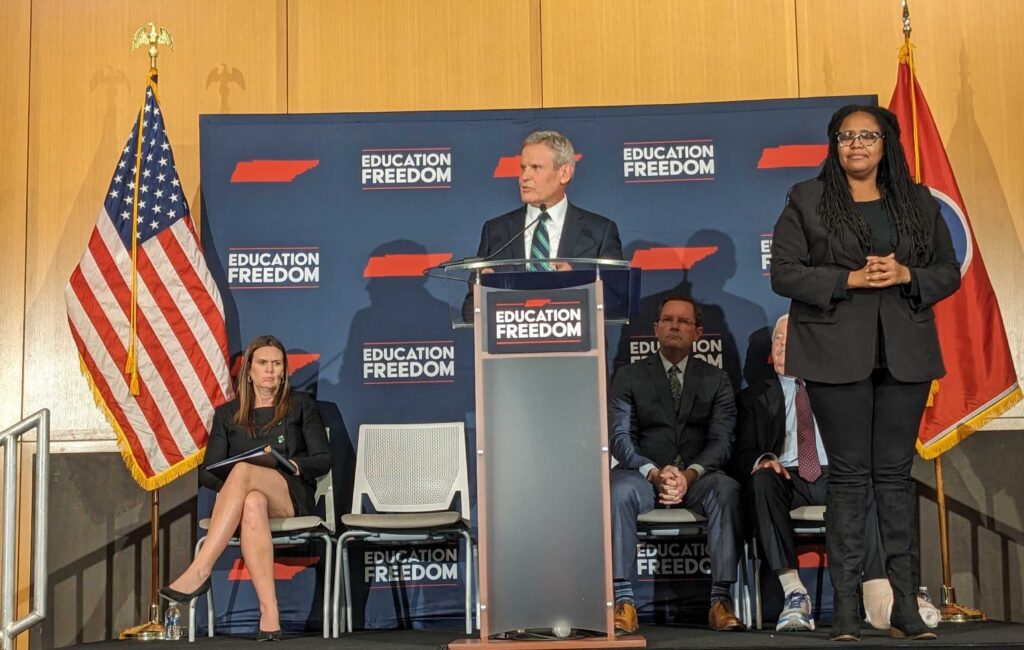
A new state report shows that students enrolled in Tennessee’s voucher program are underperforming compared to their peers in public schools.
The Education Savings Account launched in 2019 after lawmakers narrowly passed the program as a pilot approach on vouchers. It allows families to use state funds to defray the cost of private school. The award amount for the 2025-2026 school year is a little less than $10,000 for students living in Davidson, Shelby and Hamilton counties.
Gov. Bill Lee lauded the vouchers as a means for families to escape low-performing public schools. But a report from the Tennessee comptroller shows that most students in the program transferred from schools with average or above-average rankings.
These findings give fuel to concerns among critics who question the program’s efficiency, like Sen. Richard Briggs, R-Knoxville, who cited the report’s data about low scores on state assessments.
“I can be a little critical of the cost of these school vouchers and the less than stellar results for the students that went from public schools to private schools,” said Briggs. “The results are very poor.”
State law requires the Comptroller’s Office of Research and Education Accountability (OREA) to evaluate the program following its third year and annually thereafter and to provide recommendations to lawmakers. Though the program launched in 2019, it wasn’t implemented until 2022 due to legal challenges, so this is the first report.
The office found that voucher students’ scores on the Tennessee Comprehensive Assessment Program have increased over time but still remain lower than their public school peers and the statewide average.
In Nashville, by the end of the program’s third year, the performance gap on the English language arts portion of the exam worsened between voucher students and those enrolled in Metro Nashville Public Schools. Third graders who don’t perform well enough on the ELA section of the TCAP can be held back, according to state law.
While the ESA program has reported high rates of parent satisfaction, the comptroller’s report notes that only 15% of families provided any feedback last year.
Additionally, the program failed to meet capacity with 5,000 available vouchers but only 3,693 participating students, according to the report.
The pilot program’s expanded successor — the Education Freedom Scholarship — appears more popular, as more than 33,000 families applied for the available 20,000 slots in the first few hours that applications became available last year.
The new statewide universal program has no income cap and lawmakers expect to add 5,000 more vouchers this upcoming school year.

 On Air - 90.3 WPLN-FM