

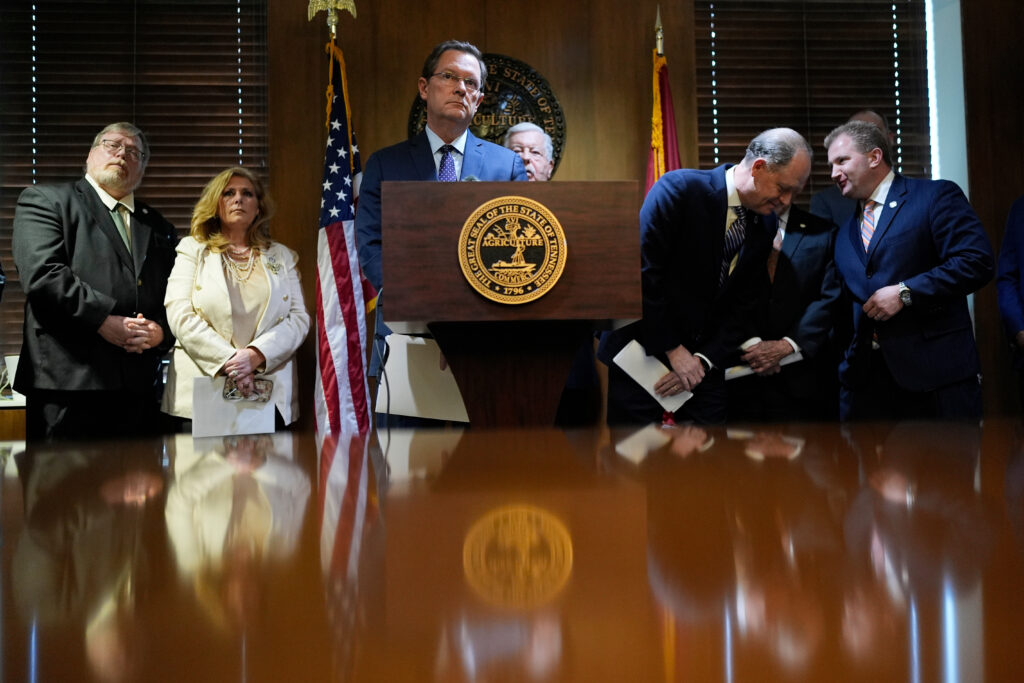
The Tennessee General Assembly has passed a measure that would make it a state crime to remain in the U.S. after a final deportation order has been issued.
Unlawful immigration is a civil offense, and the U.S. Supreme Court ruled in Arizona v. U.S. that states cannot legislate immigration since it’s a federal issue. HB 1704/SB 1779 has a “trigger law” that would give the state greater immigration enforcement power if that court case is ever overturned, the same way the state’s abortion ban went into effect after the reversal of Roe v. Wade.
The Senate voted Monday evening 26-6 in favor of the measure, which is part of an immigration package proposed by U.S. Homeland Security Advisor Stephen Miller.
Senate Majority Leader Jack Johnson, R-Franklin, who sponsored the bill, said it would not do much under the Trump administration, but would make a difference under a different administration with different immigration priorities.
“Under current law, you have to defer to who is in the White House at the particular time, and if the occupant of the White House is actually enforcing federal immigration law,” Johnson said.
Democrats argued that a law that challenging U.S. Supreme Court precedent would mean more court costs for taxpayers and eventually be struck down in the courts. Johnson, R-Franklin argued that they don’t know that it will be struck down in the courts since no other state has passed legislation like it.
“Tennessee may be the first, as we often are, to contemplate these things,” Johnson said.
Immigration attorney Alan King testified that a final order isn’t always the last word on immigration proceedings.
“An individual can receive a final order and exhaust all appeals options … and it is still a possibility for an immigration judge to reopen and dismiss that case under the right circumstances,” King said.
The bill now heads to Gov. Bill Lee’s desk for his signature. Despite other pieces of Miller’s legislative package passing both chambers, this may be the first bill to make it to Lee’s desk since the House and Senate versions of the bill are in sync.
 On Air - 90.3 WPLN-FM