

Private banks, hospitals and insurance companies in Tennessee could soon refuse to recognize same-sex marriages.
The Tennessee House passed HB1473 Thursday, which would exempt private citizens from federal anti-discrimination law.
On the House floor, Democrats argued this bill defies Obergefell v. Hodges, the Supreme Court case that legalized gay marriage nationwide.
Rep. Gino Bulso, R-Franklin, wrote the bill, which refers to LGBTQ+ marriages as “purported” marriages. He argued the measure is constitutional, as it only applies to how private citizens recognize same-sex marriages.
“It was the U.S. Supreme Court on June the 26th of 2015 that overstepped its bounds and invented this right to marriage of individuals of the same sex, despite there being no support whatsoever in the language of the 14th Amendment for that proposition,” Bulso said.
Bulso received overwhelming support from his fellow Republicans in Tennessee’s supermajority.
“The court decided to redefine something that Almighty God had not given that court the authority to redefine,” Rep. Monty Fritts, R-Kingston, said.
LGBTQ+ advocates, however, worry the law will go beyond personal belief and materially harm gay couples. In rural areas, community banks and smaller hospitals could refuse to recognize same-sex marriages.
 Marianna Bacallao WPLN News
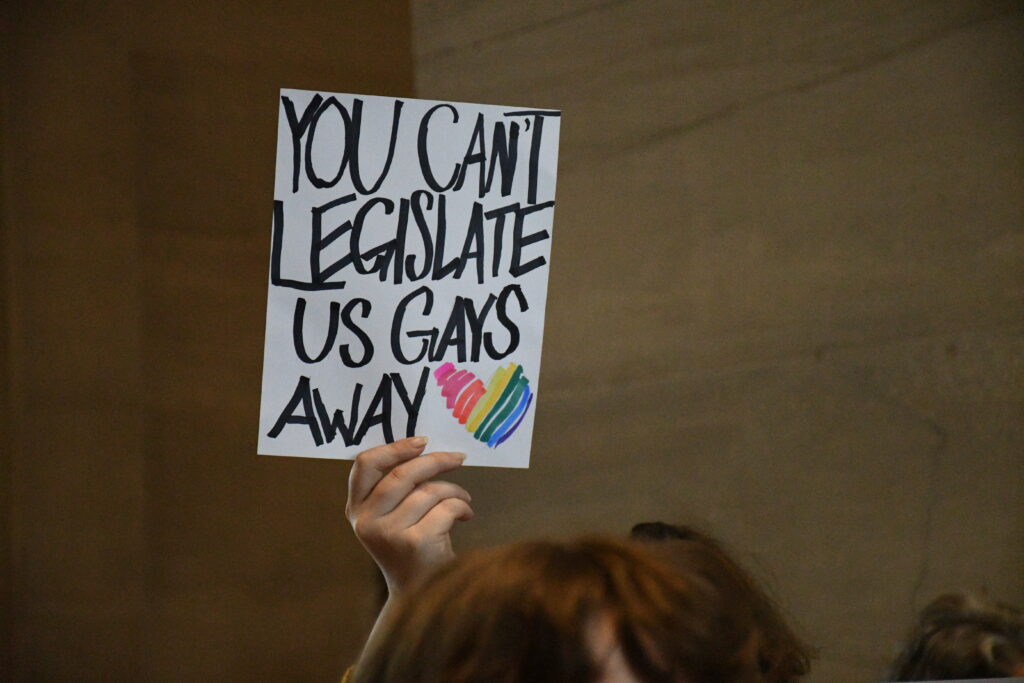
LGBTQ+ advocates watch the House vote on same-sex marriage from outside the chamber.
“Imagine if the treasury secretary were driving through the state of Tennessee and had an accident in a small rural county, and someone refused to recognize his husband as his husband, and they had to make medical decisions or wanted to visit in the health care facility,” said Chris Sanders of the Tennessee Equality Project. “No one who is legally married in this state should have their relationship questioned and belittled as it has been on the floor of the Tennessee House today.”
Tom Lee, member of the Board of Directors of the Tennessee Pride Chamber, gave another example when he testified before a House committee last week.
“Imagine if under this bill a private employer said, ‘Well, you can’t take family leave because I, as a private citizen, don’t recognize — using the language of the bill — your purported marriage,’” Lee said. “Or a bank says, ‘You’ll pay the higher rate (for unmarried couples). We’re not bound by the 14th Amendment. You’re not married in our eyes.’”
The measure still needs to clear multiple hurdles in the Senate before it can become law.
 On Air - 90.3 WPLN-FM