Tennessee communities are passing temporary bans on new data centers amid a construction boom and widespread backlash.
Since the fall, nine cities and counties have passed moratoriums on construction, and five were approved just in the past few weeks.
At least three more communities including Knoxville and Nashville have proposals in the works after developments this week.
Proponents argue that moratoriums will allow time to study local impacts, improve the power grid and set up appropriate regulations. In contrast, Tennessee has passed policies to incentivize data centers and fast-track portable power plants.
Nashville considers a short moratorium, new zoning laws
In Nashville, the Metro Council took the first step in passing a proposed moratorium on Tuesday. Councilmember Courtney Johnston introduced legislation to temporarily cease permits for data center construction following public outcry over a data center project planned in Grassmere Park next to the Nashville Zoo. More than 380,000 people have signed a petition in protest.
“A facility of this nature should not be able to move forward next to the Nashville Zoo and nearby neighborhoods before our code even defines what a data center is,” Johnston said in a statement. “It is not a permanent ban. It is a responsible pause so Metro can modernize its code and protect residents, public spaces and the zoo before irreversible decisions are made.”
If passed, the legislation would halt new permit acceptances or approvals until November or until the council passes a measure updating the city’s zoning laws related to data centers. The moratorium was passed on the first of three readings on Tuesday.
 Courtesy Nashville Zoo
 The Nashville Zoo says a neighboring data center could impact endangered wildlife housed at its facilities.
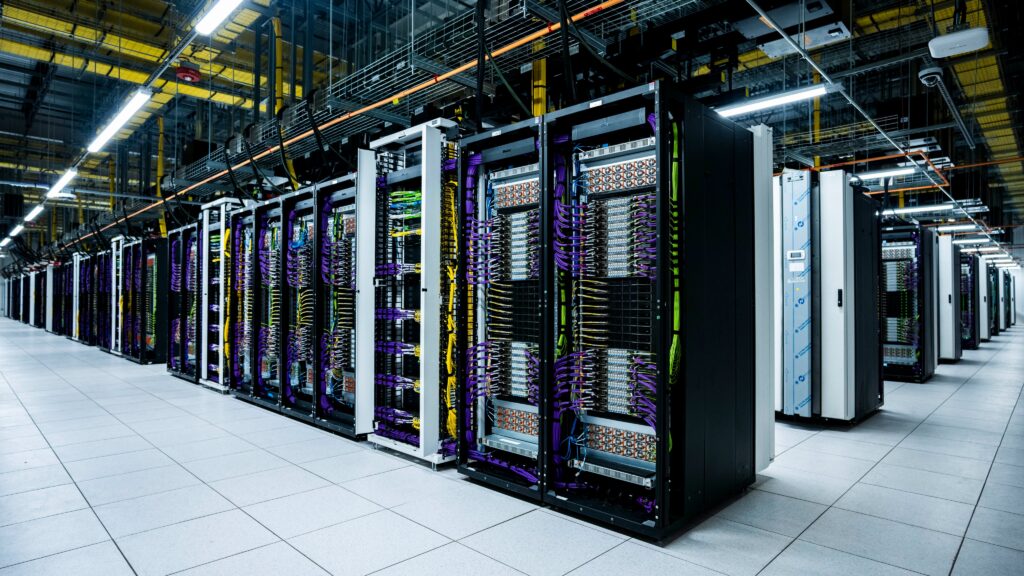
The city has already approved some permits for the zoo-adjacent project, a potentially 270,000-square foot facility proposed by Georgia-based DC BLOX that will require 50 megawatts of electricity divided between two buildings. The company said it plans to pay for all energy-related costs, including a new substation, to support its second, 40 MW building, which is equivalent to the power needs of tens of thousands of homes.
“Not all data centers are alike and much of the information circulated about data centers…apply to a much larger facility,” DC BLOX said in a statement.
More: Tennessee has 60 data centers. Nashville probably has more than you think. | WPLN News
The project may be allowed to move forward if a building permit application is approved before the moratorium takes effect, according to Johnston. The Nashville Zoo filed a zoning appeal to overturn the existing permits.
Nashville’s planning commission is holding a public hearing on proposed ordinances related to data centers on Thursday at 4 p.m.
Local moratoriums are a nationwide trend
Cities and counties across the nation are passing moratoriums on data centers. Flint, Mich., Charlotte, N.C., Zephyrhills, Fla., Dane County, Wis. and Leeds, Ala. are among the communities to pass them this week. Even Seattle, the home of Amazon and Microsoft, passed a one-year moratorium.
The state legislature of New York passed a one-year freeze on large data centers last week, pending the governor’s signature. Another 13 states have or will consider statewide moratoriums on data centers.
Nationally, seven in 10 Americans oppose artificial intelligence data centers in their local area, according to a new poll by Gallup.
Attitudes have rapidly shifted. In May, a Heatmap survey similarly found 71% of Americans oppose a data center being built near them. Just nine months ago, the same survey measured 42%. The survey noted a strong resistance in rural communities.
The opposition to AI ranges from concerns over mass surveillance and job layoffs to rising utility bills and environmental impacts.
Data centers use large amounts of electricity and water, and facilities can increase local air and noise pollution. Just this week in the Memphis area, residents near one of Elon Musk’s xAI Colossus facilities, now owned by SpaceX, filed a class action lawsuit over noise pollution.
Data centers can even heat their neighborhoods. The facilities dissipate enough warmth to create heat islands within a 6-mile radius, according to a preprint study from an international group of researchers. They found that land surface temperatures increase by 3.6 degrees Fahrenheit, on average, after the start of operations of an AI data center.
Rural Tennessee communities pass moratoriums
Coffee County and the city of McMinnville enacted moratoriums to delay data center construction just this week, and new moratorium proposals have popped up in Nashville, Knox County, which includes Knoxville, and nearby Anderson County.
McMinnville passed an 18-month moratorium following a planned project for a 25 MW, 96,000-square foot data center to support AI with Nvidia supercomputers. The company in charge of the project, Hixson, did not discuss the project with local officials or seek permit approvals before announcing it, prompting pushback in the community, according to Mayor Ryle Chastain.
He hopes the moratorium will allow enough time to study environmental impacts and set up appropriate regulations for data centers, especially to protect McMinnville’s hundreds of tree, shrub and flower nurseries.
“How would that affect groundwater, how would that affect air quality?” Chastain said. “But aside from that, how would it impact the people in and around where this facility is being built? What is noise pollution and light pollution going to look like?”
In addition to McMinnville and Coffee County, local governments in Cedar Hill, Washington County, Grundy County, Johnson City, Jonesborough and Bristol have all set up moratoriums of one to two years. Hawkins County set up a permanent ban on data centers and cryptocurrency mining last year and now faces a lawsuit from a company planning to build a bitcoin mine there.
Many state governments, in contrast, have welcomed data centers.
State governments are passing policies to support data centers
Currently, 38 states offer tax incentives for data centers. Only 12 have attached some kind of energy requirement to their data center incentive.
Tennessee has a general sales tax incentive, exempting infrastructure like computers for data centers, and the state also cuts its sales tax rate for electricity to 1.5%. In exchange, it requires at least 15 full-time jobs that pay at least 150% of the state average wage and capital requirements of at least $100 million within three years.
Tennessee lawmakers also passed legislation this year that allows data centers that require at least 50 MW of power to produce their own “behind-the-meter” power or buy electricity from an “independent power producer” without needing approval from a state regulator.
The idea is that if data centers secure their own power, customers won’t be subsidizing them through their monthly utility bills. Large companies have used this approach to avoid waiting on utilities to build out new generation.
The law could consequently “open the door to a massive influx of unregulated methane gas plants across the state,” Trey Bussey, an attorney with the Southern Environmental Law Center, told WPLN earlier this year.
For example, Elon Musk’s xAI facilities in and around Memphis are largely running on behind-the-meter generation. The company is using portable gas turbines to power operations at two facilities, initially set up without permits, along with 300 megawatts of electricity from the Tennessee Valley Authority, the utility that serves virtually all of Tennessee and parts of six other states.
Musk is planning on building a third facility. Once operational, the data centers could collectively require 2 gigawatts of electricity — enough to power 1 million homes, based on calculations used by TVA. The gas turbines could worsen air in the greater Memphis area and have caused significant noise pollution to facility neighbors.
Some data center owners have prioritized clean energy. In Gallatin, just northeast of Nashville, Meta set up an agreement with TVA and a third party to bring enough solar onto the grid to match its consumption of about 300 MW.
Most facilities in the state are much smaller, requiring less than 50 MW of energy, and are purchasing power directly from local power companies, which get power from TVA.
The utility plans to consider a special rate for data center owners in August, and is “looking at new pricing options that make sure big users pay their fair share,” spokesperson Scott Fiedler said in a statement. Update: The story was updated to include a statement from TVA about a potential new rate for data centers.

 On Air - 90.3 WPLN-FM