

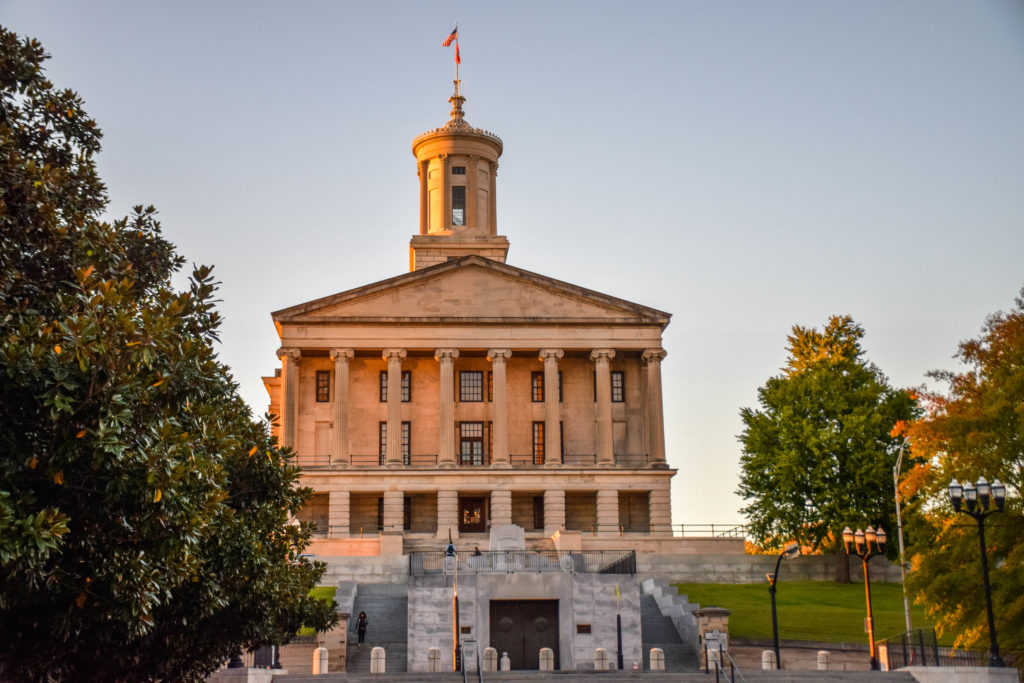
Research shows it is best practice to house foster kids with families or in communities. But a new bill at the Tennessee legislature would allow the Department of Children’s Services to place some foster kids in jail-like facilities that are usually reserved for children who have committed crimes.
Former foster youth Ella Bat-Ami said it would put more pressure on foster kids to be perfect.
“We don’t get to make mistakes,” she said. “We don’t get to have temper tantrums. We don’t get to have bad days. We’re not allowed to be children.”
Bat-Ami wrote the foster care bill of rights that passed into law last year.
She said that kids like her are living on a knife’s edge — getting into trouble could cost them their home, their foster family, and under a new proposal, their freedom.
“Foster children are entitled to a childhood in the same way other children are entitled a childhood,” she said. “It should not be a childhood with the sword of prison dangling over their heads.”
Legislating ‘violent behavior’
Senator Jack Johnson, R-Franklin, and Rep. William Lamberth, R-Portland, sponsored the measure. But it is an administration bill — meaning it came from the governor’s office and the Department of Children’s Services.
At a hearing at the capitol, DCS Legislative Director Jim Layman explained why the department feels this change is necessary.
“We have an issue where we are receiving children into custody that are dependent and neglected. The court has ruled them dependent and neglected,” Layman said of kids placed in on the child welfare side of DCS. “But their behaviors don’t match what you would think of as an abused or neglected or an abandoned child.”
He said that these particular foster care kids are hard to find placements for.
DCS Commissioner Margie Quin added that these youth are violent towards other kids or staffers, but are not punished.
“That lack of accountability, I think, gives rise to additional violent behavior within our facilities. I think that’s unsafe for youth who are vulnerable. And we need to put a stop to that.”
“Incarceration as a solution”
DCS has been under fire for years for keeping difficult-to-place youth in office buildings. A 2025 comptroller’s audit found one child slept in an office for more than 100 days while awaiting placement. This legislative push to funnel more kids into secure facilities comes as the department is expanding bed space in the state by building more high-security placements.
“It’s concerning when any youth-serving system is looking to incarceration as a solution for problems,” said Jasmine Miller, an attorney with the national nonprofit Youth Law Center.
Miller said DCS’s placement problems are not unique — Virginia dealt with a similar crisis, but invested in strengthening options to put foster youth with families and in communities. Tennessee’s DCS has taken a different approach, investing money into facilities.
She said the mechanism to re-classify foster kids is unclear in the bill. It states that foster kids could be classified as “children in need of heightened supervision” because of violent behavior, or the threat of violent behavior. And once a child has that classification, DCS could place them in the most secure, jail-like facilities in the state — facilities that have barbed wire and cells that lock.
Miller said that placement could make youth ineligible for extension of foster care benefits, like housing and education assistance.
And by choosing to keep foster kids in these facilities, the state could be risking at least $1 million in federal funding.
“There are a lot of federal incentives to keep young people in the community,” Miller said. “Those federal incentives are aligned with research and with this practice and most importantly with what is best for children.”
The governor’s office did not respond to requests for this story, and DCS wouldn’t comment on pending legislation.
“The antithesis of DCS’s mission”
While most of the bill addresses accountability for foster youth, the final section focuses on juvenile justice kids. It states that if an incarcerated kid is alleged to have assaulted a staff member, facilities can hold them for a “indefinite” period of time.
Zoe Jamail is an advocate for children with the Raphah Institute. She said that section of the bill allows the companies getting paid to hold the children to decide how long to keep them.
“That’s great for lining the pockets of private facilities,” Jamail said. “But it’s bad for taxpayers. And most importantly, it’s terrible for children. It’s the antithesis of DCS’s mission.”
She questioned why the state would grant facilities this decision-making power when a recent state audit found that DCS is not properly investigating allegations of abuse inside these placements, and one of the state’s own studies recommended that these facilities need more independent oversight.
The future of the bill is uncertain. But former foster youth Bat-Ami said it should alarm Tennesseans that this is the way the system sees kids like her.
“Our governor, with DCS, have decided the solution to kids being placed in offices is to put them in prison. This is how the children in foster care are being treated — like criminals.”

 On Air - 90.3 WPLN-FM