

The Tennessee Department of Correction executed Harold Wayne Nichols Thursday morning, injecting him with a massive dose of the sedative pentobarbital.
Nichols was put to death for the rape and murder of a 20-year-old college student, Karen Pulley, in 1988. After he was arrested, he confessed to raping four other Chattanooga women before her.
The agency put Nichols to death about an hour after the Tennessee Supreme Court denied a stay. A lawsuit filed on his behalf, seeking records about the drugs used in this year’s executions, is ongoing.
Execution day
Media witnesses watch executions from a small viewing gallery. There’s a curtain over a window that obscures the execution chamber until the IV team and other workers are finished setting up.
From the time the curtain opened, the process took about 14 minutes. Nichols and his spiritual adviser, J.R. Davis, went over several scriptures and recited the Lord’s Prayer together. Each cried.
For one minute during the execution, Nichols sighed, groaned and breathed heavily. It’s unclear whether this would have been because of the crying or another source of distress. Unlike the last man to undergo the lethal injection in Tennessee, Byron Black, Nichols didn’t say he was in pain.
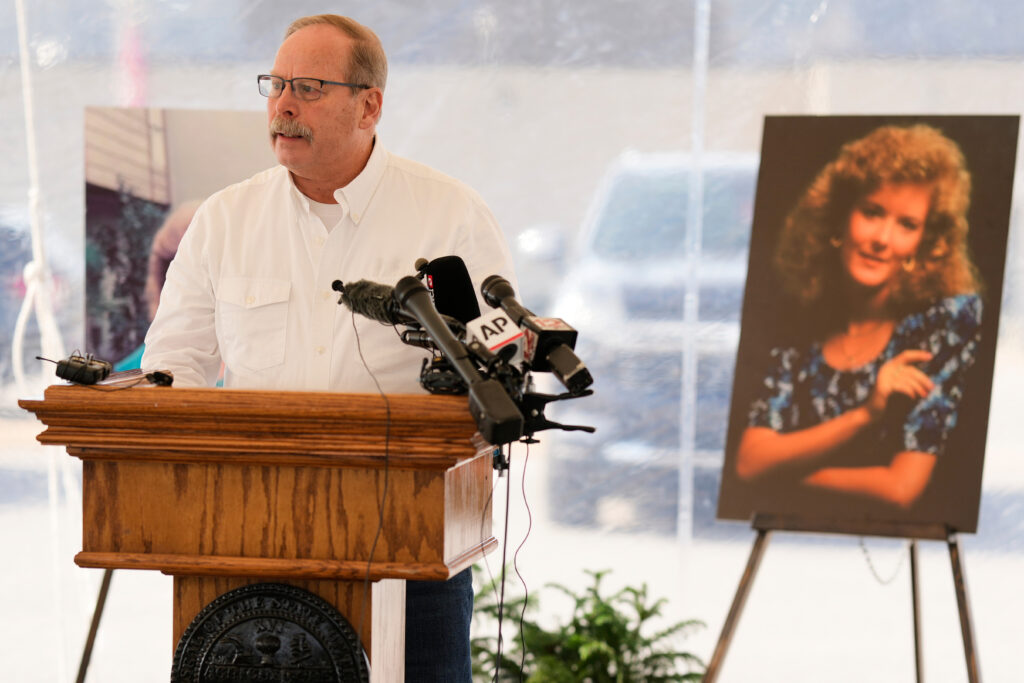
Pulley’s brother-in-law, Jeff Monroe, represented the family in remarks after the execution. He said his wife, Pulley’s sister, couldn’t bear to attend.
At the time of the murder, the couple had just moved back to the U.S. after being stationed at an Air Force base in the Philippines for three years. After learning Pulley had been hospitalized, they attempted to go see her.
“Karen died before we could get to Chattanooga,” he said.
He said nothing could atone for Pulley’s brutal murder or her lost life, but that the execution was a start.
“We are relieved that the nightmare is over, and take comfort knowing that he never again will be able to hurt anyone else,” he said. “Moving forward, our family is going to concentrate on the happy memories of Karen … She was bubbly, happy, selfless.”

Spiritual advisor J.R. Davis, left, and attorney Deborah Drew, right, for Harold Wayne Nichols leave the administration building Riverbend Maximum Security Institution after the execution of Nichols, Thursday, Dec. 11, 2025, in Nashville, Tenn. (AP Photo/George Walker IV)
Deborah Drew was among the attorneys for the Federal Defender Services of Eastern Tennessee who represented Nichols. She said he spent years confronting the pain he caused Pulley and the women he victimized before her, coming to terms with his own trauma and the pain he caused others.
“Our state sent the message that no one can rise beyond the crimes they committed decades earlier, and that redemption deserves no mercy,” she said. “Executing Wayne served but one goal: retribution.”
Recent legal battles
The sentence was carried out about an hour after the state’s supreme court denied to delay the execution.
The request was part of a lawsuit that started in October.
The legal team for Nichols filed several formal records requests with TDOC this year, seeking a clearer picture of how the state’s new lethal injection protocol will be carried out. That included requests for the expiration dates on the doses of pentobarbital intended for him, as well as on the doses for the two men who were put to death earlier this year. These three are the first to die under the state’s latest method, using only pentobarbital instead of a combination of different drugs.
When TDOC refused to fulfill the requests, attorneys sued the agency in Knox County Chancery Court. The county sided with Nichols’ team twice, and the state appealed the decision to the court of appeals, which sided with the state.
In the middle of the filing flurry, the state submitted testimony that it could confirm the dose for Nichols was not expired. It didn’t mention the doses used in Smith’s or Black’s execution. Interest is high for Black’s dose because he groaned and said he was in pain as he died, and there still isn’t a solid explanation for that reaction.
Nichols’ team asked the state supreme court Thursday morning to delay the execution while it considers the case. Justices said they wouldn’t delay the execution, but they are still considering the records issue.

 On Air - 90.3 WPLN-FM