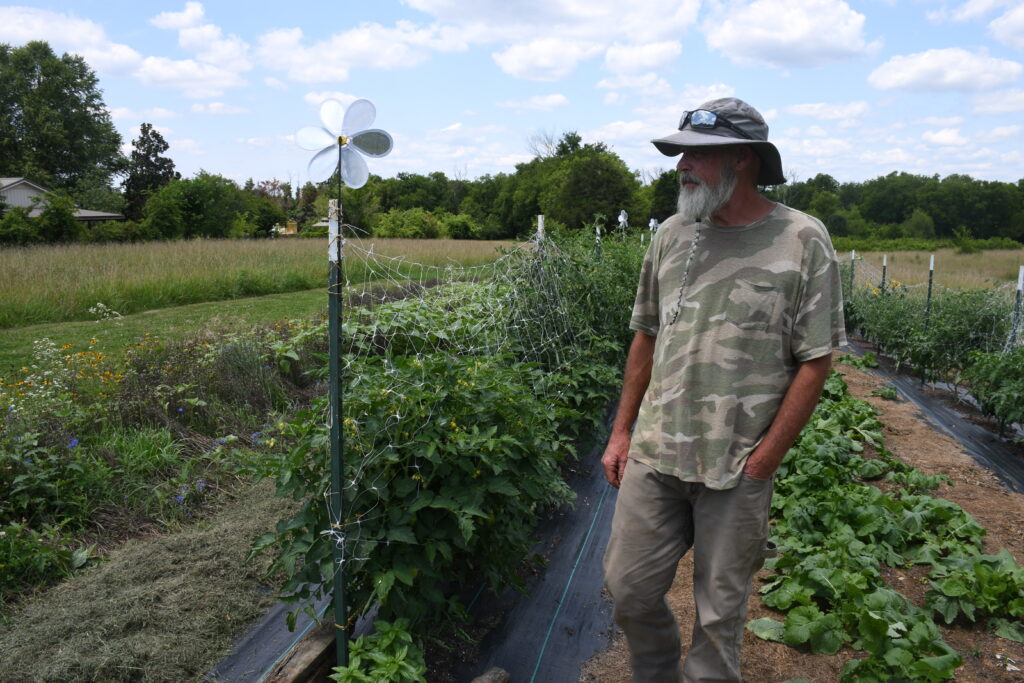
On his farm in Readyville, Tennessee, Lee Crabtree has switched to growing seasonal favorites like blackberries as a new state law upends his old cash crop.
Much of Crabtree’s farm had been devoted to a CBD variety of hemp, but, effective July 1, that side of Crabtree’s business will be impossible. As of this month, the state has banned the sale and cultivation of THCA, a type of THC that was legalized nationwide in 2018 through a loophole in the Farm Bill.
So, where there were once rows of hemp, Crabtree has planted a variety of sweet corn.
“Even right off the plant, it’s just so sweet,” Crabtree said. “I’m hoping that it sells good.”
Inside, Crabtree still has an industrial kitchen from when he made his own CBD goodies. Now, his wife, Stacey, uses the space to chop grapes for her chicken salad. In the months leading up to the THC ban, she started selling her chicken salad and pimento cheese sandwiches at a farmer’s market up the road in Murfreesboro.
“I love to cook, and it’s one of my love languages, so getting to share it with everybody else makes it a little extra special,” she said.
Hemp industry losses
This new chapter of their business is all about trying new things. Like many former hemp farmers, Crabtree has had to pivot.
“I’m not making the money that I would have been making back when CBD was huge there for a minute,” Crabtree said. “It was really good there for a moment. It had its time in the sun.”
If these crops don’t sell, Crabtree said he’ll have to look for a job. That’s also the reality for larger hemp companies that have had to lay off staff, like Gold Spectrum in East Tennessee. Other companies, like Columbia-based Burning Acre, have moved across state lines to North Carolina to keep growing.
“The state is a lot more hemp-friendly out here,” said Burning Acre co-founder Emily Schafrick. “To uproot your entire retail manufacturing and wholesale supply chain to another state definitely racks up a little bit of a bill.”
But Schafrick said she’s been lucky in navigating this change; many smaller businesses have had to close.
Frederick Cawthon, president of the Hemp Alliance of Tennessee, said that growers and sellers are facing steep taxes on top of the THCA ban.
“(For) a state that is definitely known for helping the small businessperson, this one did hit. It was a gut punch,” Cawthon said. “Small businesses like ours cannot really survive.”
A Whitney Economics report valued Tennessee’s hemp market at $1.7 billion. That value will take a nosedive, Cawthon said, and the state won’t be getting as much tax revenue from hemp as it has in the past.
Federal hemp
There’s a bigger threat on the horizon for the state’s hemp industry.
Even with the THCA ban, Tennessee still allows 15 milligrams of THC per serving.
“That’s what I would say is a pretty healthy dose of intoxicating cannabinoids,” said Jay Mitchell, founder of Mighty Fine Manufacturing.
A federal law set to take effect in November would ban all THC products.
“We’re talking about a $50 billion national industry staring down a complete ban at the end of this year,” Mitchell said.
Some farmers are getting back to their roots: growing a fiber variety of hemp that’s used to make everything from rope to packaging to molded car parts, like dashboards and seat backs.
In Springfield, Tennessee, farmer Bill Corbin is preparing his first crop of hemp for the French company, Hemp-It.
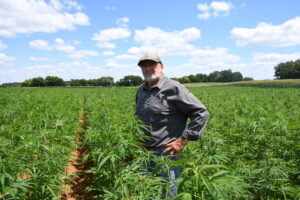 Marianna Bacallao WPLN News
Bill Corbin stands between rows of his hemp crop in Springfield, Tennessee.
Corbin was one of the first farmers to start growing hemp under Tennessee’s 2016 initiative, a full two years before the federal farm bill made it possible nationwide.
“There’s not a person in this industry that didn’t know this day was coming,” he said.
The industry was unsustainable, Corbin said. He agrees with lawmakers’ efforts to tamp down on people using hemp products recreationally, but he’s worried about consumers who use it medicinally.
“Take me for example, obviously I’m an older person. I have issues with arthritis,” Corbin said. “I rely heavily on full-spectrum CBD.”
Full-spectrum CBD has THC in it. Corbin said the CBD without THC doesn’t do as much for pain management, but it will soon be the only type of CBD available to Tennessee customers.
Medicinal, full-spectrum CBD is a huge part of the market, Cawthon said.
“A lot of people think it’s the young generation. No,” Cawthon said. “The data shows: it’s your grandmother. It’s your auntie. It’s the church lady, actually.”
 On Air - 90.3 WPLN-FM