

A bill that originally aimed to keep undocumented students out of Tennessee schools is advancing in the statehouse but with key changes. Still, many education and immigration advocates insist that the revised measure remains a threat to all students.
Amendment doesn’t jeopardize federal funding
One of the most controversial bills introduced during the 2025 legislative session would have allowed public schools to refuse undocumented students or charge their families tuition.
Now, its sponsor, Rep. William Lamberth, R-Portland, is bringing an amended version of HB793 that requires schools to verify students’ immigration status and report that information to the state government. The schools would not record students’ names or addresses, according to Lamberth.
He told the House Finance, Ways, and Means Subcommittee at a hearing Wednesday morning that the amendment was financially motivated.
The original bill ran afoul of the Plyler v. Doe Supreme Court ruling that guarantees all students a right to an education, regardless of their immigration status. Additionally, if implemented, the proposal may have cost the state $1.1 billion in federal education funding, according to a state review.
Lamberth said he never got a clear answer from the federal government on how much of that money would be at risk.
“I do want to thank the Trump administration for having a robust back and forth with us over the last roughly 10 months,” he said. “We’ve sent several questions to them to try to get answered a very straightforward question: ‘Would the bill in the previous form endanger $1.1 billion?’ ”
This amendment, he said, has a minimal fiscal impact and would not jeopardize federal funding. However, Lamberth did not explain what the state plans to do with the students’ immigration information. He said that would be decided at a later date.
Revised bill may still be a financial and administrative burden
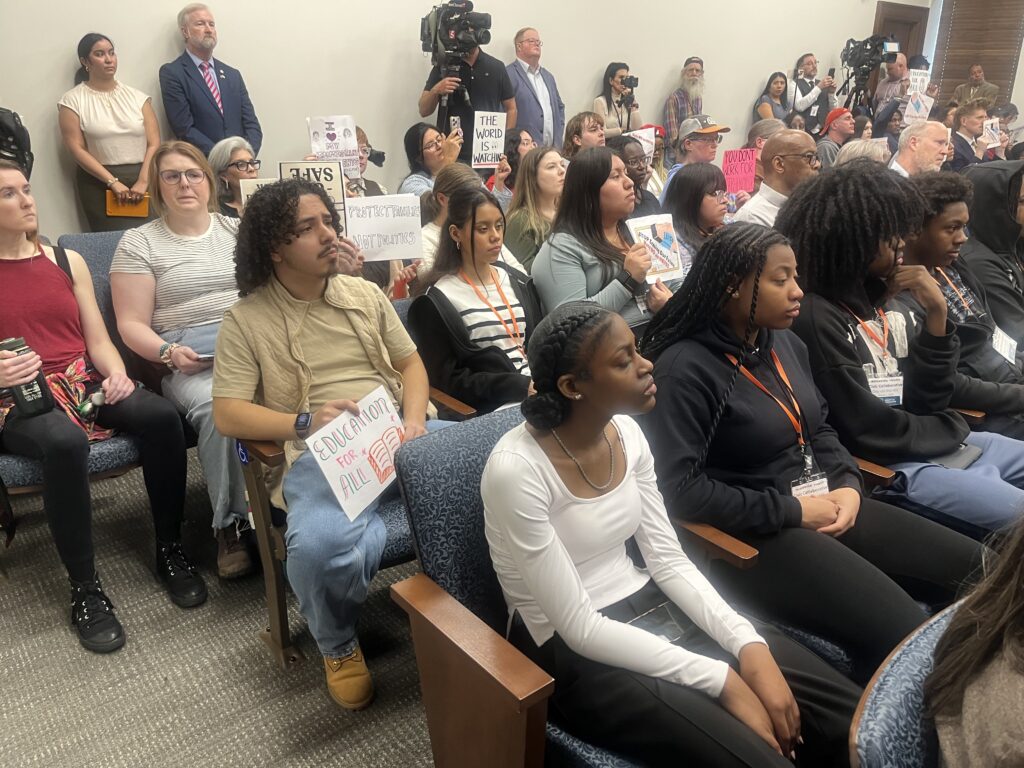
Still, many members of the crowd, which packed the meeting room in the Cordell Hull Building, were not satisfied with the change. Some sang the protest song “Ain’t No Power like the Power of the People.” Others, like Katherine Bike of Knox County, testified that collecting this information will cost the state millions of dollars.
“Where are we gonna come up with this money? Are our special education services going to be cut? Reduced?” she asked. “Our student support department, our security budget, where is it going to come from? We always make do, but don’t make us do this.”
A report from the Immigration Research Initiative found that evaluating the immigration status of all students in the state would cost Tennessee taxpayers roughly $55 million in the first year alone. In Metro Nashville Public Schools, it would take 77 full-time employees one year to verify the status of the 78,000 students in the district, with each employee being responsible for 1,038 students.
Immigration lawyer, Johnny Epstein, testified that the bill requires school staff to act as immigration judges and does not take into account how nuanced an individual’s status can be.
Aside from the administrative cost and burden, Franklin County School Board member and former teacher, Sarah Marhevsky, recently spoke about how the legislation would also harm children who are not immigrants but might still have trouble producing their documentation.
“For students who are homeless or students in foster care or students who were adopted from international locations,” she said, “that might be an impossible task.”
The bill is scheduled for a House Finance, Ways, and Means Committee hearing on March 10.

 On Air - 90.3 WPLN-FM