

Tennessee ranks last in the nation for solar, wind and geothermal energy.
The state produced the equivalent of 1% of the electricity it uses from solar last year, according to a new report from advocacy group Environment America.
Nationwide, the picture is different: 32 states produced at least a tenth of their power from solar, wind or geothermal.
South Dakota remained in the top spot with 95% renewable energy last year, up from 31% a decade ago, according to the report. The state now primarily relies on wind farms for power.
Some states have seen massive growth in just the past couple of years. Wyoming’s renewable share jumped from 55% to 75% in 2025 alone, while Maine jumped from 31% to 52% between 2023 and 2025. Energy-hungry California and Texas now have 49% and 37%, respectively.
Solar remains the top source of new generation in the country. Solar and storage is the fastest and cheapest power source to deploy without subsidies, according to the latest annual report from Lazard, a global financial services firm.
Although the Trump administration has cut incentives for renewables and passed policies to support the fossil fuel industry, the U.S. Energy Information Administration forecasted that solar, wind and battery projects will represent about 93% of new electricity generation in the U.S. this year.
New gas projects have still been proliferating in some areas, though the fossil fuel infrastructure has become less competitive: The cost and time required to bring gas plants online increased significantly between 2023 and 2025, according to the research firm BloombergNEF.
Energy choices have serious consequences for people and the environment, impacting aspects of life from air pollution and utility bills to water quality and climate change.
Why Tennessee is falling behind
The Tennessee Valley Authority is the utility that provides nearly all electricity to Tennessee, plus parts of six other states.
Last year, TVA produced 4% of its entire energy mix from wind and solar. TVA also got 10% of its power from hydropower, a renewable energy system that uses dams to generate electricity. The utility sourced the majority of its power from fossil fuels.
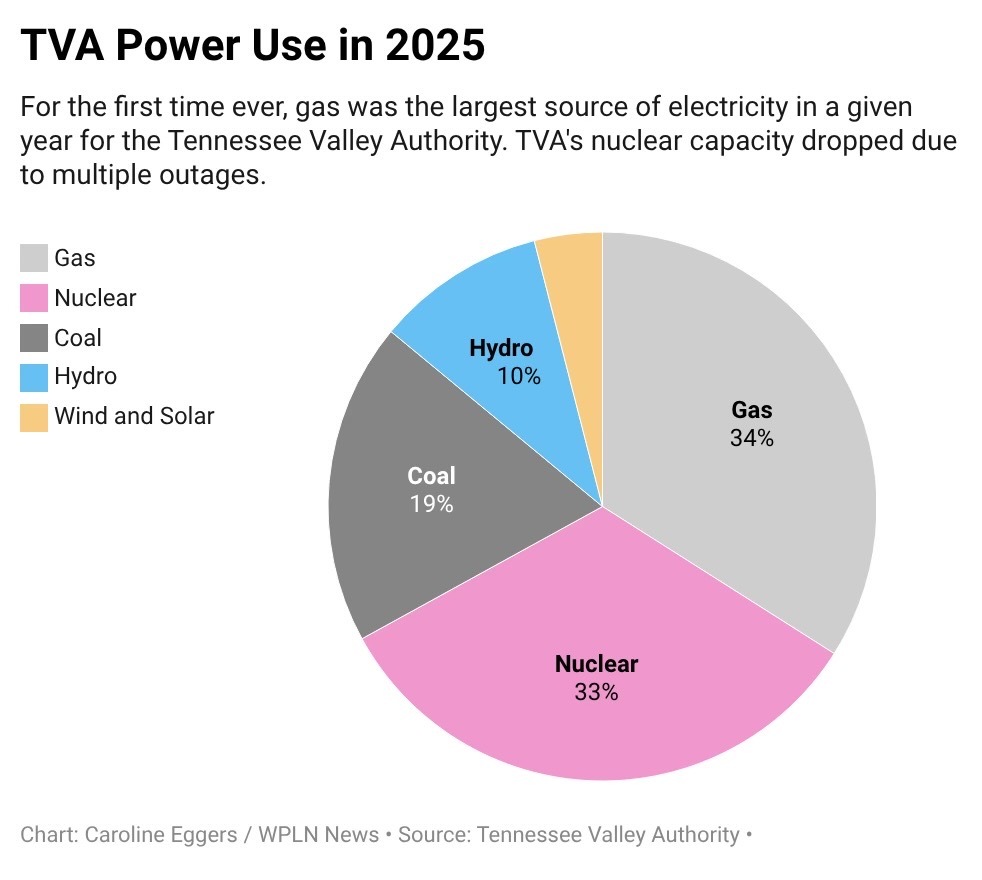
TVA could have been well on its way this decade to 100% clean energy. (The common definition of clean energy includes solar, wind, hydropower, geothermal and nuclear. The Tennessee legislature legally defined one type of fossil fuel as “clean” and then “renewable” last year.) The Southern Alliance for Clean Energy mapped a pathway for TVA to reach the milestone by 2030 back in 2021. GridLab produced an analysis in 2023 showing how TVA could reach the goal by 2035.
Tennessee has significant geothermal potential, along with a specialized workforce that could support its supply chain within the state, according to an analysis from energy consultancy RMI.
Tennessee also has plenty of wind and solar potential: “Even with rapid demand growth from electrifying buildings and vehicles, Tennessee could generate the equivalent of 31 times its electricity demand in 2050 from the sun and wind,” the Environment America report says.
TVA has fallen short of promises for significant solar additions this decade. In 2020, then-CEO Jeff Lyash said the utility — which had 400 MW of solar at that time — would add between 700 to 1,000 megawatts (1 gigawatt) each year. In 2021, TVA set a goal of net-zero emissions by 2050, and the utility began emphasizing an “aspiration” of 10 gigawatts of solar by 2035.
Last year, TVA had about 1.7 GW of solar in operation, roughly a third of the low end of Lyash’s goal, according to TVA’s latest financial filing to the U.S. Securities and Exchange Commission. TVA has 2.5 GW of solar in development.
TVA has not stated whether it will continue to pursue 10 GW of solar over the next decade.
“It’s not about the number, it’s about adding as many megawatts to the grid as we can get from every source, including solar,” TVA spokesperson Scott Brooks said in an email.
Instead, TVA has primarily expanded its electric capacity from gas, a fossil fuel composed mostly of methane, and formed more distant plans to expand its nuclear fleet. TVA also recently scrapped its commitment to retire coal within the next 10 years.
TVA’s chief financial officer, Tom Rice, thanked the Trump administration for the push to keep coal online during a board meeting earlier this year.
“We would not be in the position today to recommend continuing to operate over 3,000 megawatts of beautiful, clean coal that will directly support energy resiliency, reliability, and low-cost power,” Rice said.
By keeping coal online and building new gas plants, TVA is now on track to create a more polluting mix of energy overall over the next decade. Both coal and gas cause air, water and climate pollution along the entire supply chain of drilling, transport and burning.

 On Air - 90.3 WPLN-FM