
Tennessee leaders want the state to house the nation’s nuclear waste.
Earlier this year, the U.S. Department of Energy requested proposals from states to host a consolidated, national site for used nuclear fuel, a longtime wish of nuclear industry advocates and national leaders.
The department called for a “Nuclear Lifecycle Innovation Campus” to anchor parts of the entire nuclear energy ecosystem, including fuel fabrication, uranium enrichment, reprocessing used nuclear fuel and disposition of waste.
Tennessee is in the running, and state lawmakers are already signaling their support: A Senate committee on Tuesday unanimously passed a resolution sponsored by Lt. Gov. Randy McNally and Sen. Ken Yager, R-Kingston, to support the effort.
“This is a significant opportunity to generate billions of private dollars in Tennessee and create thousands of jobs statewide,” Yager said Tuesday during a committee hearing.
The resolution urges Gov. Bill Lee to submit a thorough response to the Department of Energy and pledges the state legislature to taking any necessary legislation action to ensure Tennessee is selected as the host location.
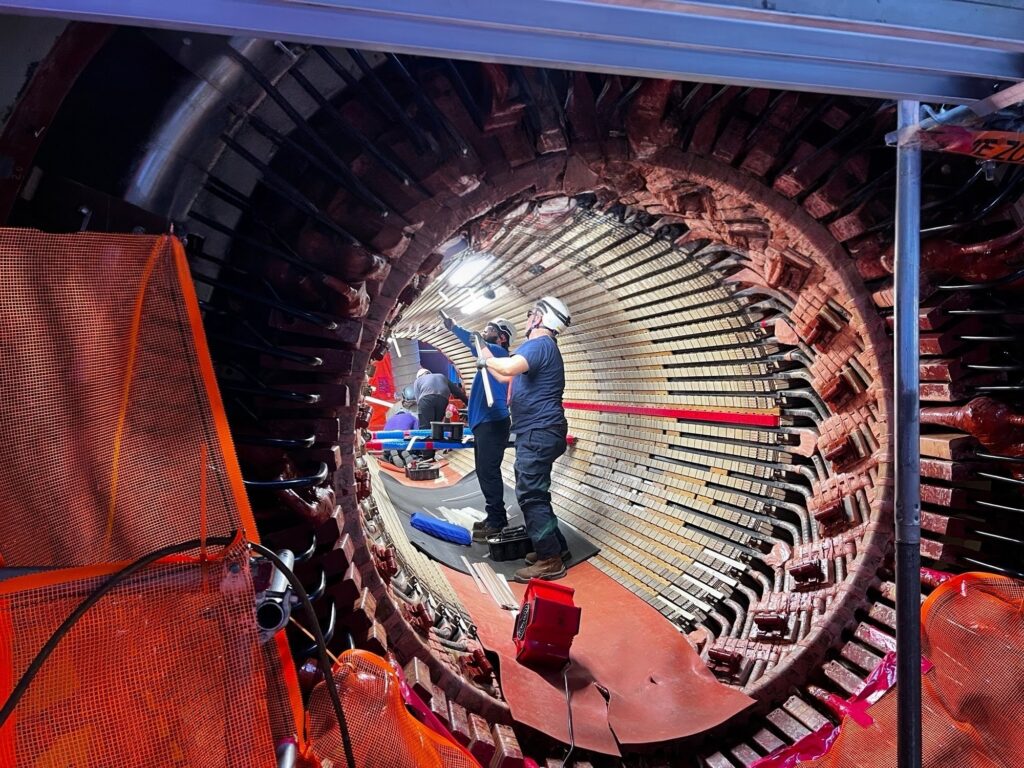
 Courtesy Tennessee Valley Authroity
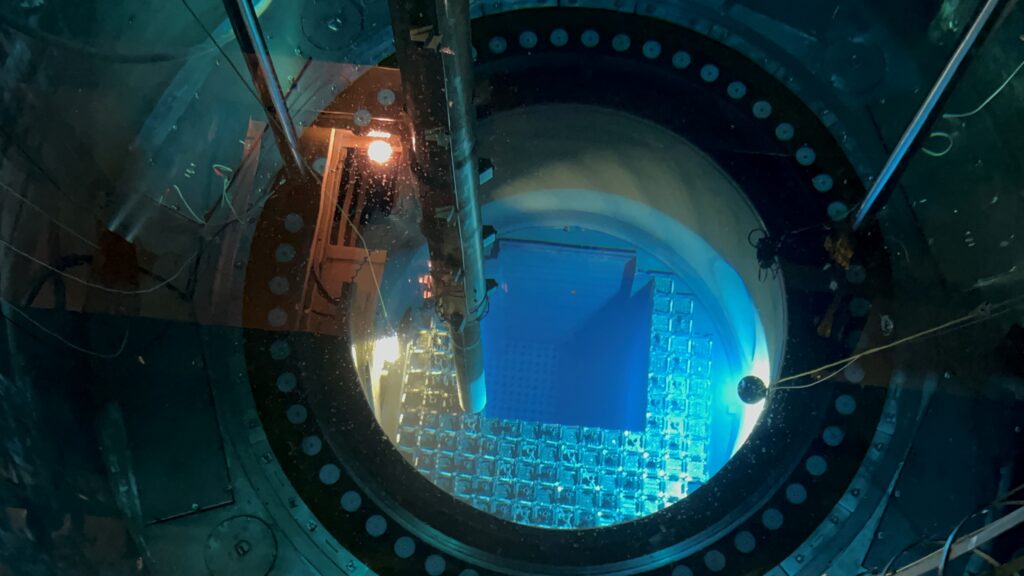
 The Tennessee Valley Authority loads fuel into the Sequoyah Nuclear Plant.
Tennessee has been a large part of the nuclear conversation for 80 years, ever since the Manhattan project, Yager said, and the state is also quickly becoming a central figure in the nation’s nuclear future.
The Tennessee Valley Authority became the first utility to request federal approval to build a small modular reactor in Oak Ridge, and other companies have announced plans to construct reactors nearby. Oak Ridge may also soon house facilities for uranium processing, nuclear waste recycling and the manufacture of portable nuclear generators.
Now, Tennessee could position itself to handle the end of the nuclear life cycle.
How nuclear waste is generated and stored
Producing power through fission requires uranium, a highly radioactive fuel source.
The process to get uranium starts with mining the minerals that contain uranium. Uranium ore is then extracted, milled into a “yellowcake,” and then further processed and refined.
 Courtesy Ross D. Franklin/Associated Press
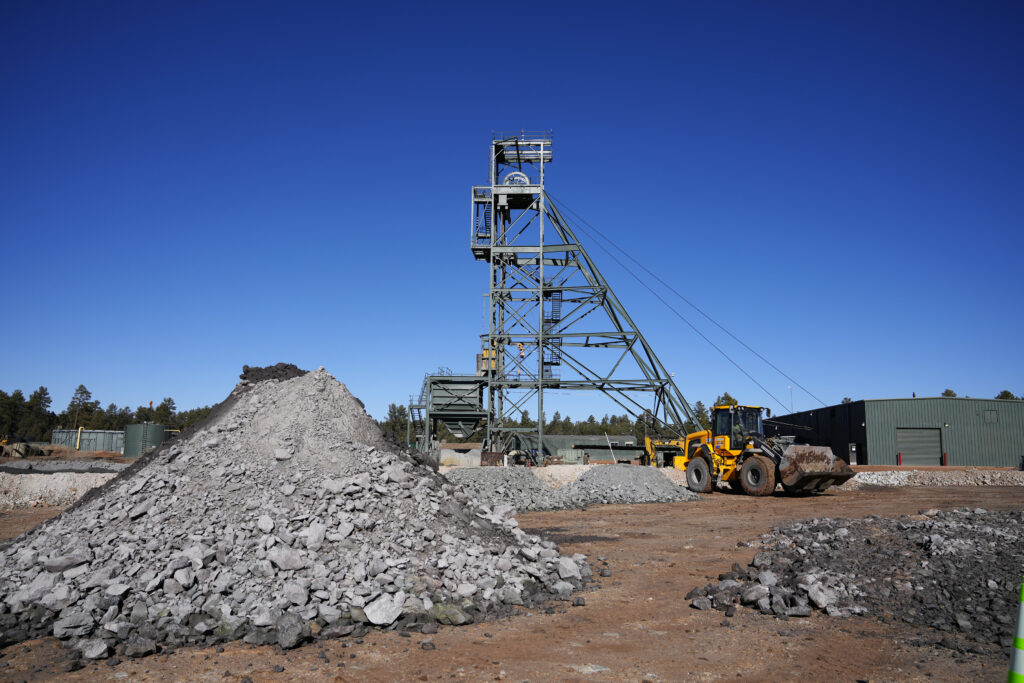
 A uranium ore pile is the first to be mined at the Energy Fuels Inc. uranium Pinyon Plain Mine on Jan. 31, 2024, near Tusayan, Ariz.
 Courtesy Energy Fuels Inc.
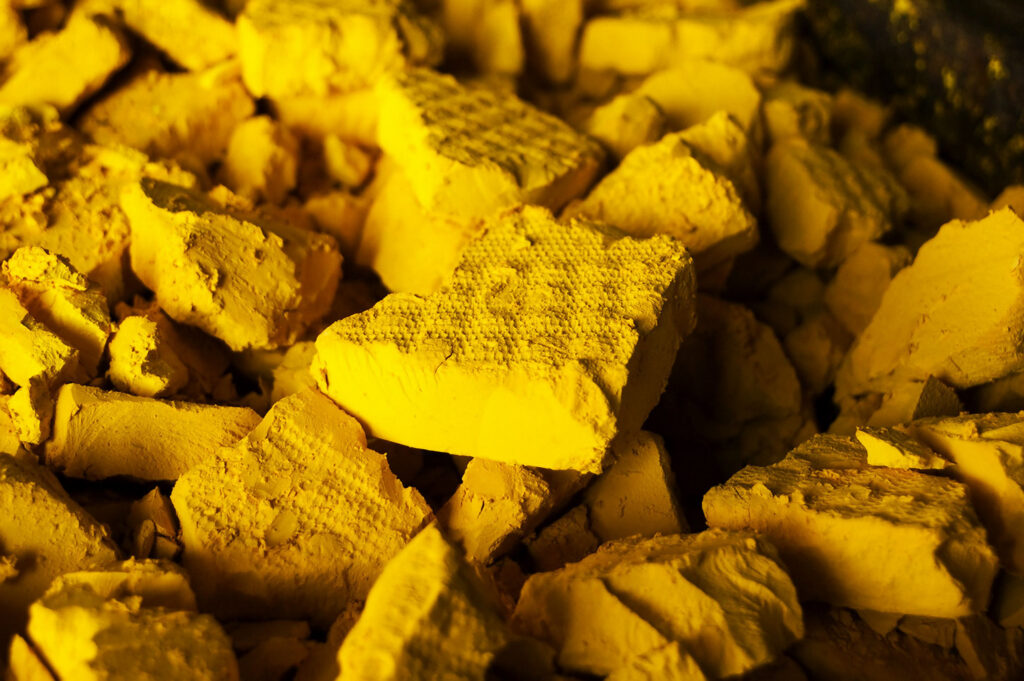
 Yellow cake uranium, a solid form of uranium oxide produced from uranium ore, must be processed further to create nuclear fuel.
The refined uranium is then combined with other fissionable materials in a ceramic pellet. These pellets are placed into a long metal tube called a “fuel rod.” Hundreds of fuel rods are bundled together into “assemblies,” which are then packed into nuclear reactor cores.
A nuclear reactor core may contain upwards of 50,000 fuel rods, or about 200 assemblies. Fuel assemblies are as small as 14 feet long. After about five years of use, these metal containers are placed in steel and concrete pools or later dry steel-and-concrete casks at the power plant.
The U.S. houses more than 90,000 tons of fuel waste from commercial nuclear plants. Power plants still produce about 2,000 tons of used fuel assemblies each year, about half the volume of an Olympic-sized swimming pool.
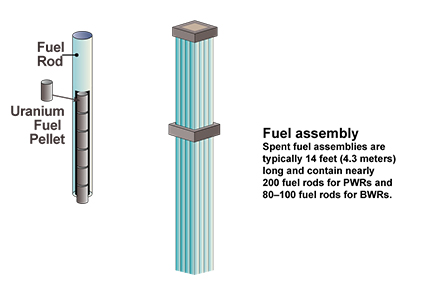
Waste has collected in about 80 sites at closed and operating nuclear plant sites since the 1950s, and more than one in three people across the U.S. live within 50 miles of a nuclear waste site today.
All of the national nuclear waste together could fit on a single football field, stacked less than 30 feet high, according to the Department of Energy.
Nations across the globe have created two main types of repositories for nuclear leftovers: The main difference is depth. Some countries have buried waste in facilities just below ground level, though that type may be more vulnerable to future climate changes. In the U.S., the conversation on a consolidated, long-term repository has focused on “deep geological disposal,” which would entail entombing nuclear detritus in specific rock types like granite or salt.
Beyond geology, one challenge may be convincing a community to permanently hold radioactive material.
A brief policy history of nuclear waste
In 1982, Congress passed the Nuclear Waste Policy Act to support the use of geologic repositories for the storage or disposal of radioactive waste and tasked the Department of Energy, or DOE, to build and operate that site.
Congress selected Yucca Mountain in Nevada as an option for a waste site in 1987. DOE initiated support for the site in 2002, later recommending it as viable in 2008, and then abandoned the project in 2010.
Conservative groups have continued to show support for the site. Project 2025, the policy blueprint for the Trump administration prepared by allied organizations, said that Yucca Mountain “remains a viable option for waste management and DOE should recommit to working with the Nuclear Regulatory Commission.”
 Courtesy Tennessee Valley Authority
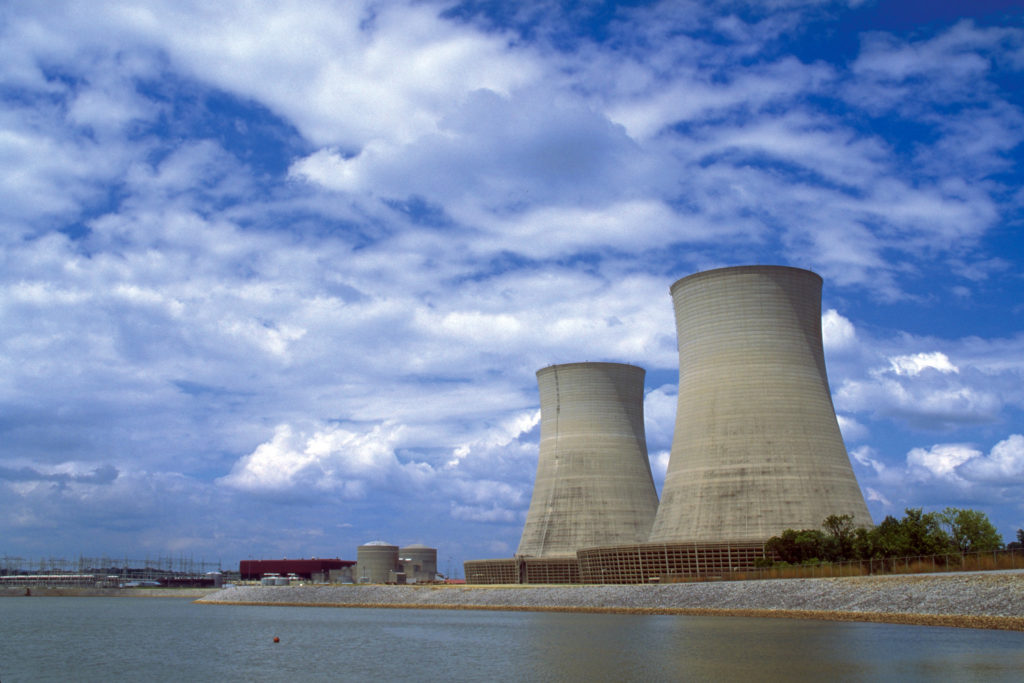
 In 2016, the Tennessee Valley Authority opened the Watts Bar Nuclear Plant.
One analysis suggests that the price tag of using Yucca Mountain would be more than $200 billion, because the rock along the edge of the Las Vegas Valley is highly fractured and not ideal for long-term storage. The nation’s only deep geological repository for nuclear waste is an underground salt mine in Carlsbad, New Mexico, which solely houses waste from nuclear defense projects — not waste from the nuclear power industry.
Some nuclear advocates have urged Congress to support a new site by using the $50 billion “Nuclear Waste Fund,” which was established by the Nuclear Waste Policy Act. The fund was partially paid for by electricity customers via utilities before court orders stopped the fee collection, according to a policy breakdown from a group supported by the University of British Columbia. Project 2025 also encouraged reform of this funding mechanism and said that Congress uses the funds to “finance unrelated spending.”
The need for nuclear waste solutions has ‘grown more urgent’
The 1982 policy was designed with “no consideration for advanced-reactor fuel cycles, potential recycling pathways or the need for consolidated interim storage,” said John Wagner, director of the Idaho National Laboratory, while testifying before the Senate Committee on Energy and Natural Resources last week.
The U.S. only stores and does not recycle spent nuclear fuel, which still contains more than 90% of the source’s potential energy. France and Russia both have programs to recycle nuclear fuel, and several other countries are exploring recycling development. Recent research from the Massachusetts Institute of Technology shows that recycling nuclear waste can be safe but is technically less safe than underground storage.
Wagner also expressed support for a consolidated, long-term storage site.
“That need has only grown more urgent as the advanced reactor fleet begins to take shape,” Wagner said.
Last year, President Donald Trump signed four executive orders to reform American nuclear policy. The administration set a goal of quadrupling U.S. nuclear capacity from roughly 100 gigawatts to 400 gigawatts by 2050.

 On Air - 90.3 WPLN-FM