

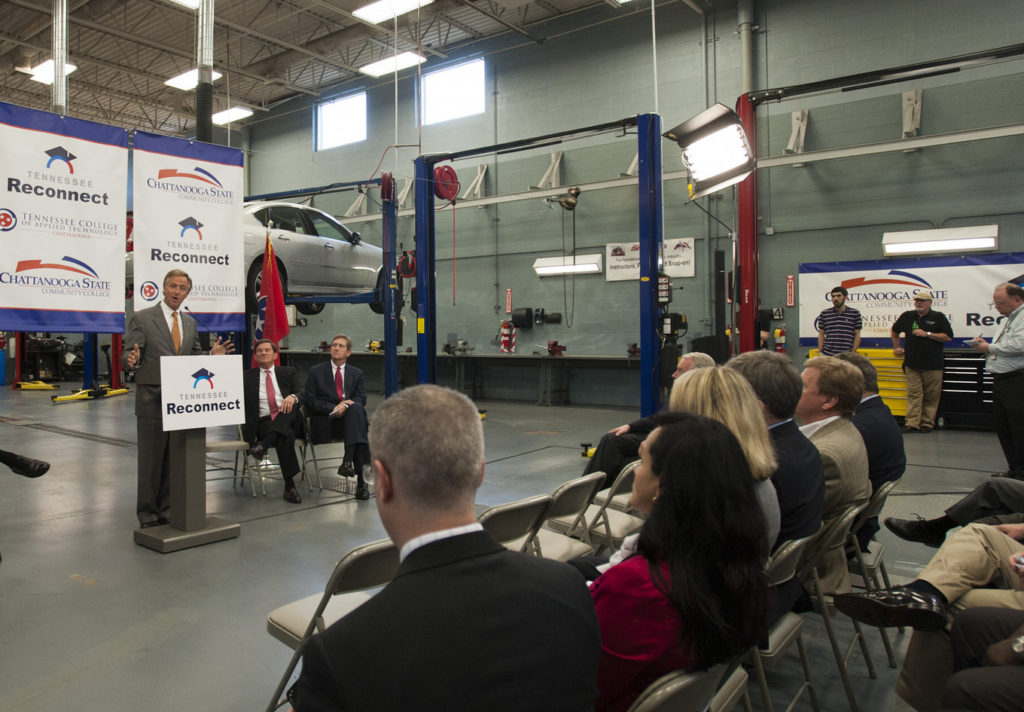
Tennessee’s community colleges have been the center of attention this year while the governor’s office implemented Tennessee Promise, a free-tuition program for graduating high school seniors. But another branch of the state’s higher education system far surpasses community colleges in terms of enrollment growth: technical schools.
While community colleges have seen a large influx of full-time freshmen, their overall enrollment has grown less than 1 percent. The state’s technical colleges, however, have grown 26 percent since last fall, buoyed by more than 1,700 Tennessee Promise students.
The small Tennessee College of Applied Technology campus in Murfreesboro, for example, is
seeing record enrollment this fall, says director Lynn Kreider. Students pursue
certifications in more than a dozen vocations, including automotive technology and dental assisting
.
They
had to add night classes and hire seven new faculty to accommodate the enrollment surge.
“The biggest difficulty we have right now is finding good, solid qualified instructors, because here in Middle Tennessee, just about everybody’s working,” Kreider says. “The really good people are out there working for industry and making a lot more than I can actually pay.”
He says the school had to get creative with how it found instructors, including posting openings to Craigslist.
This kind of growth has been happening at TCATs across the state, and the system has put $2.3 million into adding programs, equipment and faculty. But despite the mild growing pains, administrators are thrilled.
“Parking lots are full, classrooms are full,” says
Carol Puryear,
associate vice chancellor for the TCATs. ”
People are pretty excited about what’s going on.”
Technical colleges were also boosted by a new state grant called Tennessee Reconnect, which allows most adults to attend TCATs tuition-free as well. Nearly 5,000 adults took advantage of that this fall, according to TCAT data.
But vice chancellor James King says he expects to see the most growth
in the coming years from Tennessee Promise students, especially as young students tell their friends in high school about this option.
“One of the most exciting things for us is that for years, we struggled getting those students directly out of high school,” King says. “This is a significant increase in the number of 18-year-olds that we normally get, and I think this number is going to continue to grow.”

 On Air - 90.3 WPLN-FM